Wizz Air Returns to Abu Dhabi and Dubai With 12 Routes, 13 Months After Fleeing the Gulf
Wizz Air is going back to a market it fled just over a year ago. The Hungarian budget carrier said this week it will restart flying to Abu Dhabi and Dubai, part of a wider 12-route restoration across the United Arab Emirates, Saudi Arabia and Jordan that will add roughly 470,000 seats through the winter season. The announcement, made September 9 and detailed further in a press release dated September 11, marks a reversal for an airline that shut down its entire local UAE subsidiary just over a year ago and cited both geopolitical risk and its engines' struggles with Gulf heat as reasons for leaving.
What Wizz Air announced
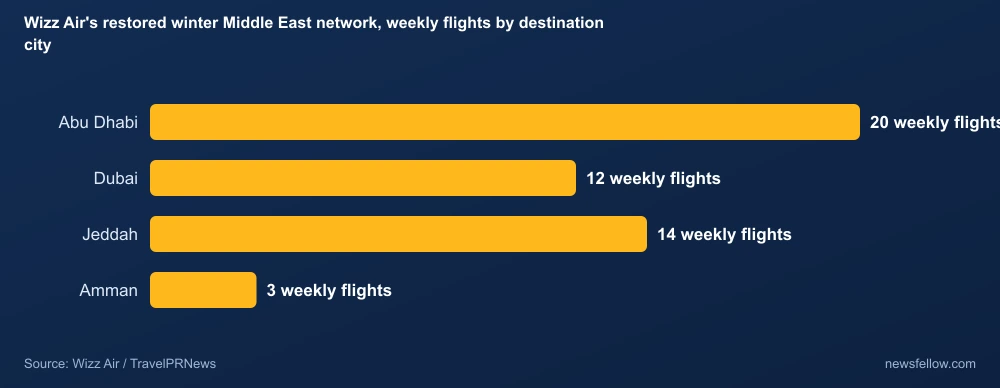
Under the new plan, Wizz Air will operate 12 routes carrying 49 weekly flights between its European network and four Middle East destinations: Abu Dhabi, Dubai, Jeddah and Amman. Crucially, this is not a revival of Wizz Air Abu Dhabi, the locally based joint-venture carrier that ceased all operations on September 1, 2025. Instead, the flights will be operated from Wizz Air's mainline European bases, connecting cities such as Budapest, Bucharest, Rome, Milan, Krakow, Katowice, Sofia and Cluj directly to the Gulf and the Levant.
The rollout is staggered across several start dates. Milan-Jeddah, at seven weekly flights, and Rome-Jeddah, at four weekly, had already resumed in early September (September 6 and September 7 respectively). A Budapest-Amman service, three times weekly, follows on September 22. The bulk of the Abu Dhabi and Dubai flying then comes online October 25-27: Budapest-Abu Dhabi (four weekly), Budapest-Dubai (five weekly), Katowice-Abu Dhabi (five weekly) and Bucharest-Dubai (daily, seven weekly) start October 25, while Larnaca-Abu Dhabi, Sofia-Abu Dhabi, Krakow-Abu Dhabi, Cluj-Abu Dhabi and Budapest-Jeddah follow on October 27. Frequencies across the network range from twice-weekly, on the Cluj-Abu Dhabi link, up to the daily Bucharest-Dubai service.
Andras Rado, Wizz Air's head of corporate communications, said the restored network would "make the Middle East accessible again to customers across the airline's European network." Introductory one-way fares start at €24.99, though the airline says all routes remain subject to ongoing security assessments, and it has not committed to the network beyond the winter 2026 season. Neither the September 9 announcement nor the fuller September 11 route release specified which aircraft type would operate the flights.
Why Wizz Air left in the first place
The retreat now being reversed was abrupt and, at the time, framed as permanent. Wizz Air Abu Dhabi — a joint venture with the Abu Dhabi government's ADQ investment vehicle, launched in 2020 as the carrier's flag-bearer for expansion into the Gulf and beyond — wound down entirely on September 1, 2025, after five years of operations. Wizz Air pointed to a combination of factors: recurring geopolitical instability in the region disrupting schedules and route planning, and what it described as engine reliability problems that were "particularly problematic" in the extreme heat of Gulf summers. Wizz Air's fleet, like several other operators flying the Pratt & Whitney PW1100G geared turbofan, had already been contending with a global inspection and overhaul backlog tied to a contaminated powder-metal issue discovered in 2023; hot, high-altitude operations of the kind common in the Gulf were known to accelerate wear on those engines, compounding the airline's existing capacity constraints.
That exit came at a cost to Wizz Air's broader growth ambitions. The Abu Dhabi venture had been positioned as a base for long-haul, low-cost flying to Central Asia, the Indian subcontinent and beyond — an attempt to replicate, on a budget-carrier model, some of the connecting-hub advantages that Emirates and Etihad Airways have built at Dubai and Abu Dhabi. When it folded, Etihad moved to absorb some of the resulting gap in Abu Dhabi's short-haul European network, a shift covered separately at the time as Etihad's opportunity from the Wizz Air withdrawal.
Wizz Air's regional troubles were not confined to the UAE. In late February 2026, the airline suspended a broader slate of its European-network flights into the Middle East entirely, citing regional conflict and airspace disruption that had made scheduling unpredictable. That suspension followed months of intermittent airspace closures across the Gulf tied to the wider escalation between Israel and Iran, which at various points in 2026 also forced Qatar Airways, Emirates and other carriers to cancel or reroute flights through the region. A ceasefire earlier in 2026 had allowed some of that capacity to rebuild before the truce broke down in July, when renewed U.S. strikes on Iran and Iranian missile and drone attacks on Gulf states — including Qatar, the UAE, Bahrain and Kuwait — brought airspace restrictions and flight cancellations back for several Gulf carriers.
For an ultra-low-cost operator like Wizz Air, that pattern of intermittent, unpredictable disruption is especially punishing. Budget carriers depend on high aircraft utilization — flying the same jet as many hours a day as possible to keep unit costs down — and a schedule vulnerable to sudden airspace closures or diversions undermines that model far more than it does a full-service carrier with larger fleets, deeper cash reserves and more scheduling slack.
Why it's returning now
Wizz Air's stated rationale for reversing course centers on a change in the official risk assessment for the region. The airline said the European Union Aviation Safety Agency had revised its conflict-zone guidance covering the airspace in question, and that Wizz Air had additionally conducted its own internal "operational and security assessments" before deciding it was safe to resume flying. The company did not specify what changed in the underlying security picture, nor did it commit to a fixed timeline beyond the winter 2026 season, and it explicitly flagged that the restored routes remain subject to continued monitoring.
Notably, the return is being executed differently from the original approach. Rather than re-establishing a UAE-based subsidiary with its own certificate and locally domiciled aircraft, Wizz Air is running all 12 routes as extensions of its existing European mainline operation — a structure that avoids the fixed costs and regulatory complexity of standing up a new foreign carrier, while still letting the airline test demand and re-enter a market it once considered central to its long-term growth. It is a materially smaller footprint than the original Wizz Air Abu Dhabi venture, which at its peak operated its own widebody-adjacent long-haul ambitions; the new network is entirely short- and medium-haul, feeder-style flying from Central and Eastern Europe.
The competitive backdrop
Wizz Air's re-entry lands in a Gulf aviation market that has kept growing even as security conditions have remained unsettled. Etihad Airways has described 2026 as its biggest summer on record, operating more than 300 daily flights — a roughly 10% increase over 2025 — across a network of around 70 destinations from Abu Dhabi. Emirates, meanwhile, has spent September reshuffling its Airbus A380 deployment across a dozen routes, temporarily swapping the superjumbo for Boeing 777s on some services, while continuing to add new widebody routes elsewhere in its network. Turkish Airlines has also been adding frequency into the UAE, lifting its Istanbul-Abu Dhabi service from four to seven flights weekly in early September.
Against that backdrop, Wizz Air's comeback is modest in scale but notable as a signal: a low-cost carrier that pulled out of the Gulf citing both war-related airspace risk and mechanical reliability problems is now judging both risks manageable enough to fly back in, at least on a limited, mainline-operated basis, ahead of the winter travel season. Whether the airline moves to re-establish a locally based Gulf carrier again — as opposed to simply feeding traffic in from Europe — remains an open question the company has not addressed.
For travelers, the immediate effect is a modest expansion of low-cost options between Central/Eastern Europe and the Gulf and Red Sea coast, arriving just as several full-service carriers in the region continue to navigate their own disrupted and recovering schedules amid the wider regional volatility. It also gives cities such as Katowice, Krakow, Cluj and Larnaca — none of which are typically served nonstop by Gulf legacy carriers — a direct low-cost link into Abu Dhabi that didn't exist a year ago, a niche Wizz Air has built much of its European growth strategy around: flying underserved secondary cities that larger network carriers tend to skip in favor of their own hubs.
What happens after the winter season is unclear. Wizz Air has given no indication of whether it intends to file for a longer-term schedule, add capacity, or scale back again if regional security conditions deteriorate. Given the airline's own history in the market — a five-year local joint venture that ultimately could not absorb the combined pressure of geopolitical disruption and mechanical unreliability — investors and regional aviation authorities are likely to watch the coming months for signs of whether this smaller, mainline-operated reentry proves durable, or turns out to be another short-lived test of a market Wizz Air has struggled to make work twice now.
Sources
- Wizz Air announces return to Abu Dhabi and Dubai with new routes — The National
- Wizz Air reveals eight returning UAE routes – here's where it will fly — The National
- Wizz Air restores 12 Middle East routes as Dubai and Abu Dhabi return for winter 2026 — Travel PR News
- Wizz Air signals return to UAE: Dubai and Abu Dhabi flights, dates and routes revealed — Gulf News
- Etihad Picks Up the Pieces as Wizz Air Exits Abu Dhabi — Skift