A Broken Seat Deal Just Pushed Back Vueling's First Boeing in Its History

Vueling is not going to get its first Boeing jet this year after all. The Barcelona-based, historically all-Airbus carrier was due to take delivery of its first Boeing 737 MAX 8-200 by the end of December 2026, with commercial service beginning on the Barcelona–Alicante route. That plan has now slipped into 2027, and the reason has nothing to do with the airframe itself: it is the cabin seats.
FlightGlobal reported this week that the delay traces to a certification holdup affecting the Recaro-supplied seats intended for the aircraft's interior. Vueling confirmed it is in active discussions with Recaro to resolve the issue, but the carrier and its parent, IAG, now expect the postponement to run to several months, with entry into service pushed toward the first half of 2027.
For an airline that has flown nothing but Airbus metal for its entire history, the arrival of the 737 MAX was already a symbolically large moment. Now it is also a lesson in how a single interior-fit supplier can hold up a jet that is otherwise ready to fly.
An order that outgrew its own timeline
The aircraft at the center of the delay trace back to one of the largest single commitments in Boeing's order book. IAG, the parent of British Airways, Iberia, Aer Lingus and Vueling, placed a firm order for 200 Boeing 737 MAX aircraft — later reported in industry coverage as a 150-aircraft firm commitment plus options — at the 2019 Paris Air Show, at a time when the MAX program was grounded worldwide following two fatal crashes. The order was widely seen as a vote of confidence in Boeing's recovery.
Vueling was earmarked to operate a large share of that order rather than IAG's mainline carriers. The airline was initially allocated 50 of the jets — a mix of the high-density 737 MAX 8-200, seating up to 210 passengers in a single-class layout, and the larger 737 MAX 10, which can carry up to 230. In May 2026, IAG exercised 10 additional options tied to the original agreement, lifting Vueling's allocation to 60 aircraft.
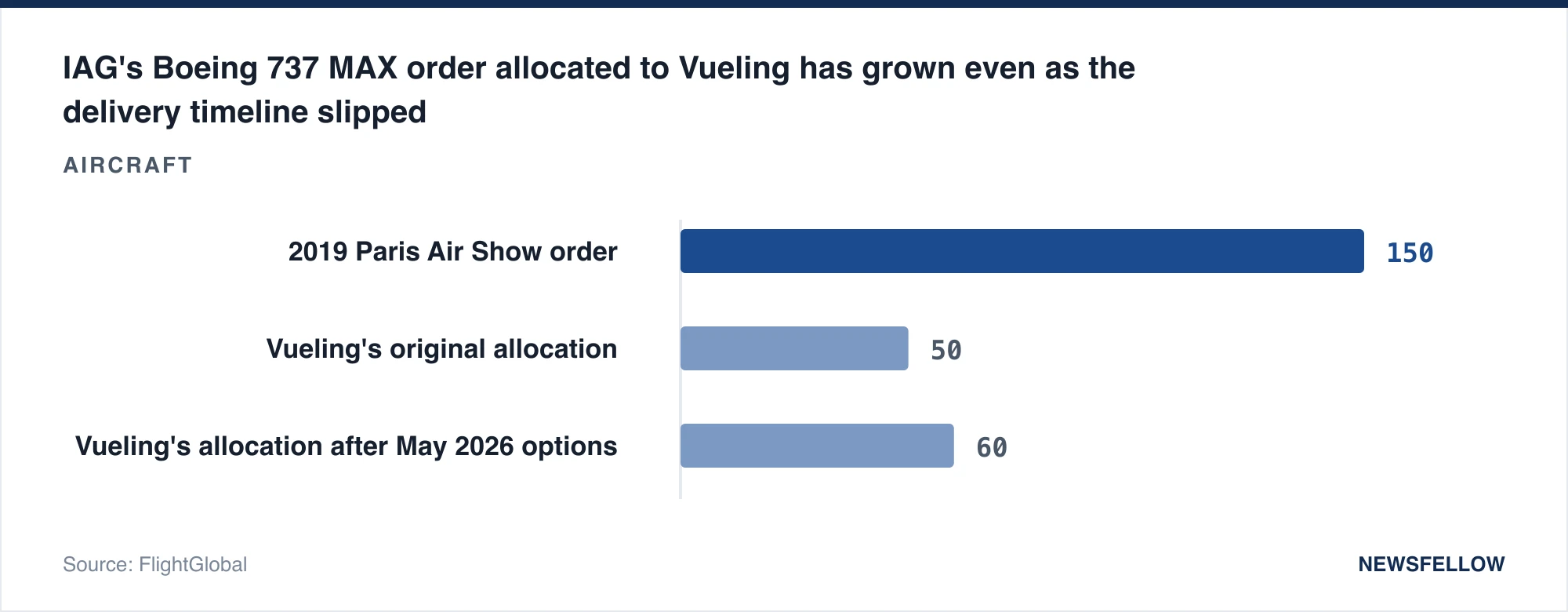
That growing allocation reflects how central the 737 MAX has become to Vueling's future network plans, even as the entry-into-service date keeps moving. The carrier's first commercial MAX flight had been pencilled in for the Barcelona–Alicante corridor, with additional routes to Seville, Palma de Mallorca and Rome Fiumicino set to follow shortly after. All of those launches are now on hold pending the seat resolution.
Why a seat can ground a delivery date
Aircraft interiors — specifically passenger seats — must be certified separately from the airframe itself, covering everything from crash-load survivability to flammability and emergency-evacuation performance. A seat design that has not cleared that process cannot be installed on an aircraft destined for revenue service, regardless of how close the airframe itself is to being flight-ready.
Recaro, one of the aviation industry's largest seat manufacturers, supplies cabin seating to a wide range of carriers, and certification bottlenecks at seat suppliers have become a recurring theme across the industry this year as airlines push for lighter, higher-density cabin configurations to maximize revenue per aircraft. Industry trade coverage has noted that seat-certification delays are increasingly acting as a bottleneck independent of aircraft manufacturing schedules — a dynamic that is now playing out directly in Vueling's case.
Vueling has not disclosed the specific technical nature of the certification holdup, and Boeing has not issued a public statement attributing the delay to the airframe or its own production schedule. The delay, as reported, sits specifically with the Recaro seat certification process rather than with Boeing's assembly line or delivery readiness.
What changes for Vueling's network plans
A multi-month slip is a manageable setback for an airline that has run an all-Airbus fleet for its entire operating history, but it does complicate near-term planning. Vueling had built its December 2026 route launches — the Barcelona hub connections to Alicante, Seville, Palma de Mallorca and Rome — around having Boeing capacity in hand for the winter schedule. With that timeline now sliding toward the first half of 2027, those routes will likely continue to be served by Vueling's existing Airbus A320-family fleet for longer than originally planned, or the launches themselves may be pushed back to align with the delayed Boeing deliveries.
The bigger strategic story is largely undisturbed: IAG's decision to diversify Vueling away from an all-Airbus fleet, and the group's continued commitment to the 737 MAX program — reinforced by the May 2026 exercise of additional options — signals that the group still sees long-term value in operating both manufacturers' aircraft across its airline portfolio. A seat-certification delay, however disruptive to a single quarter's launch calendar, does not appear to have shaken that broader commitment.
What it does underline is a pattern recurring across the industry in 2026: as airlines chase denser, more revenue-optimized cabin layouts, the supply chain for the seats themselves — not just airframes and engines — has become one of the more fragile links in getting new aircraft into passenger service on schedule.
Sources
- Vueling's first 737 Max deliveries delayed by seat-certification issue — FlightGlobal
- Seat cert issues delay Vueling B737 MAX entry into service — AeroTime
- Vueling to operate IAG's full 50-aircraft Boeing 737 MAX order — Air Data News
- Airlines' arms race hits a snag: There just aren't enough seats — Travel Weekly