Vietnam Airlines Signs Paris MOU for Five More A350-900s, Eyeing Long Thanh's 2026 Debut

A widebody pledge signed in Paris, not Hanoi
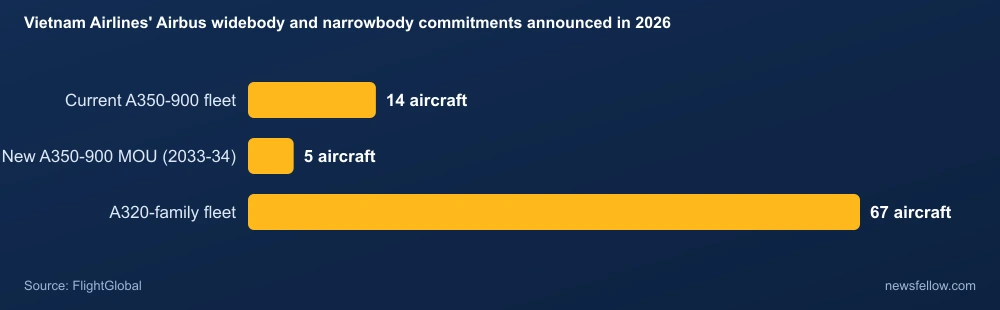
Vietnam Airlines and Airbus signed a memorandum of understanding on September 10, 2026, for five additional Airbus A350-900 widebody jets, in an agreement exchanged in Paris during a state visit by Vietnamese General Secretary and President To Lam. The ceremony took place in the presence of French President Emmanuel Macron, according to reporting from FlightGlobal, AeroTime and Aviation A2Z, folding a commercial aircraft deal into a broader diplomatic visit between Hanoi and Paris.
The memorandum is provisional rather than a firm, binding order. It sets out a framework under which Vietnam Airlines and Airbus will work through the commercial and technical terms before the airline commits the investment and completes procurement. If it converts to a firm contract on the terms outlined, the five A350-900s would be delivered in 2033 and 2034 — a horizon that places the jets well past the near-term fleet decisions Vietnam Airlines is currently executing, and ties them instead to the carrier's stated ambition to keep growing its long-haul widebody fleet through the next decade.
The MOU adds to, rather than replaces, an already-flagged widebody ambition. In February 2026, when Vietnam Airlines finalized its first-ever Boeing narrowbody order — 50 737-8 MAX jets worth up to $8.1 billion at list price, signed in Washington — airline leadership used the same visit to discuss with Boeing a separate plan to invest in roughly 30 widebody aircraft, an initiative the carrier valued at more than $12 billion. The five-aircraft Airbus MOU signed in Paris seven months later is a concrete, Airbus-side installment of that widebody appetite, even as the larger 30-aircraft widebody plan remains unresolved and could still involve either manufacturer.
What Vietnam Airlines already flies
Vietnam Airlines currently operates 14 Airbus A350-900s, according to FlightGlobal's reporting on the deal. The carrier was the second airline in the world to put the A350-900 into commercial service, launching it in 2015, and has used the type as the backbone of its long-haul network to Europe, Australia and North America. Alongside the widebodies, Vietnam Airlines flies roughly 67 A320-family narrowbody jets, putting its total Airbus-built fleet at about 81 aircraft before the Boeing 737-8s and any additional Airbus widebodies arrive.
Separately from the new-build MOU, Dubai Aerospace Enterprise (DAE) has announced a sale-and-leaseback arrangement covering three existing Airbus A350-900s with Vietnam Airlines — a financing mechanism distinct from the Paris MOU that nonetheless underscores how active the carrier has been in restructuring and expanding its widebody fleet through 2026. Vietnam Airlines has also been preparing a binding tender to dry-lease 12 additional widebody aircraft, according to earlier reporting, as it works multiple tracks simultaneously — new orders, leasing, and sale-leaseback — to grow long-haul capacity ahead of a fixed and heavily publicized deadline.
The deadline behind the deal: Long Thanh
The timing of Vietnam Airlines' widebody push is inseparable from Long Thanh International Airport, the $12.8 billion airport under construction outside Ho Chi Minh City that is scheduled to open on December 1, 2026. It is the largest and most expensive airport project in Vietnamese history, and the government has designed it explicitly to compete with regional transit hubs such as Singapore Changi, Bangkok Suvarnabhumi and Kuala Lumpur International for long-haul connecting traffic.
Vietnam Airlines has said it will shift about 12% of its flights to Long Thanh from the day it opens, with long-haul international flights, cargo operations and new international routes concentrated there from the outset. The transition is planned in phases: from the 2027 summer season, the carrier intends to move all flights to Europe, the Americas, Oceania, Africa, the Middle East, the Indian subcontinent and Central Asia to the new airport, effectively making Long Thanh Vietnam Airlines' primary long-haul gateway within about eighteen months of opening.
That plan only works if the airline has widebody aircraft to fill the new routes Long Thanh is meant to enable. The current A350-900 fleet of 14 aircraft, built up gradually since 2015, was sized for Vietnam Airlines' existing long-haul network — not for a second wave of European, Australian and North American routes launched out of a brand-new hub airport competing for connecting traffic. That gap is the direct commercial logic behind both the five-aircraft Airbus MOU and the unresolved 30-aircraft widebody plan floated with Boeing in February: Vietnam Airlines needs meaningfully more long-haul capacity on a timeline that lines up with Long Thanh's phased rollout through 2027.
Reading the fine print: an MOU, not a firm order
It is worth being explicit about what was and was not signed in Paris. Multiple outlets covering the announcement — FlightGlobal, AeroTime and Aviation A2Z among them — describe the document as a memorandum of understanding or provisional order, not a firm, binding purchase agreement. Unlike the Boeing 737-8 deal, which Boeing's own newsroom confirmed in February 2026 as "finalized," the Airbus A350-900 agreement still requires both sides to work through commercial and technical details before it converts into a contract with the kind of specificity — final pricing, engine selection, cancellation terms — that a firm order carries.
That distinction matters for a carrier operating in a region where announced intentions do not always become delivered aircraft. Vietnam Airlines' neighbor and domestic rival Vietravel Airlines signed its own letter of intent for 50 Airbus jets, including Vietnam's first A220s, earlier in September — a separate transaction from a separate airline, underscoring how much aircraft-deal activity Vietnamese carriers are generating around this period, but also how much of it currently sits at the MOU or LOI stage rather than as signed, deliverable contracts.
The five A350-900s' 2033-2034 delivery window is itself a signal of where this sits in Airbus's production queue: Airbus's A350 line is already booked out years in advance across multiple global customers, so a provisional slot that far out is consistent with an airline securing production position now rather than committing to near-term capital spending.
A network already stretching toward Europe
The widebody math behind the MOU is grounded in a network that has been expanding steadily rather than standing still. Vietnam Airlines currently flies 12 direct routes from Hanoi and Ho Chi Minh City to European destinations including Paris, Frankfurt, Munich, London, Moscow, Milan, Copenhagen and Amsterdam, according to VnEconomy. The carrier added Amsterdam service in June 2026, flying it three times weekly on the A350, and has separately announced plans to add Hanoi-Prague flights from October 2026 and to bring Madrid back onto the network later in the year. Frequency increases are also planned across London Gatwick, Munich, Frankfurt and Manchester.
Every one of those European routes, plus growth markets in Australia, Japan and South Korea that Vietnam Airlines has also been adding frequencies to, currently depends on the same 14-aircraft A350-900 fleet. Expanding a long-haul network this actively while holding widebody fleet size roughly flat is not sustainable for long, which is precisely the constraint the Paris MOU — and the still-unconverted 30-aircraft Boeing widebody discussion — is aimed at relieving. None of the newly announced widebodies, Airbus or Boeing, are due before 2030 at the earliest, meaning Vietnam Airlines will need to run its Long Thanh transition and its European growth on the existing 14-aircraft A350 fleet, supplemented by the leased and sale-leased-back aircraft it has been separately lining up, for at least the next several years.
The business backdrop: revenue up, fuel costs biting harder
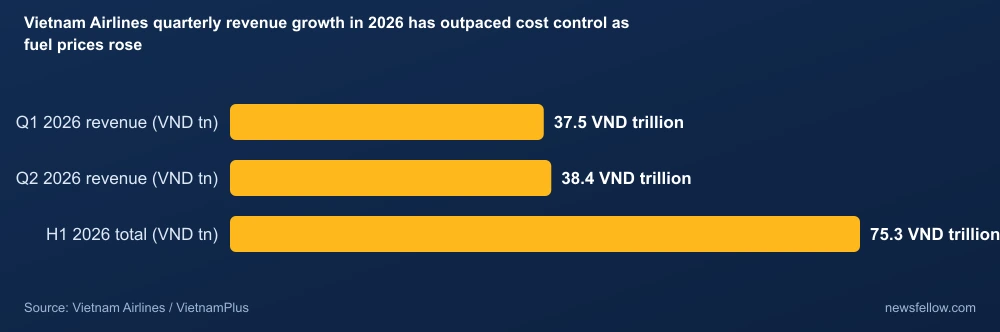
The fleet commitments are landing against a financial picture that is growing but under pressure. Vietnam Airlines reported first-half 2026 consolidated revenue of roughly VND75.3 trillion (about $2.9 billion), up more than 28% year-on-year, with consolidated profit of about VND3.85 trillion for the half. Quarterly filings show the strain building: in the second quarter, revenue rose more than 36% year-on-year to roughly VND38.4 trillion, but cost of goods sold rose nearly 59%, to over VND36.6 trillion, driven chiefly by rising Jet A1 fuel prices from late February 2026 onward. That combination — strong top-line growth eaten into by a steep run-up in fuel costs — is the same pressure that has been cited across the region's carriers this year, and it is the backdrop against which Vietnam Airlines is simultaneously financing a Boeing narrowbody order, a prospective Airbus widebody order, a widebody leasing tender, and a sale-and-leaseback of existing aircraft, all at once.
What comes next
Two things will determine whether this MOU becomes a real fleet addition. First, whether Vietnam Airlines and Airbus convert the memorandum into a firm order — a step that typically follows within months to a couple of years for airlines that intend to follow through, but which can also lapse or be renegotiated if fleet plans change. Second, and more immediately, whether Long Thanh International Airport actually opens on its stated December 1, 2026 date after a construction timeline that has already been adjusted more than once during the project's build-out; Vietnamese authorities have said flight inspection and calibration work at the airport had been completed successfully ahead of the target launch.
For now, Vietnam Airlines has laid out a widebody roadmap in two pieces: a provisional five-aircraft Airbus commitment for the early 2030s, and a still-unresolved 30-aircraft widebody plan worth over $12 billion first flagged alongside February's Boeing narrowbody order. Neither is a firm contract yet. Both point in the same direction — a national carrier trying to make sure it has enough long-range aircraft to fill the hub Vietnam is building to compete for Asia's connecting traffic.
Sources
- Vietnam Airlines poised to order five A350s — FlightGlobal
- Vietnam Airlines Signs New Deal for Five Airbus A350-900 Jets — Aviation A2Z
- Airbus wins Vietravel order, A350 MOU with Vietnam Airlines — AeroTime
- Vietnam Airlines Finalizes Order for 50 Boeing 737 MAX Airplanes — Boeing Media Room
- Vietnam Airlines order for 50 Boeing 737-8s finalised — Key.Aero
- Vietnam finalizes traffic transfer to new Long Thanh airport in Ho Chi Minh City — TravelMole
- Vietnam Targets Long-Haul Shift To Long Thanh In 2026 — Aviation Week
- DAE announces sale and leaseback of three Airbus A350-900 aircraft with Vietnam Airlines — Gulf News
- Vietnam Airlines keeps 12 direct air routes to Europe — VnEconomy
- Vietnam Airlines posts 28% revenue growth in H1 — Vietnam News
- Despite fuel costs eroding Q2 profits, Vietnam Airlines still reports over VND 3,800 billion in profit for first half of 2026 — BigGo Finance