United 767 Bound for Newark Squawks 7700 Over the Channel, Diverts to Heathrow

What happened
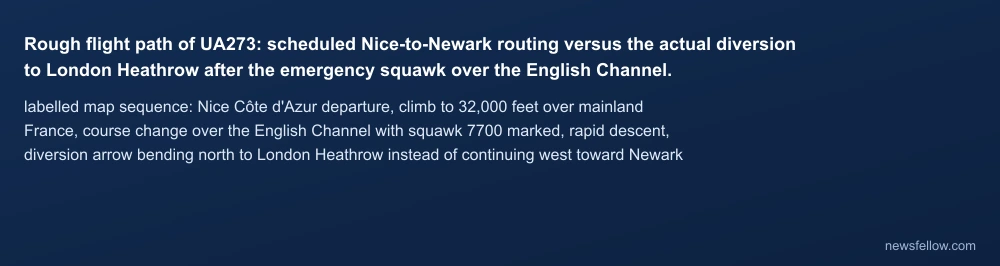
A United Airlines Boeing 767-322ER operating flight UA273 from Nice Côte d'Azur Airport (NCE) in France to Newark Liberty International Airport (EWR) diverted to London Heathrow Airport (LHR) on September 9, 2026, after the flight crew declared a general emergency while crossing the English Channel.
The aircraft, a 28-year-old widebody registered N664UA, departed Nice at 13:45 CEST for what was scheduled to be a roughly nine-hour transatlantic crossing. According to flight-tracking data and aviation-incident trackers, the jet climbed to a cruising altitude of approximately 32,000 feet over mainland France before altering course once it reached the Channel. The crew transmitted transponder code 7700 — the international "general emergency" squawk that alerts air traffic control to an urgent situation requiring priority handling, without specifying its cause — and began a rapid descent.
Air traffic controllers in the UK prioritized the widebody jet for an immediate diversion to Heathrow, and emergency response crews were positioned at the airport as a standard precaution ahead of the landing. The aircraft landed safely at Heathrow.
As of this writing, United Airlines has not publicly detailed the specific nature of the emergency — whether it stemmed from a technical malfunction, a cabin pressurization issue, a medical event onboard, or another cause. Following ICAO Annex 13 norms for incident reporting, NewsFellow is not speculating on a cause until the airline, the UK Air Accidents Investigation Branch (AAIB), or another competent authority provides an official account. A squawk 7700 declaration does not by itself indicate the severity of an event; crews are trained to use it for a wide range of situations, from a suspected mechanical fault to a passenger medical emergency, whenever they want guaranteed priority handling from air traffic control.
Aircraft and route context
The 767-300ER involved has been in service for roughly 28 years, according to aircraft-tracking databases — a reminder that United, like several legacy US carriers, continues to operate older widebody types on transatlantic long-haul routes even as newer aircraft are phased in elsewhere in the fleet. United uses 767s on a range of secondary European routes, including seasonal and year-round service to markets like Nice, where demand doesn't always justify larger widebodies.
Nice–Newark is one of United's smaller European offerings, typically operated with lower frequency than the airline's flagship routes into Paris, London, or Frankfurt. The nine-hour scheduled block time reflects the routing distance and prevailing winds for a westbound Atlantic crossing in September.
Heathrow was the logical diversion point given the aircraft's position over the Channel at the time of the emergency squawk — it offered the nearest major airport with the runway length, emergency services, and widebody-handling capability appropriate for a Boeing 767 making an unplanned landing.
Part of a busier-than-usual week for diversions
UA273's diversion adds to a cluster of emergency diversions involving US carriers in the first two weeks of September. In a separate incident on September 5, a United flight bound for South Africa, UA1011, diverted after a passenger suffered a mid-flight medical emergency more than two hours into the transatlantic journey. That event was unrelated to UA273 and involved a different aircraft, route, and circumstances — but the back-to-back nature of the incidents has drawn attention from aviation trackers who log emergency squawks in near-real time via public ADS-B flight-tracking data.
It's worth noting that a rise in publicly tracked emergency squawks does not necessarily indicate an increase in the underlying rate of serious incidents. Flight-tracking services and dedicated aviation-incident accounts have made it far easier than a decade ago for the public to see routine squawks — including many that resolve without any drama by the time the aircraft is on the ground — that would previously have gone unreported outside of official filings. Distinguishing a statistically meaningful trend from increased visibility requires waiting for aggregated data over a full quarter or year, which is not yet available for September 2026.
What passengers can expect next
Passengers aboard UA273 would typically be re-accommodated by United onto a later flight to Newark or another onward connection, either operated by United or a partner carrier, once ground staff at Heathrow assess the situation and, if needed, the aircraft or a replacement is cleared to continue the journey. Diverted widebody flights sometimes require a different aircraft to complete the remaining sector, particularly if the diversion was prompted by a mechanical issue that requires inspection or repair before the jet is released back into service.
United has not issued a detailed public statement beyond confirming, through standard channels, that the flight diverted; the airline typically does not comment on the specific nature of an in-flight emergency until initial assessments are complete, both to avoid speculation and because early information from the flight deck can be incomplete. NewsFellow will update this story if United, the AAIB, or the US National Transportation Safety Board (NTSB) — which would be notified for an emergency involving a US-registered aircraft — releases additional information.
Why the 767 is still flying transatlantic routes
United's mainline fleet includes both older 767-300ERs and newer 787 Dreamliners on international routes, and the split is not random. The 767 remains a workhorse on thinner long-haul markets — smaller European cities, some South American routes, and certain Caribbean and Central American runs — where the aircraft's roughly 200-seat capacity is a better match for demand than a larger widebody. Nice is a seasonal-leaning leisure and business market for United, without the year-round volume that would justify a 787 or 777.
That means an aging-but-maintained aircraft type continues to see regular transatlantic duty, subject to the same maintenance and inspection regime as the rest of United's fleet regardless of the airframe's age. Aircraft age alone is not considered a reliable predictor of mechanical risk by aviation regulators; well-maintained older jets can and do operate safely for decades, provided they pass the recurring inspections, airworthiness directives, and maintenance checks the FAA and manufacturer require. Nothing in the public information about UA273 indicates the aircraft's age was a contributing factor, and no such conclusion should be drawn before an official assessment, if any is deemed necessary.
How emergency squawks get investigated
Not every squawk 7700 declaration results in a formal investigation. In the United Kingdom, the AAIB assesses incidents involving aircraft operating to or from UK airports and decides whether a full investigation, a short "bulletin" writeup, or no further action is warranted based on the severity and safety implications of what occurred. For incidents involving US-registered and US-operated aircraft, the NTSB and FAA are typically notified as a matter of course, though the depth of any subsequent review depends on what happened once investigators have the full picture from the flight crew, maintenance records, and any relevant data recorders.
Because United has not disclosed the specific trigger for the emergency, it isn't yet possible to say which of these paths, if any, this incident will follow. A device malfunction affecting a single aircraft typically stays within an airline's and manufacturer's internal safety reporting systems unless it reveals a design or maintenance issue with implications for other aircraft of the same type — the threshold that typically triggers a public regulatory response such as an airworthiness directive.
The regulatory backdrop
Emergency diversions on their own do not trigger a formal investigation unless there is evidence of a safety-of-flight issue, injury, or aircraft damage. If the cause turns out to be mechanical, findings would ordinarily feed into United's and Boeing's routine safety reporting processes, and could result in a service bulletin or, in more serious cases, a Federal Aviation Administration airworthiness directive if a broader fleet-wide risk is identified. If the cause was medical, no aircraft-related regulatory action would typically follow.
Until an official cause is confirmed, this incident should be read as exactly what is verified: a United 767 crew treated a situation over the Channel as serious enough to declare a general emergency and divert immediately to the nearest suitable major airport, and the aircraft landed there without further incident reported.
Sources
- The Aviation Hub — United 767 Zurich-Newark Declares Emergency & Diverts to London Heathrow
- AIRLIVE — United 28-year-old Boeing 767 to Newark is declaring an emergency and diverting to London Heathrow
- AIRLIVE — United UA1011 declared an emergency 2 hours after departure from Washington and diverted to Newark
- FlightAware — UA273 (UAL273) United Flight Tracking and History