Turbulence Is Now an ICAO Risk Category. The People It Injures Are Mostly Crew.

Turbulence has always occupied an awkward place in aviation safety. It rarely destroys aircraft and almost never kills, which keeps it off the list of things regulators lose sleep over. It also injures more people in commercial service than almost anything else, which makes that reasoning increasingly hard to defend. In the 2026-2028 edition of its Global Aviation Safety Plan, ICAO has finally split the difference: turbulence encounters now appear as an explicit global operational risk category, sitting alongside abnormal runway contact and system failures in a second tier below the five headline categories of controlled flight into terrain, loss of control in-flight, mid-air collision, runway incursion and runway excursion.
The framing matters less than the accounting. Once a risk has a category, it acquires reporting obligations, regional safety plan targets and a line in state safety programmes. What that machinery is likely to surface, if the American data is any guide, is a problem the industry has quietly tolerated for two decades: turbulence is overwhelmingly an occupational injury affecting cabin crew, and the countermeasure that works has been known since at least 2021.
What the accident record shows
The most rigorous study of the question remains the US National Transportation Safety Board's 2021 safety research report on turbulence-related injuries in Part 121 air carrier operations. Its findings are blunt.
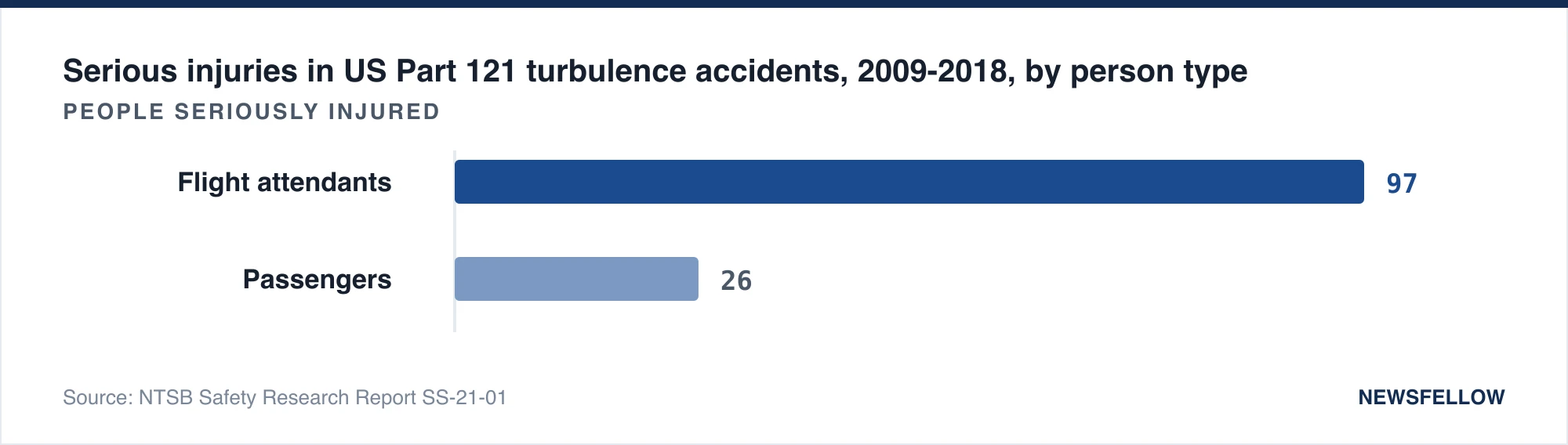
Across 2009 to 2018 there were 111 turbulence-related accidents in US scheduled air carrier operations. That is a small number in absolute terms, but it represented 37.6 percent of all Part 121 accidents in the period — turbulence was, by a wide margin, the single most common way an American airline flight became an accident at all. Those 111 events produced 123 serious injuries. Ninety-seven of them were flight attendants. Twenty-six were passengers. No flight crew member was seriously injured in any of them.
The seat belt data is close to a controlled experiment. Of the 123 seriously injured, exactly one passenger was documented as having worn a seat belt during the event. Among injured flight attendants, 81 of 97 were documented as not belted, with the remainder unknown. The NTSB's conclusion was that occupants wearing a seat belt at the time of a turbulence accident were, in general, not seriously injured.
That is not a mystery to be solved. It is a description of a job. Flight attendants are unbelted because they are working — securing galleys, completing a service, walking the aisle — during exactly the phases when the aircraft is most likely to be hit. Earlier research cited by the NTSB found the injury rate was nearly 24 times higher for flight attendants than for passengers.
The descent problem
The most actionable finding in the 2021 report concerns when the injuries happen. Roughly half of turbulence-related accidents occurred during the descent and approach phases, accounting for about half of the serious injuries; 60 percent of those occurred below 20,000 feet, and flight attendant was the injured party in roughly three-quarters of them.
Position in the cabin compounded it. Of flight attendants in the aft section during these events, 51.9 percent were seriously injured, against 13.3 percent in the forward section and 4.8 percent in the middle. The tail of an aircraft moves more, and the aft galley is where the last of the service is cleared.
The NTSB's recommendation followed directly: the FAA should revise its turbulence guidance to airlines, including the phases of flight and associated altitudes at which flight attendants should be secured in their seats. In practice that means seating crew earlier in the descent than current practice requires — trading a few minutes of service time for the elimination of a large share of an injury category.
The recommendation has not been acted on with any urgency. In a November 2023 post on its own safety blog, the NTSB observed that the FAA had not made updating this guidance a priority, and said it must, to avoid serious injuries that are entirely preventable. Nearly three years further on, the guidance framework airlines work to remains FAA Advisory Circular 120-88A, which predates the study.
Why the trend line points the wrong way
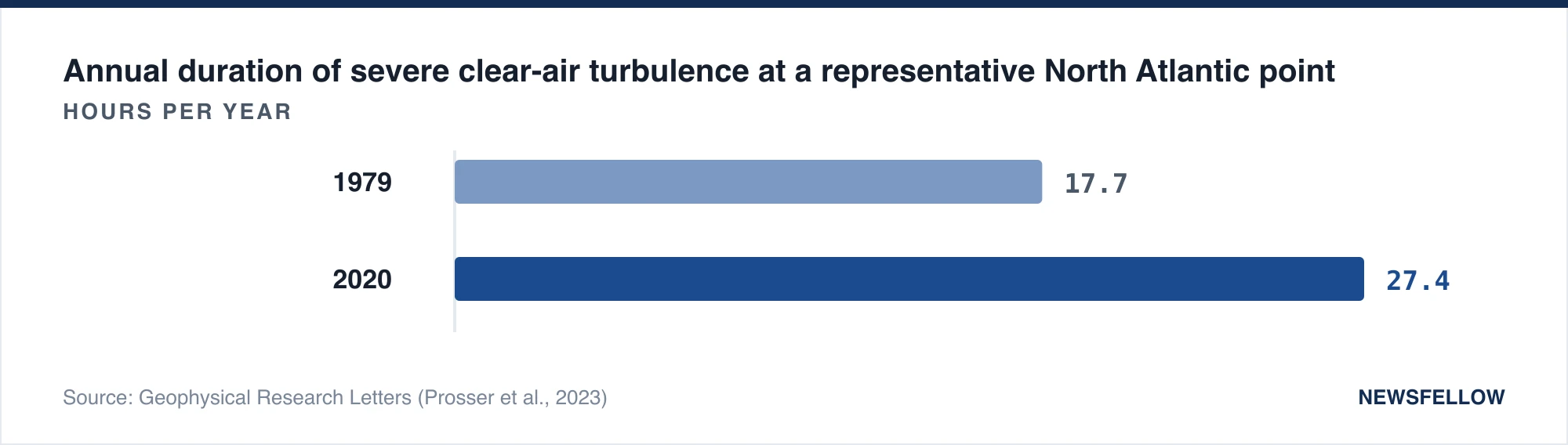
The reason a dormant recommendation has become newly urgent is atmospheric. A 2023 study published in Geophysical Research Letters, led by researchers at the University of Reading, examined four decades of reanalysis data and found substantial increases in clear-air turbulence — the kind that arrives without cloud, radar return or warning. At a representative point over the North Atlantic, one of the busiest oceanic corridors in the world, the total annual duration of severe clear-air turbulence rose from 17.7 hours in 1979 to 27.4 hours in 2020, an increase of 55 percent. The authors attributed the trend to strengthening wind shear in the jet stream, consistent with the expected effects of a warming climate.
Clear-air turbulence is the hardest variety to mitigate operationally, because the classic defences do not apply. Onboard weather radar detects moisture; clear-air turbulence has none. Convective turbulence can be seen and flown around. Shear-driven turbulence at cruise altitude frequently cannot. The NTSB found that in 59 of 111 accidents the flight crew was aware of a turbulence risk beforehand — meaning that in roughly half, some element of forecast or report existed. The gap is not always detection. It is often the interval between knowing and acting.
Notably, convective turbulence was present in 57.7 percent of the accidents studied and clear-air turbulence in 28.8 percent. If the clear-air share grows while the convective share holds, the total does not stay flat.
What the industry is doing instead of rulemaking
The most substantial operational progress has come from data sharing rather than regulation. IATA's Turbulence Aware platform pools anonymised, automatically generated turbulence reports from participating airlines and redistributes them almost instantaneously, giving pilots and dispatchers a near real-time picture of conditions ahead rather than a forecast issued hours earlier. More than 30 airlines now contribute. In June 2026 Aeromexico joined, bringing coverage across Latin America to more than 3,200 flights per day, a 25 percent increase on 2024. The data now also flows into third-party flight planning and cockpit systems through integration agreements.
The practical value is prosaic and exactly right: a report accurate enough and early enough to let a captain switch on the seat belt sign, suspend a meal service or ask for a different level before the aircraft arrives in the rough air, rather than during it. That is the same intervention the NTSB identified, delivered by a different route.
Public attention to turbulence has been driven by a handful of severe events. A Singapore Airlines flight from London encountered severe turbulence over Southeast Asia in May 2024 during a breakfast service; one passenger died and more than 30 people were injured, and the aircraft diverted to Bangkok. In August 2025 a Delta service from Salt Lake City to Amsterdam diverted to Minneapolis-St Paul after an encounter that left 25 people needing treatment. Events of that severity are rare. The accident record is made up mostly of quieter incidents in which one flight attendant sustains a fractured ankle in an aft galley during descent, and which never reach the news at all.
What a risk category should buy
ICAO's inclusion of turbulence in the 2026-2028 plan is a classification decision, not a rule. Its value depends on what regional aviation safety plans and national regulators do with the classification over the next three years. Three tests are worth watching.
The first is whether the FAA finally revises its turbulence guidance on when cabin crew must be seated during descent — the single change with the clearest evidentiary support and the lowest cost. The second is whether turbulence encounter reporting becomes consistent enough across states to compare rates internationally; today's cleanest dataset is American, and it ends in 2018. The third is whether data-sharing coverage extends to the regions where it is thinnest, since a platform's usefulness scales with the density of reports beneath a given route.
None of that requires new technology or new aircraft. It requires treating an injury pattern that has been documented for fifteen years, concentrated in one occupational group, as the safety problem it is. Having a category is how that argument starts. It is not how it finishes.
Sources
- ICAO — Doc 10004, Global Aviation Safety Plan 2026-2028 Edition: https://www.icao.int/sites/default/files/safety/GASP/Documents/Doc.10004.2026-2028.GASP_.EN_.pdf
- ICAO / Uniting Aviation — ICAO's Global Aviation Safety Plan: Advancing the vision of zero fatalities: https://unitingaviation.com/news/safety/icaos-global-aviation-safety-plan-advancing-the-vision-of-zero-fatalities/
- NTSB — Preventing Turbulence-Related Injuries in Air Carrier Operations Conducted Under 14 CFR Part 121 (SS-21-01): https://www.ntsb.gov/safety/safety-studies/Documents/SS2101.pdf
- NTSB Safety Compass — Flight Attendants Continue to Be Seriously Injured in Turbulence: https://safetycompass.wordpress.com/2023/11/13/flight-attendants-continue-to-be-seriously-injured-in-turbulence/
- Geophysical Research Letters — Evidence for Large Increases in Clear-Air Turbulence Over the Past Four Decades: https://agupubs.onlinelibrary.wiley.com/doi/10.1029/2023gl103814
- University of Reading — Aviation turbulence strengthened as the world warmed: https://www.reading.ac.uk/news/2023/Research-News/Aviation-turbulence-strengthened-as-the-world-warmed
- IATA — Turbulence Aware Coverage of Latin America Boosted: https://www.iata.org/en/pressroom/2026-releases/06-09-iata-turbulence-aware-coverage-latin-america-boosted
- IATA — Turbulence Aware Platform: https://www.iata.org/en/services/data/safety/turbulence-platform/
- FAA — Advisory Circular 120-88A, Preventing Injuries Caused by Turbulence: https://www.faa.gov/documentLibrary/media/Advisory_Circular/AC120-88A.pdf
- CBS News Minnesota — 25 hospitalized after turbulence diverts Delta flight to Minneapolis-St. Paul: https://www.cbsnews.com/minnesota/news/minneapolis-airport-flight-emergency-landing-turbulence-injuries/
- SKYbrary — Turbulence Injuries: https://skybrary.aero/articles/turbulence-injuries