Sydney Airport Just Got Approved to Grow to 72 Million Passengers — Without Building a New Runway

Australia's busiest airport just won permission to nearly double its passenger volume — without adding a single runway.
On August 14, 2026, the federal Minister for Infrastructure, Transport, Regional Development and Local Government, Catherine King, approved Sydney Kingsford Smith Airport's Master Plan 2045, the 20-year blueprint that governs how the airport can grow between now and the middle of the next decade. It is the first master plan clearance of its scale in years for the airport, and it arrives at a pointed moment: Western Sydney International, the country's newest airport, opens to domestic freight already and begins passenger service in October, giving the Sydney basin a second major gateway for the first time in its history.
The approval does not authorize a fourth runway, a change to the airport's overnight curfew, or an increase to its hourly movement cap. Instead, it commits Sydney Airport to a strategy that aviation planners elsewhere are watching closely: squeeze significantly more capacity out of existing infrastructure through terminal reconstruction, smarter gate allocation and noise redistribution, rather than through additional concrete.
What the Plan Actually Approves
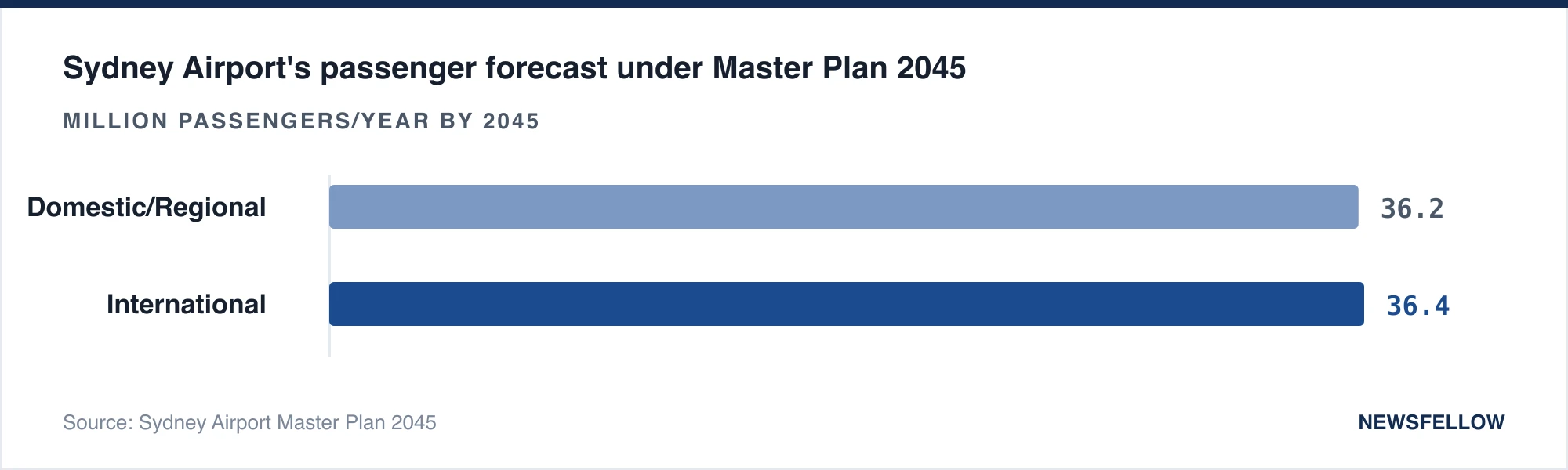
Master Plan 2045 forecasts that Sydney Airport will handle more than 72 million passengers a year by 2045 — split roughly evenly between 36.4 million international travelers and 36.2 million domestic and regional passengers. For comparison, the airport handled well under half that figure in recent pre-plan years, so the growth trajectory implied is substantial even stretched across two decades.
To support that traffic, the plan calls for a rebuild across all three of the airport's terminals. The international terminal, T1, is set for expansion, while the two domestic terminals, T2 and T3, face what airport documents describe as substantial redevelopment. The airport's own economic modelling projects that its annual contribution to the Australian economy will climb to around AU$70 billion, with direct employment on site rising past 105,000 jobs.
Notably absent from the approved plan is any new runway. Sydney Airport already operates three runways, including the third parallel runway that opened in the early 1990s after its own long and contentious approval fight. Federal aviation policy has for decades treated a fourth runway at the Mascot site as effectively off the table given the airport's dense urban surroundings — which is precisely why this master plan leans so heavily on terminal capacity and operational efficiency instead of new pavement.
The Curfew Stays, and So Does the Noise-Sharing Deal
Sydney Airport operates under some of the tightest movement restrictions of any major hub in the world: an overnight curfew between 11pm and 6am, and a hard cap of 70 aircraft movements per hour. Those two constraints have shaped the airport's operations — and Sydney's political relationship with its airport — since the curfew was legislated in 1995 following years of resident complaints about aircraft noise.
Master Plan 2045 leaves both restrictions untouched. Sydney Airport has committed to maintaining the existing curfew, the hourly cap, and the long-standing noise-sharing arrangement that rotates which runway handles departures and arrivals over the course of a day, spreading the noise burden across different residential corridors rather than concentrating it on one flight path. The plan also commits to maximizing flights routed over Botany Bay, where the noise footprint affects far fewer homes than routes over populated suburbs.
Perhaps counterintuitively, the airport's own projections suggest its 2045 noise footprint will actually be smaller than today's, a function of newer, quieter aircraft entering the fleet even as movement volumes rise. Regulators have nonetheless directed the airport to keep refining its noise abatement procedures as traffic grows, rather than treating the forecast improvement as a reason to ease up.
A New Neighbor Changes the Calculus
The timing of this approval is inseparable from what is happening 45 kilometers to the west. Western Sydney International Airport — the first entirely new airport built to serve a major Australian city in decades — has already opened for domestic freight flights as of July 2026, and is scheduled to begin passenger operations in October.
Rather than positioning the new airport as competition that will siphon traffic away from Sydney Airport, the master plan treats Western Sydney International as capacity for future growth that Sydney Airport's own hard caps cannot otherwise absorb. Under this reading, the two airports split the basin's rising demand rather than fight over a fixed pool of passengers — Sydney Airport stays curfew-constrained and cap-constrained, and the new airport catches the overflow instead of competing head-on for existing services.
The master plan also acknowledges more direct operational overlap: Western Sydney International's opening will require changes to some of Sydney Airport's existing flight paths, as air traffic controllers manage two major commercial airports operating within the same broader airspace for the first time.
Why a Terminal-First Growth Model Matters Beyond Sydney
Sydney's approach is a live test case for a question airports worldwide are wrestling with: how much passenger growth can be absorbed through terminal reconstruction, gate reallocation and scheduling discipline before new runways become unavoidable. Heavily constrained hubs — Heathrow among the most cited internationally — have spent years debating whether operational efficiency can substitute for physical expansion. Sydney's federal government has now bet, at least through 2045, that the answer is yes for this airport, provided the terminal rebuild is thorough enough.
The plan folds in Sydney Airport's five-year environment strategy as well, covering emissions reduction and climate resilience measures tied to the construction program, though the operational commitments — curfew, cap, noise-sharing — remain the parts of the approval most likely to be tested against reality as passenger numbers climb toward the 72-million mark over the next two decades.
Sources
- Sydney Airport 2045 master plan approved by the Federal Government - PS News
- Australian Government approves Sydney Airport's Master Plan 2045 - TRBusiness
- Australian Government approves Master Plan 2045 for Sydney Kingsford Smith Airport - CAPA
- Green light for Sydney Airport's Master Plan 2045 - Airport World
- Sydney Airport's Master Plan 2045 gets Federal Government approval - Travel Weekly
- Sydney Airport's Master Plan 2045 approved by Australian government - Passenger Terminal Today
- Sydney Airport Master Plan 2045 approved by Australian Government - DFNI
- Sydney Airport is going to look very different: Inside its huge 2045 overhaul - Karryon