From 11 Jets to 31: SpiceJet Leases 20 Aircraft to Rebuild Its Fleet Before Winter

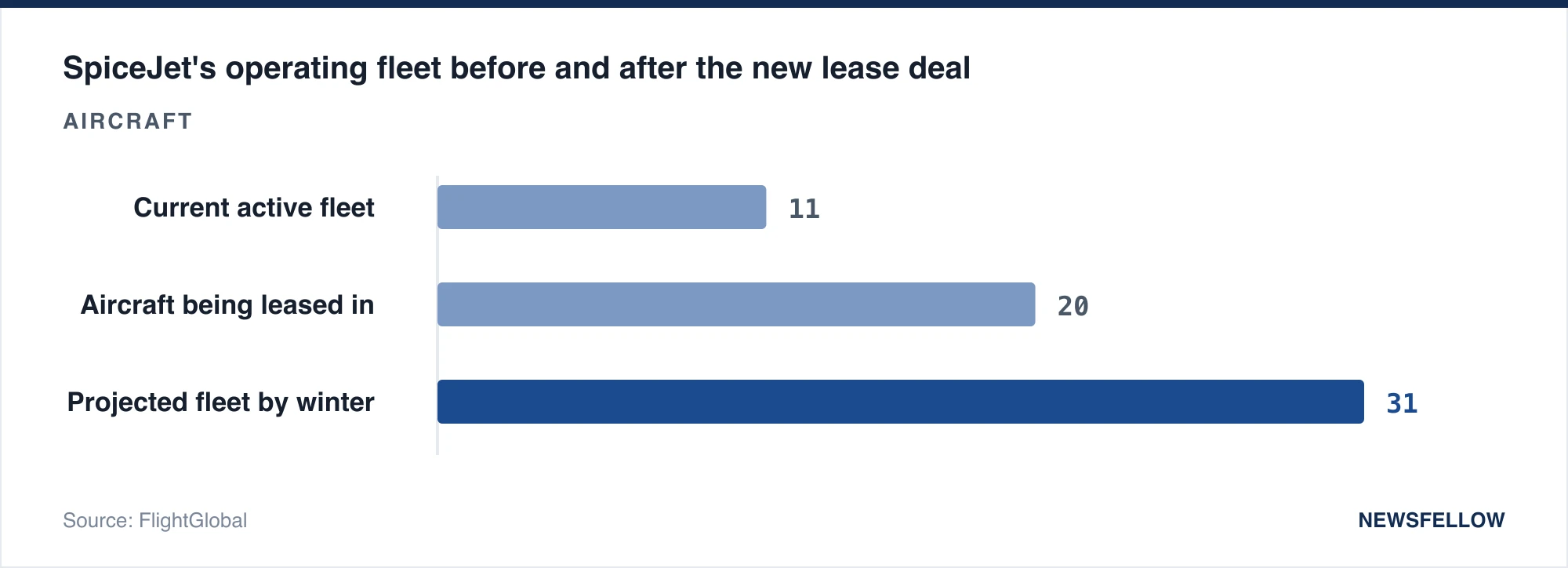
SpiceJet has signed lease agreements for 20 additional aircraft — 15 Boeing narrowbodies and five Airbus A321s — in a bid to nearly triple its operating fleet ahead of India's winter travel season, the airline confirmed in the first week of September 2026. The deal, reported first by FlightGlobal and since picked up by multiple Indian outlets including The Tribune and the Free Press Journal, marks one of the most aggressive short-term fleet rebuilding efforts by an Indian carrier in recent years — and comes only weeks after the once-dominant low-cost airline lost its last three operational Boeing 737 MAX 8s to lessor repossession.
The deal: 20 jets, three lessors, two lease types
According to the reporting, SpiceJet has finalized agreements with three separate aircraft lessors to bring in the 20 jets — a mix of 15 Boeing aircraft and five Airbus A321s — under a combination of wet and damp lease arrangements. Under a wet lease, the aircraft's owner supplies the plane along with crew, maintenance and insurance; a damp lease follows a similar structure but the leasing airline, in this case SpiceJet, provides some of its own crew, typically cabin attendants. The airline has not disclosed the specific Boeing variants, the identities of the three lessors, or the financial terms of the agreements.
The induction will happen in phases between mid-October and mid-November 2026, timed deliberately to be in place before the Durga Puja travel period and the broader winter demand surge that typically runs through the following spring. SpiceJet's stated target is to operate around 200 daily flights once the new aircraft are integrated into its schedule — a sharp jump from its current, heavily diminished operation.
A fleet that has shrunk to a fraction of its former size
The scale of SpiceJet's rebuilding effort is best understood against how far the airline's operating fleet has fallen. As of early September 2026, SpiceJet's active fleet stood at just 11 aircraft, according to FlightGlobal's reporting — a small fraction of the roughly 55 aircraft nominally on its books as of August 2026, which include Boeing 737-800s, Boeing 737 MAX 8s and Bombardier Dash 8 Q400 turboprops. The gap between registered and operational aircraft reflects years of grounded jets sitting idle due to engine and maintenance issues, chiefly problems tied to Pratt & Whitney and CFM LEAP-1B engines affecting the wider Indian narrowbody fleet, combined with SpiceJet's own well-documented cash and maintenance troubles.
To keep some capacity flying in the interim, the airline has also been supplementing operations with wet-leased Airbus A320s from Cambodia's Sky Angkor Airlines — a stopgap measure that underscores how thin SpiceJet's own available capacity had become heading into September.
The MAX exit that forced the issue
The immediate trigger for the scramble was the loss of SpiceJet's remaining Boeing 737 MAX 8 aircraft. In a case that has drawn attention beyond the airline itself, Dublin-based lessors Sky High LXXVIII Leasing Co. Ltd and Sky High LXXX Leasing Co. Ltd — both owned by ICBC Financial Leasing — sought the return of four Boeing 737-8s that had been leased to SpiceJet and were sitting grounded across Delhi, Hyderabad and Amritsar. India's Directorate General of Civil Aviation (DGCA) subsequently issued deregistration notices under the Irrevocable De-registration and Export Request Authorisation (IDERA) mechanism, based on applications from the lessors.
SpiceJet has said the deregistration would not affect its current flight operations, noting the aircraft had already been out of service for a prolonged period. The airline attributed the extended grounding to the broader, industry-wide issue affecting CFM LEAP-1B engines rather than to SpiceJet-specific maintenance failures. Still, the episode is notable for reasons beyond SpiceJet's own fleet count: aviation finance publications have described it as one of the first high-profile tests of India's strengthened aircraft repossession regime, introduced through legislative reforms in 2024 that were meant to align India more closely with the Cape Town Convention and make it faster and more predictable for lessors to reclaim aircraft from defaulting or distressed airlines. How smoothly and quickly that repossession played out carries implications for how global lessors view India as a market to place aircraft in — a factor that matters to every Indian carrier, not just SpiceJet, since access to leased capacity underpins nearly all of their fleet growth.
Betting on wet leases to buy time
The wet-and-damp-lease structure SpiceJet is using is a familiar playbook for the airline. It employed similar short-term leasing during the 2025 winter season, bringing in Boeing 737s while it worked to return grounded aircraft to service. The approach lets an airline add capacity quickly without the multi-month process of sourcing, inspecting, and registering aircraft under its own air operator's certificate for a dry lease, and it sidesteps the need to immediately hire and train additional pilots and cabin crew. The tradeoff is cost: wet and damp leases typically carry a higher price per aircraft than dry leases or owned aircraft, since the lessor is also compensated for crew, maintenance and insurance overhead.
Chairman and managing director Ajay Singh has previously set a public target of reaching 100 aircraft by the end of 2026, a goal announced after the airline completed a roughly Rs 3,000 crore fundraise. The 20-aircraft lease deal, even if fully realized, would leave SpiceJet's operating fleet at around 31 jets — well short of that 100-aircraft target, illustrating the distance between the airline's stated ambitions and its near-term operational reality.
Why it matters for the winter schedule
India's winter aviation schedule is traditionally the industry's busiest stretch, driven by festival travel around Durga Puja and Diwali followed by the peak wedding and holiday season into the new year. Airlines with insufficient available aircraft risk losing market share on high-demand routes to competitors like IndiGo, Air India and Akasa Air, all of which have been expanding capacity through 2026. For SpiceJet, which has spent recent years fighting to stay solvent and in the air amid lessor disputes, employee salary delays, and a shrinking market share, the ability to field even 200 daily flights would represent a meaningful, if partial, recovery in visible capacity — a signal to both the market and its own creditors that the airline still intends to compete rather than wind down.
Whether the leased aircraft materialize on the announced timeline remains to be confirmed; SpiceJet's public commitments on fleet growth have, in the recent past, not always matched delivered outcomes. The identities of the three lessors and the specific Boeing variants being inducted have not been disclosed publicly as of this writing, and neither has pricing.
A pattern across India's leasing market
The SpiceJet episode also lands at a moment when India's aircraft leasing landscape is under unusually close scrutiny. Reports on the ICBC repossession case have framed it as a bellwether for how effectively India's 2024 legislative reforms — intended to bring the country's insolvency and aircraft-recovery rules closer in line with the Cape Town Convention on International Interests in Mobile Equipment — actually function in a live dispute. Lessors have historically been wary of placing aircraft with financially stressed Indian carriers because recovering an asset through Indian courts could take years, a risk that was starkly illustrated during Jet Airways' collapse and Go First's insolvency proceedings, both of which left lessors fighting for years to reclaim grounded jets. A faster, more predictable repossession process, in theory, should make lessors more willing to place aircraft in India in the first place — which matters directly for a carrier like SpiceJet that depends entirely on outside capital and leased metal to rebuild capacity quickly.
That dependency also explains why SpiceJet is reaching for wet and damp leases rather than trying to negotiate longer-term dry leases or outright purchases. A dry lease typically requires the lessor to have confidence in the lessee's long-term creditworthiness and operational stability, since the aircraft is handed over with no crew or maintenance support attached — exactly the kind of commitment that is hardest for a carrier with SpiceJet's recent financial history to secure quickly. Wet and damp leases, by contrast, let a lessor retain more control and reduce its own risk exposure, since it keeps its own crews, maintenance responsibility or both in the arrangement. That makes such leases faster to arrange but structurally more expensive per flight hour, a tradeoff SpiceJet appears willing to accept in exchange for having aircraft in the air before the winter peak rather than after it.
The competitive backdrop
SpiceJet's rebuilding push is happening against a backdrop of aggressive expansion by its rivals. IndiGo, India's dominant carrier, has continued to add aircraft and international routes through 2026, while Air India has been working through its own post-merger fleet renewal under Tata ownership, and Akasa Air has been inducting new Boeing 737 MAX 8-200s at a steady clip as part of its own multi-year order book. Against that expansion, SpiceJet's operating fleet of 11 aircraft prior to this lease deal represented a marginal, almost token presence in the domestic market it once helped define as India's original ultra-low-cost carrier. Even a rebuilt fleet of around 31 aircraft would keep SpiceJet well behind its principal competitors in scale, but it would restore enough capacity for the airline to credibly compete on a meaningful number of domestic trunk and regional routes during the season when Indian air travel demand is at its highest.
For passengers, the practical effect of the lease deal, if it proceeds as announced, would be more available SpiceJet seats and route frequencies from mid-October onward, offering an alternative on routes where capacity from larger carriers has been tight. For the broader Indian aviation sector, the deal is also a data point in a longer-running story: whether smaller, financially strained carriers can find a sustainable path back to relevance through short-term leasing, or whether such moves simply delay a more fundamental reckoning over capital structure and fleet ownership.
Sources
- SpiceJet to lease 20 aircraft as it aims to ramp up again for winter - FlightGlobal
- SpiceJet plans to nearly triple active fleet with deal for 20 leased aircraft - AeroTime
- SpiceJet seals lease agreements for 20 aircraft, targets 200 daily flights in winter - The Tribune
- SpiceJet To Lease 20 Aircraft Ahead Of Winter Schedule To Tackle Shrinking Fleet, Operational Challenges - Free Press Journal
- What SpiceJet's latest repossession case reveals about aircraft leasing - MRO Business Today
- SpiceJet Fleet Size & Aircraft Types August 2026 - HappyFares
- SpiceJet aims for fleet of 100 by the end of 2026: CMD Ajay Singh - Indiablooms