Schiphol Lost Its Flight Cap in Court. The Noise Fell Anyway.

For three years the fight over Amsterdam Airport Schiphol has been argued as a numbers war: how many aircraft movements per year the Dutch state would permit, and how loudly the airline industry would object. The number in dispute was 478,000, down from a notional 500,000. On 11 March 2026, the Dutch Council of State — the country's highest administrative court — annulled it, ruling that the transport ministry had never adequately demonstrated why that particular ceiling was necessary, or that it would deliver the noise relief promised to the people living beneath the approach paths.
It looked, at the time, like a total defeat for noise policy at one of Europe's most contested airports. Five months later the picture is stranger and more interesting. On 19 August 2026, Schiphol published the second evaluation of its Balanced Approach package — and three of the four interim noise targets had been beaten, in one case by more than double. The instrument doing the work was not the cap the court threw out. It was the price list.
What the court actually struck down
The annulled measure was a set of amendments to the Schiphol Airport Traffic Decree, introduced by the government on 6 May 2025 and in force from 1 November that year. Two provisions mattered. The first capped annual aircraft movements at 478,000. The second cut permitted night movements from 32,000 to 27,000.
The Council of State's objection was procedural in form and substantive in effect. Judges found the ministry had not shown why a specific maximum number of take-offs and landings was the necessary tool, nor proven the promised reduction in noise would follow from it. With the amendments annulled, the older 2008 decree — which contains no total movement ceiling — snapped back into force. The night limit survived, but only by accident of litigation strategy: no party had challenged that part of the decision, so an interim ruling left the 27,000 figure standing.
The government's response was to press on. Within a fortnight it confirmed it would keep pursuing the 478,000 number through a redrafted decree, with revised rules expected to take effect in November 2026. That is the constitutional oddity of the case. A court did not rule that Schiphol may grow without limit; it ruled that the state had not done its homework. The homework is being redone.
The measure nobody litigated
The Balanced Approach is a European procedure, set out in Regulation 598/2014, that obliges a member state to work through every alternative — quieter aircraft, better operating procedures, land-use planning, and economic instruments — before it may impose an operating restriction such as a movement cap or a curfew. The European Commission assessed the Dutch plan on 5 March 2025 and was pointed about the gaps: the plan covered only commercial aviation while ignoring general and business aviation, considered fleet renewal only partially, and had not adequately explored noise-abating flight procedures. The underlying Dutch target is a 20 percent reduction in people and homes exposed to aircraft noise, nested inside the EU's broader goal of cutting chronic transport noise exposure 30 percent by 2030.
Buried in that package, and far less argued over than the cap, was a reform of landing charges: steeply noise-differentiated tariffs that make an older, louder airframe expensive to fly into Amsterdam and a new-generation one comparatively cheap. Roughly 40 percent of the traffic at Schiphol is now newest-generation equipment.
The August evaluation suggests that lever pulled harder than anyone in the ministry expected. Against an interim benchmark of 15 percent for each metric, the number of severely affected residents fell 17 percent; sleep disturbance fell 29.8 percent; the count of homes inside the 48 Lnight contour fell 35 percent. Only one target was missed, and narrowly: homes within the 58 Lden daytime contour came in at 14 percent. Schiphol's own assessment is that the tariff differentiation proved far more effective than the ministry originally estimated. Final figures are due in December.
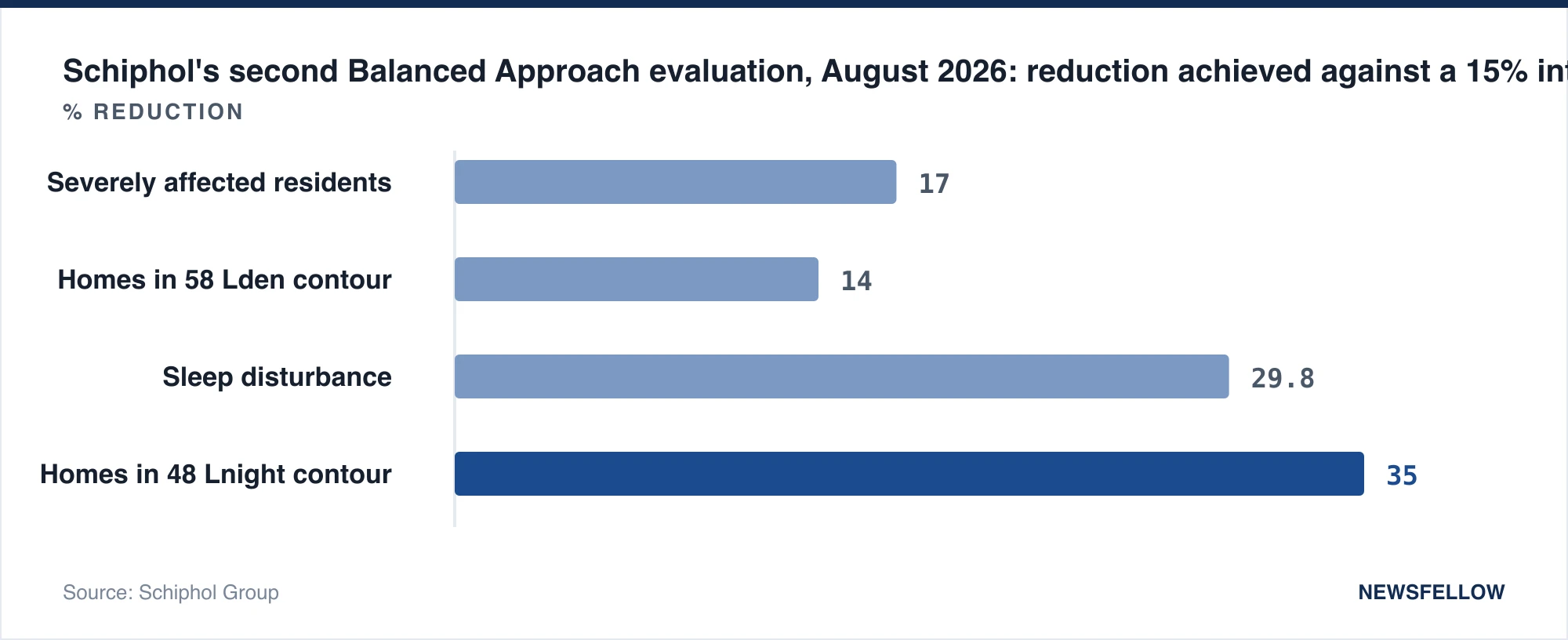
Read carefully, that table is an argument against the government's own legal strategy. The night-time metrics moved furthest. The daytime housing metric, the one tied most directly to sheer volume of traffic, moved least. If the objective is quieter nights for the people under the flight path, a charging structure that prices the noisiest aircraft out of the darkest hours appears to be reaching them faster than a headline ceiling on annual movements would.
Why the industry noticed before the residents did
KLM has made the pricing argument for years, and made it again during the fight over the decree: the state can protect residents without drastically cutting flight movements by making noisy aircraft more expensive, thereby pushing airlines toward quieter fleets. The carrier's complaint about the cap was that quieter replacements would not arrive until 2026, so a restriction imposed in 2025 amounted to shrinking the airline rather than reducing the noise. Whatever one makes of the self-interest in that position, the August data does not contradict it.
The politics have moved too. Schiphol under its 2023 leadership proposed an eight-point plan including a ban on take-offs and landings between midnight and 05:00 — an unusually radical offer from an airport operator. That position has since been reversed. In January 2026, Schiphol, KLM and aircraft manufacturers submitted a joint position paper to coalition negotiators opposing further restrictions and calling for no further night closures. The reversal caught even the airport's own shareholders off guard; Amsterdam's city council owns a fifth of the company, and its alderman Hester van Buren noted publicly that she had repeatedly been told a night-flying ban was not under discussion.
Meanwhile a coalition of fifteen municipalities, Amsterdam among them, is pushing the opposite way, seeking a ban on flights between 23:00 and 07:00 and citing health evidence on disrupted cognition and cardiovascular disease. A partial night closure from November 2026 remains on the table in the ministry's redrafted package.

The precedent that travels
Schiphol matters beyond the Netherlands because it is the test case every European hub is watching. Brussels, Cologne and Paris-Charles de Gaulle all have live night-flight restriction debates. Freight operators, whose economics depend disproportionately on overnight slots, have been lobbying hard across the continent. Each of those cases will have to clear the same Regulation 598/2014 hurdle the Dutch state just failed to clear.
The March ruling establishes something specific and portable: that under EU law, a government that wants to cap movements must produce a defensible evidentiary chain linking the number it picked to the noise reduction it promises. Round numbers chosen through political negotiation will not survive judicial review. That is a high bar, and one reason it is high is that alternatives exist — as the Dutch charging reform has now demonstrated with its own data.
There is a second, less comfortable lesson. In May 2026, an independent panel concluded that the environmental impact assessment underpinning Schiphol's regulation understated the airport's harm to surrounding residents. A policy can simultaneously be beating its interim targets and be measured against a baseline that flatters it. Percentage reductions are only as honest as the contour maps they are calculated from, and residents who can hear a widebody at 04:00 are not consoled by a 35 percent improvement in a statistical population.
What happens in November
The immediate question is whether the redrafted decree lands, and in what form. The ministry intends to reinstate the 478,000 cap in November 2026 with better reasoning attached, alongside a decision on whether Schiphol closes partially overnight. The airport and its home carrier are lobbying against the closure; fifteen local councils are lobbying for a broader one; the Commission has already told the Dutch that their plan under-uses fleet renewal and procedural measures.
The evidence from August points toward a package that leans harder on the tools that worked. A tariff structure that has cut night-contour housing by 35 percent in an interim evaluation is a stronger legal foundation than a movement ceiling that has already been annulled once. Whether Dutch politics can accept that the most effective noise measure at Schiphol turned out to be an invoice — rather than a headline number of flights — is the real test between now and December.
Sources
- Aviation Week Network — Schiphol Flight Cap Not Valid, Dutch High Court Rules: https://aviationweek.com/air-transport/airports-networks/schiphol-flight-cap-not-valid-dutch-high-court-rules
- ch-aviation — Dutch Council of State strikes down Schiphol flight cap: https://www.ch-aviation.com/news/164696-dutch-council-of-state-strikes-down-schiphol-flight-cap
- NL Times — Council of State scraps gov't-imposed flight limit at Schiphol Airport: https://nltimes.nl/2026/03/11/council-state-scraps-govt-imposed-flight-limit-schiphol-airport
- NL Times — Government sticks to 478,000 Schiphol flight cap despite legal setback: https://nltimes.nl/2026/03/24/government-sticks-478000-schiphol-flight-cap-despite-legal-setback
- Schiphol Group — Second Balanced Approach evaluation shows that Schiphol is becoming quieter: https://news.schiphol.com/second-balanced-approach-evaluation-shows-that-schiphol-is-becoming-quieter/
- European Commission, DG MOVE — Commission adopts decision on Schiphol Airport noise reduction plan: https://transport.ec.europa.eu/news-events/news/commission-adopts-decision-schiphol-airport-noise-reduction-plan-2025-03-05_en
- DutchNews.nl — Schiphol changes course to lobby against night flying ban: https://www.dutchnews.nl/2026/01/schiphol-changes-course-to-lobby-against-night-flying-ban/
- NL Times — Independent panel says Schiphol impact report understates airport's harm to residents: https://nltimes.nl/2026/05/16/independent-panel-says-schiphol-impact-report-understates-airports-harm-residents
- NL Times — KLM finds night flight ban for loud aircraft at Schiphol "harmful and disproportionate": https://nltimes.nl/2024/05/25/klm-finds-night-flight-ban-loud-aircrafts-schiphol-harmful-disproportionate
- The Loadstar — Dutch top court annuls Schiphol flight cap: https://theloadstar.com/dutch-top-court-annuls-schiphol-flight-cap/