Ryanair Just Bet That $140 Oil Will Kill Its Rivals This Winter

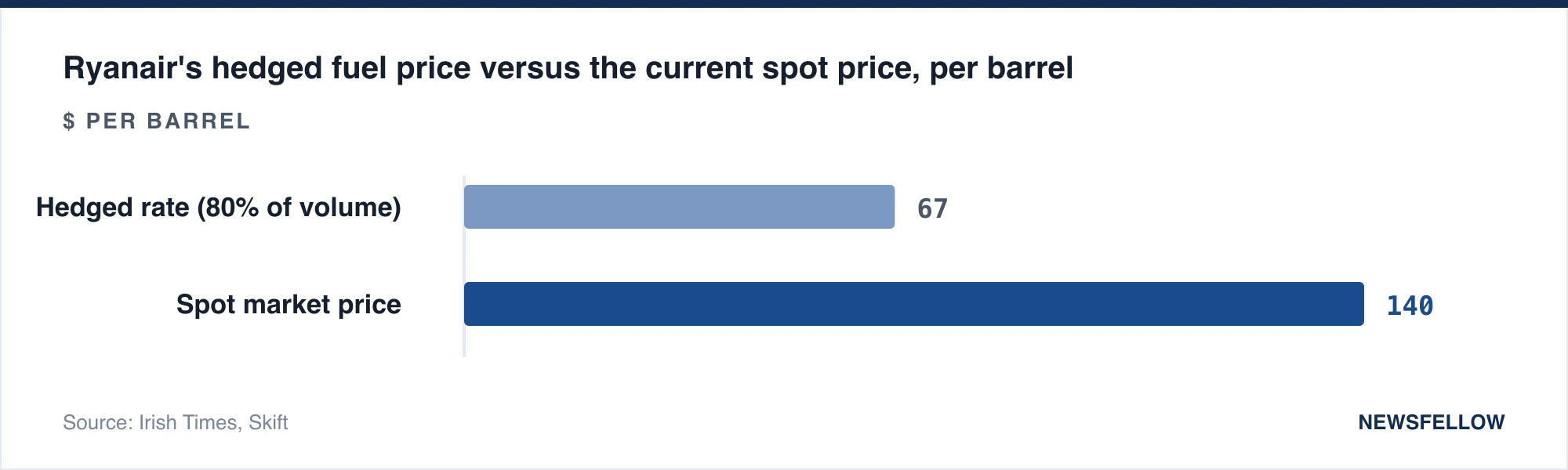
Europe's largest low-cost carrier is pulling back capacity for the coming winter and warning that some of its competitors may not make it through the season. Ryanair said on September 2, 2026, that it is trimming its full-year traffic target from 216 million to 214 million passengers, a deliberate move to shrink its exposure to jet fuel it has not locked in at a fixed price — fuel now trading at roughly $140 a barrel, more than double the rate Ryanair secured through hedging.
The announcement, made in an interim update ahead of the airline's half-year results, marks one of the sharpest signals yet that a sustained spike in jet fuel costs is starting to reshape flying schedules across Europe, not just airline balance sheets.
Why Ryanair Is Cutting Now
Ryanair has long prided itself on hedging discipline, and the airline said it has around 80% of its fuel costs for the current period locked in at roughly $67 a barrel — a rate that looks increasingly favorable against a spot market that has surged toward $140. It is the remaining 20%, bought at prevailing market prices, that is driving the airline's decision to trim capacity during what is already its least profitable stretch of the year.
Winter, running from November through March, is structurally unprofitable for most short-haul European carriers because demand softens and fares fall even as fixed costs stay largely the same. Ryanair calculates that flying fewer unhedged, marginally profitable winter flights will reduce its winter losses by an estimated €70 million to €100 million.
"It is sensible to strategically reduce the group's exposure to unhedged jet fuel during the unprofitable winter schedule," the airline said in its update, according to reporting by the Irish Times and Skift. Ryanair added that if oil prices remain elevated into the summer 2027 season, short-haul airfares would need to "increase materially" to reflect the higher cost base.
A Warning Aimed at Weaker Rivals
Where Ryanair's announcement goes beyond routine cost management is in its message to the rest of the industry. The airline explicitly warned that competitors with less fuel hedged than its own 80% could "struggle to maintain capacity or even survive this coming winter season" if oil prices hold near current levels. Ryanair CEO Michael O'Leary has previously flagged what the airline's own executives have called an "armageddon" scenario for weaker-hedged carriers, according to a CNBC report from earlier this year in which Ryanair's finance chief raised similar concerns about the sector's exposure to a jet fuel crunch.
The subtext is strategic as much as it is cautionary. If smaller or less well-capitalized airlines are forced to cut capacity or exit routes because they cannot absorb unhedged fuel costs, Ryanair — with its scale, balance sheet, and hedging book — stands to benefit from reduced competition and firmer fares once the market stabilizes. Ryanair itself said fares would need to rise "materially" industry-wide if $140 oil persists, a dynamic that would favor the carrier best positioned to weather the interim losses.
What Changes for Passengers
For travelers, the immediate effect is a modestly smaller winter European short-haul market: roughly 2 million fewer Ryanair passenger journeys than previously planned, spread across the November-to-March period. Ryanair has not detailed which specific routes or frequencies will be trimmed, and the airline said it still expects to remain profitable for the current fiscal year — just below the record €2.17 billion net profit after tax it posted in fiscal 2025/26.
The bigger question for consumers is fares. Ryanair's own framing suggests that if oil prices do not retreat, ticket prices across short-haul Europe are likely to climb next year regardless of which airline is flying the route, as the cost of unhedged fuel works its way through the whole industry's pricing.
The Broader Fuel Picture
Jet fuel prices near $140 a barrel represent a significant jump from the levels airlines budgeted for heading into 2026, and Ryanair is far from alone in feeling the pressure — the airline's own commentary was framed explicitly as a warning about sector-wide risk, not a Ryanair-specific problem. Carriers with lighter hedging books, thinner balance sheets, or higher reliance on winter leisure routes are the ones Ryanair suggested are most at risk.
Ryanair's move also illustrates a broader pattern in how the airline has historically used downturns: pulling back capacity when conditions are unfavorable, then moving to capture market share and pricing power once weaker competitors retreat. Whether that plays out again this winter will depend largely on how long jet fuel prices stay elevated, and how much runway smaller carriers have to absorb the cost before service cuts or restructuring become unavoidable.
Ryanair said it is still too early to provide detailed profit guidance for the fiscal year, with more clarity expected as the airline reports its half-year results later in the season.
Sources
- Ryanair cuts winter capacity as unhedged jet fuel costs bite – The Irish Times
- Ryanair Pulls Winter Capacity and Warns Rivals May Struggle to Survive – Skift
- Ryanair trims traffic target as fuel costs cloud outlook – RTÉ
- Ryanair Warns Some European Airlines May Not Survive Winter – AeroTime
- Ryanair has plans for 'armageddon' scenario as CFO warns weaker European carriers may not survive jet fuel crunch – CNBC