Riga Airport Breaks Ground on €98 Million Terminal Expansion to Chase 12 Million Passengers

Riga International Airport has moved its long-planned passenger terminal expansion into an active construction phase, the Latvian hub confirmed this week, marking the most concrete step yet in a project meant to roughly double the airport's capacity by the end of the decade.
The airport operator said site works are scheduled to begin in the second half of September 2026, starting with preparation and temporary infrastructure before heavier construction follows. The full build-out is expected to run in four stages over a period of up to 42 months — meaning the project, if it stays on schedule, would substantially wrap up by around early 2030.
What Is Actually Being Built
The centerpiece of the project is a new terminal extension of roughly 20,000 square metres, attached to the existing passenger building. According to the airport and construction-industry trade press covering the announcement, the extension will include new check-in facilities, expanded passenger waiting areas, a rebuilt security screening zone, and a new baggage reclaim hall.
Beyond the terminal footprint itself, the project also covers a further 29,500 square metres of external work: reconstructed access roads, new public areas, upgraded utility networks, and landscaped green space around the redeveloped site. Airport officials have described the addition as "energy-efficient" and built around updated passenger-processing technology, though specific systems have not yet been detailed publicly.
Construction will proceed in stages rather than as a single continuous build. The first phase, now underway, focuses on preparing the site and temporary infrastructure. A second stage is set to handle reconstruction of external infrastructure, utility networks, new roads and public realm work, and landscaping. A third stage covers the terminal expansion itself, with a final stage to follow before the new facilities are fully operational.
The Money Behind It
The construction cost is put at approximately €98 million. Financing is being split evenly across three lenders selected through a competitive tender: the European Bank for Reconstruction and Development (EBRD), the Nordic Investment Bank (NIB), and OP Corporate Bank plc's Latvian branch. Combined, the lending arrangements give the airport access to up to €150 million in financing — headroom beyond the immediate construction budget that suggests room for cost overruns or follow-on phases.
The involvement of two development banks — the EBRD and NIB — rather than purely commercial lenders is notable. Both institutions typically attach financing to projects they judge to have a regional economic development rationale, in this case tied to Baltic and Northern European connectivity rather than a purely commercial return calculation.
Why Riga Needs More Room
Riga handled slightly over 7.1 million passengers in 2025, essentially flat against the prior year, according to the airport's own year-end traffic statistics. airBaltic, the Latvian flag carrier that is based at Riga and uses the airport as its primary hub, held the largest share of that traffic at 57.2%, with Ryanair a distant second at 22.8%. Cargo volumes, by contrast, grew by roughly 7% over the same period — a smaller but growing part of the airport's business.
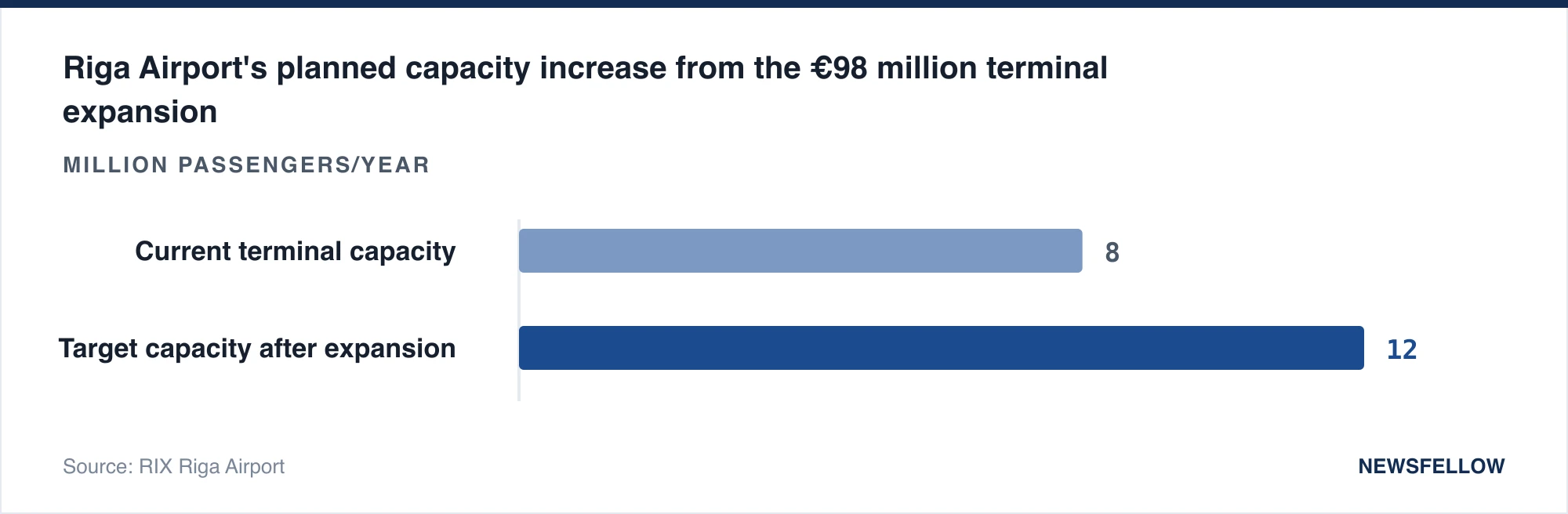
Against that traffic base, the airport's current terminal capacity is described as around 8 million passengers a year — meaning Riga's 2025 volumes were already pressing close to the ceiling of the existing building. The expansion is designed to lift that ceiling to approximately 12 million passengers annually, giving the hub meaningful headroom against forecast growth across the Baltic states and wider Northern Europe.
That growth assumption is not without risk. Riga's passenger numbers were essentially flat in 2025 rather than climbing sharply, and the airport's traffic mix is unusually concentrated: airBaltic alone carries more than half of all passengers, so the airline's own fleet plans, financial health, and route network will weigh heavily on whether the new capacity actually gets used on the timeline the airport is building for.
The Rail Baltica Connection
One detail that distinguishes this project from a typical single-airport capacity build is its planned integration with Rail Baltica, the European-gauge high-speed rail line under construction to link Estonia, Latvia and Lithuania with the rest of the EU rail network. A Rail Baltica station building at the airport itself is expected to be completed in 2026, ahead of the terminal expansion's own timeline.
The airport says the new terminal facilities are intended to connect directly with that rail infrastructure, positioning Riga as a combined air-rail interchange point for the Baltic region rather than a stand-alone airport. Full operations of the new terminal are scheduled to begin around 2030, which would roughly coincide with further progress on the broader Rail Baltica line, though the rail project has faced its own delays and cost escalations in past years across all three Baltic states involved.
A Regional Pattern
Riga's move follows a broader pattern of mid-sized European airports investing in capacity ahead of — rather than strictly in response to — demonstrated demand growth, a strategy that carries obvious execution risk if traffic forecasts don't materialize on schedule. Airports across the Baltic and Nordic region have cited longer-term connectivity and EU cohesion goals, alongside straightforward passenger growth projections, as justification for such projects.
For Latvia specifically, Riga Airport functions as the country's principal international gateway and the base for its only major national carrier. A capacity bottleneck at the airport would constrain not just tourism arrivals but also airBaltic's own ability to grow its network, so the project carries strategic weight for Latvian aviation policy beyond the immediate construction contract.
The airport has not yet named a lead general contractor for the terminal-building phase specifically, according to available reporting, though the site-preparation and early infrastructure work is proceeding under the September 2026 start date. Further contract announcements are expected as the project moves from its current early stage into the terminal-construction phase proper.
What to Watch
Three things will determine whether this project delivers what's being promised. First, whether the 42-month, four-stage schedule holds — European airport construction projects of this scale have a mixed record on timelines, and a project spanning to 2030 leaves ample room for delay. Second, whether airBaltic's own growth trajectory justifies the jump to 12 million annual passengers, given that 2025 traffic was flat rather than rising. Third, how closely the terminal's completion actually lines up with Rail Baltica's own construction progress, since the value of an integrated air-rail hub depends on both projects landing in the same window rather than one significantly trailing the other.
For now, the concrete fact is that Riga Airport has moved from planning documents to an active construction site, backed by a specific, tendered €98 million financing package from two development banks and a commercial lender — a level of financial commitment that makes this more than an announcement-stage project.
Sources
- Riga Airport expansion enters construction phase — Travel Daily News
- RIX Riga Airport Launches the Next Stage of Its Major Passenger Terminal Expansion Project — RIX Riga Airport official news
- Riga Airport begins next stage of €98m terminal expansion — DFNI Online
- Rīga Airport begins terminal expansion — LSM (Latvian Public Broadcasting)
- 2025 at Riga Airport: A Year of Stable Operations, Serving 7.1 Million Passengers — RIX Riga Airport official news
- Riga International Airport Passenger Terminal Expansion, Riga — Airport Technology