NATS Grounds Nearly 2,000 UK Flights in Third System Failure Since 2023 — Airlines Demand Chief's Resignation

A technical fault, then a cascade
Just after 1:46 p.m. on Tuesday, September 8, 2026, engineers at NATS — the company that runs air traffic control for the United Kingdom — detected a fault in the system that processes flight plans at its Swanwick control center in Hampshire. Rather than let aircraft take off without properly processed routing data, NATS restricted departures across the airspace it manages while it worked to fix the problem. A repair was in place by roughly 4:40 p.m., according to the company, but the backlog it created rippled through the following day.
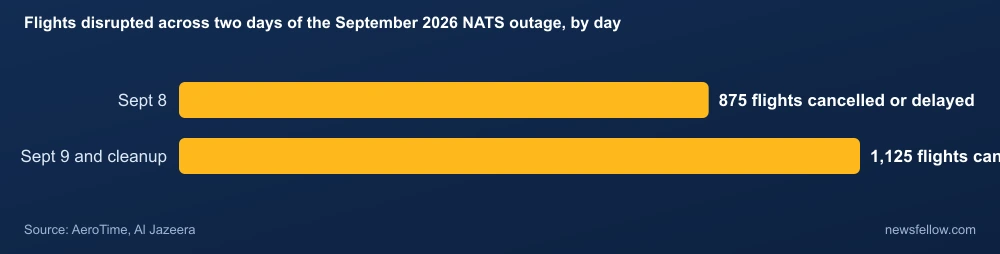
By the time the disruption cleared, more than 2,000 flights to, from, and within the UK had been cancelled or delayed over September 8 and 9, according to reporting from Al Jazeera and the Washington Times. Roughly 875 flights were affected on the first day alone, per AeroTime, at Heathrow, Gatwick, Manchester and Birmingham — the four busiest airports in the network of about 15 that NATS handles. Ryanair said 65,000 of its passengers were disrupted by the outage.
NATS said it did not believe the fault was the result of a cyber-attack, characterizing it instead as an internal issue with its own flight-processing software.
The third collapse in three years
What has turned a technical glitch into a political and commercial crisis is the pattern behind it. This is being described by multiple outlets, including Tech Times, as the third major failure of NATS' Swanwick systems since 2023 — following a catastrophic August 2023 flight-plan processing failure that disrupted more than 700,000 passengers and was estimated to have cost the aviation industry £75–100 million, and a further system failure in July 2025 that triggered fresh cancellations at Heathrow.
That history is why airline executives reacted with unusually blunt public anger this week rather than the standard expressions of regret. Ryanair's chief operations officer, Neal McMahon, said in a statement reported by multiple outlets: "Following the 2023 collapse, we were told lessons would be learned. We were told resilience would improve. We were told the systems had been fixed."
McMahon went further, calling directly for NATS chief executive Martin Rolfe to resign, referencing the 2023 disruption and saying that "families and thousands of visitors have once again paid the price for NATS' abhorrent failure." A spokesperson for Wizz Air was similarly pointed, saying NATS "is simply not fit for purpose in its current form."
Government intervention
The political response came quickly. UK Transport Secretary Heidi Alexander met with Rolfe on Wednesday, September 9, and gave him one week to deliver a full account of what went wrong and why. According to reporting on the meeting, the resulting report must identify the root cause of the failure and set out corrective measures. Alexander also commissioned an independent review of the incident by the UK Civil Aviation Authority (CAA), separate from NATS' own internal investigation.
Despite the pressure from airlines, Rolfe has not been removed. A spokesperson for Prime Minister Andy Burnham's office said that Rolfe retains the confidence of the government, according to reporting from Yahoo News and other UK outlets covering the meeting. Rolfe's total remuneration has been reported by UK media at roughly £1.5 million, a figure that has fed into public criticism of NATS' accountability given the repeated failures.
As with any live investigation of this kind, the specific technical root cause of the September 2026 fault has not yet been confirmed publicly — NATS' own account describes it only as an issue within its flight-processing system, and the CAA's independent review has not concluded.
Why a "flight-processing" fault grounds so many planes
NATS' flight-plan processing system doesn't route individual aircraft in real time the way a control tower or radar system does — it validates and files the flight plans that airlines must have accepted before an aircraft is permitted to depart into controlled airspace. When that system falters, NATS can either allow departures without the normal automated checks, which raises operational risk, or restrict departure rates until plans can be verified, which is the more conservative choice NATS made on September 8. That conservative choice is also why the disruption compounds over subsequent hours and days: aircraft, crews and passengers all end up out of position relative to their scheduled rotations, and a single afternoon's restriction can take more than 24 hours to fully unwind across a network as dense as the UK's.
This is structurally similar to the August 2023 failure, when a corrupted flight plan forced NATS engineers to process flight data manually rather than through the automated system, again forcing a sharp cut to departure rates rather than an outright shutdown of airspace.
What passengers can expect
For travelers affected by cancellations or delays connected to the NATS fault, UK and EU passenger-rights rules under UK261/EU261 generally still apply to the airline operating the flight, even though the underlying cause originated with the air navigation service provider rather than the airline itself. Airlines have historically argued that ATC failures constitute "extraordinary circumstances" that limit their compensation liability, though care and assistance obligations — meals, rebooking, and in some cases accommodation — typically still apply regardless of the cause. Specific compensation determinations from this event had not been finalized as of publication.
The bigger picture for UK aviation
The repeated failures are landing at a politically sensitive moment for UK airspace more broadly, with ongoing scrutiny of NATS' technology modernization program and separate debates over airport capacity expansion elsewhere in the country. For an air navigation provider that operates as a public-private partnership — NATS is majority owned by a group of airlines and the UK government's National Air Traffic Services holding, with a minority stake held by the Airport Operators Association — three major software-driven failures in three years raises the question of whether the underlying Swanwick infrastructure needs a more fundamental overhaul rather than incremental fixes after each incident.
The CAA's independent review, alongside the internal report Alexander has demanded within a week, will be the first indicators of whether that broader modernization case gets made. For now, NATS has confirmed it will conduct what it calls a "full investigation," a process that in 2023 took several months to produce a public accounting of the failure's technical cause.
What went wrong in 2023, and why it still matters
The August 2023 failure remains the benchmark against which every subsequent NATS incident is measured, both because of its scale and because of what the post-incident investigation found. That failure disrupted more than 700,000 passengers over the August bank holiday weekend, one of the busiest travel periods of the UK calendar year, and the independent panel that later reviewed it concluded the fault stemmed from a single corrupted flight-plan data point that the system's automated processing was not designed to handle gracefully — instead of rejecting or flagging the bad data cleanly, it caused the system to fail in a way that forced engineers to fall back to slower, partially manual processing. NATS committed at the time to a series of resilience improvements, including changes intended to prevent a single flight-plan anomaly from cascading into a system-wide restriction. The core criticism leveled by Ryanair and Wizz Air this week is that a structurally similar failure mode — a flight-processing fault requiring departure restrictions while engineers intervene — has now recurred twice more, including the July 2025 Heathrow disruption, suggesting the underlying resilience work either did not address the true root cause or introduced new vulnerabilities of its own.
NATS' structure and why accountability is complicated
NATS occupies an unusual position in UK infrastructure: it is neither a fully nationalized public utility nor a conventional private company, but a public-private partnership established when the UK government part-privatized air traffic control in 2001. The Airline Group, a consortium of UK and international airlines, holds a majority stake, the UK government retains a stake through what is now organized as part of the Department for Transport's holdings, and NATS' employees and the Airport Operators Association hold smaller stakes. That structure means the airlines publicly demanding Martin Rolfe's resignation this week are, collectively, also among NATS' owners — a dynamic that has fed criticism that the governance model blurs lines of accountability that would be clearer under either full nationalization or a conventional private monopoly subject to a single regulator's enforcement powers. The UK Civil Aviation Authority regulates NATS' charges and service standards, but the events of the past three years have intensified calls, including from some airline executives, for a more fundamental review of whether that regulatory model is fit for an air traffic control system that the UK's growing aviation demand is straining more with each passing year.
Comparable failures elsewhere
The UK is not alone in facing questions about the resilience of aging or software-dependent air traffic control infrastructure. The United States' Federal Aviation Administration has faced its own high-profile system outages in recent years, including a January 2023 failure of the Notice to Air Missions (NOTAM) system that grounded all domestic flights across the country for several hours — an incident that, like NATS' 2023 failure, prompted congressional scrutiny and calls for accelerated modernization funding. Both cases illustrate a common thread in modern aviation infrastructure: air traffic management systems built up over decades, patched and extended rather than replaced wholesale, can carry latent single points of failure that only reveal themselves when a specific, rare combination of data or conditions triggers them. That pattern is central to why aviation analysts covering the NATS incident have been cautious about predicting how quickly, or how completely, a "full investigation" can actually eliminate the risk of a fourth failure, rather than simply patching the specific fault identified this time.
The stakes for NATS' modernization program
NATS has for several years been engaged in a long-term technology modernization effort intended to replace aging systems, including elements of the Swanwick center's flight-data processing infrastructure, with newer software architecture. That program has faced its own scrutiny over cost and pace, and the recurrence of major failures despite ongoing modernization spending is likely to become a central theme of both the CAA's independent review and the internal report Transport Secretary Alexander has demanded within a week.
Sources
- NATS to conduct 'full investigation' into system issue that disrupted thousands of UK flights — FlightGlobal
- Airlines scramble to dig out from British air traffic control tech problems that canceled 2K flights — Washington Times
- Hundreds of flights delayed, cancelled after UK air traffic control glitch — Al Jazeera
- Technical issue causing some disruption to flight departures — NATS official statement
- NATS Grounds Nearly 1,000 Flights in Third Swanwick Failure Since 2023 Reforms — Tech Times
- Air traffic control boss rules out cyber crime as flight chaos continues — ITV News
- Heathrow and Gatwick flights chaos: Air traffic boss Martin Rolfe on £1.5m given week to come up with answers as he faces call to quit — Yahoo News
- Airlines fume as UK air traffic control failure disrupts nearly 1,000 flights — AeroTime
- Massive disruption hits UK airports after air traffic control issue — CNN