No Boarding Pass Required: Memphis Airport's New Lounge Will Let Anyone In for $45

Most airport lounges still run on a simple gate: fly a certain airline, hold a certain credit card, or pay for a certain status, and the door opens. Memphis International Airport is about to test a different model entirely — one where the only requirement is having somewhere to fly and $45 to spare.
The Memphis-Shelby County Airport Authority has approved a 12-year lease with CAVU Experiences to build the airport's first lounge open to travelers regardless of which airline they're flying. The deal is valued at $2.9 million and will place an Escape Lounge — CAVU's branded lounge product, already operating at a number of other US airports — in the main rotunda of what is formally named Memphis International Airport, sometimes referred to locally by its full designation honoring FedEx founder Frederick W. Smith.
A Lounge With No Airline Attached
The distinction matters more than it might sound. Nearly every major lounge network in the US — American's Admirals Clubs, Delta's Sky Clubs, United Clubs — ties access to flying that specific carrier, holding one of its co-branded credit cards, or qualifying through elite status or a paid membership tier. A traveler flying a smaller regional carrier, a budget airline, or simply connecting through on a partner ticket that doesn't clear the access rules is typically locked out entirely, regardless of ability to pay.
The Escape Lounge model sidesteps that structure. There's no membership requirement and no credit card tie-in described in the lease terms — access is sold directly, per visit, to anyone passing through the terminal. Reported pricing places advance-booked entry at $45 per person, rising to $60 for walk-up guests, with children under three admitted free. That's a straightforward transaction: pay at the door or online beforehand, walk in.
In exchange, guests get an experience built to resemble the traditional airline club rather than replace it with something lesser — complimentary hot and cold food, alcoholic and nonalcoholic beverages, seating away from the concourse crowds, wifi, charging ports, printing access, and restrooms. The lease also calls for a food and beverage program built around local Memphis producers and vendors, giving the space a regional identity rather than a generic airport-lounge template.
The Physical Footprint
The new lounge is planned for roughly 3,200 square feet to start, positioned in the airport's main rotunda — a central, high-traffic location rather than a tucked-away corner near a single set of gates. The lease includes room to grow: if usage triggers set out in the agreement are met, the space can expand to nearly 4,900 square feet, roughly a 50% increase in footprint.
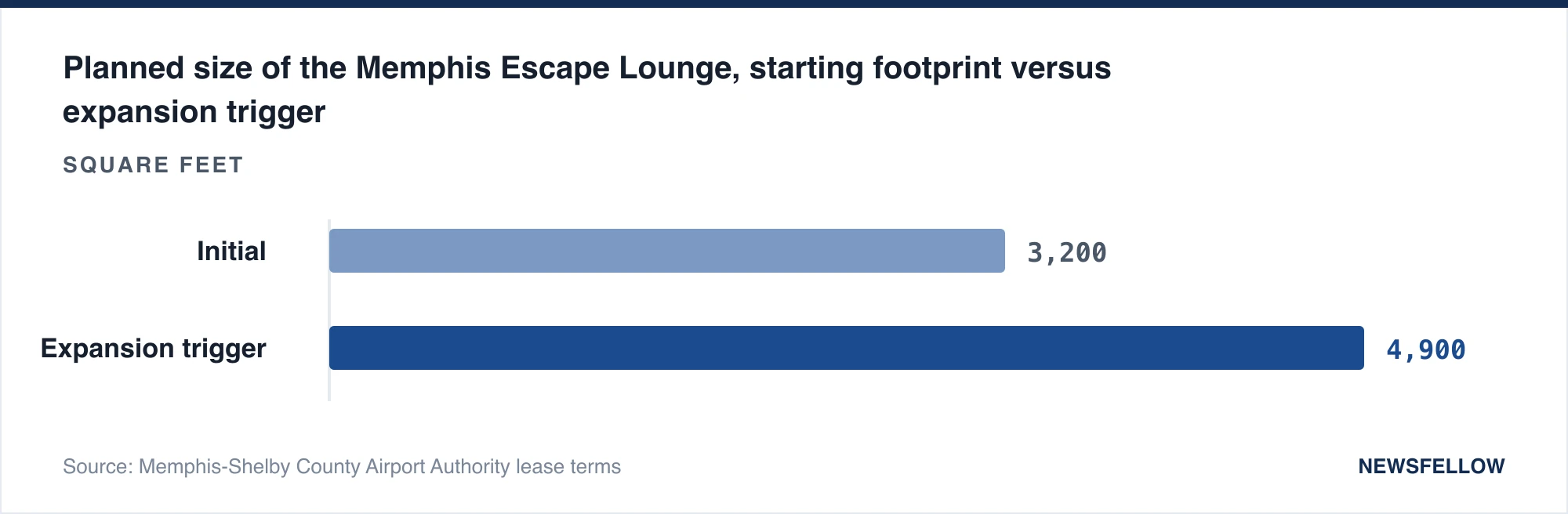
That growth clause is a meaningful signal in itself. Airport authorities and lounge operators don't typically write expansion triggers into a 12-year lease unless they expect the initial footprint to be tested reasonably quickly — a bet that demand from non-elite, non-co-branded-cardholder travelers is large enough to justify nearly doubling the space if it materializes.
Part of a Broader Pattern, Not a One-Off
Memphis isn't the first CAVU project, and the broader push toward pay-per-visit, carrier-agnostic lounges has been building for several years across mid-size and secondary US airports — places that don't have the traffic volume to support a dedicated airline club for every carrier serving the field, but do have enough travelers willing to pay for a quieter seat and a drink before boarding.
A comparable CAVU project closer in scale is the recently renovated Escape Lounge at Cincinnati/Northern Kentucky International Airport (CVG), which reopened this year after a $6.3 million expansion — a considerably larger investment than Memphis's, reflecting CVG's larger passenger base, but built on the identical premise of lounge access sold directly to any traveler rather than gated by airline loyalty.
For an airport like Memphis, historically defined more by its role as FedEx's global air cargo hub than by premium passenger traffic, a lounge model that doesn't depend on a dominant local airline's loyalty program makes structural sense. No single passenger carrier holds the kind of overwhelming share at Memphis that would make an exclusive, single-airline club economically obvious the way it is at a major hub like Atlanta or Dallas-Fort Worth. A pay-as-you-go lounge open to everyone sidesteps that problem by not needing one.
What It Signals About Airport Concessions
The Memphis deal also reflects a shift in how airport authorities think about concession space. A traditional airline club lease effectively cedes a chunk of a terminal to a single carrier's brand and passenger base. A model like Escape Lounge instead lets the airport authority capture concession revenue from a broader cross-section of travelers — business fliers without status, leisure travelers with a long layover, or anyone simply willing to pay for a calmer environment — without needing a dominant hometown carrier to anchor it.
Whether the $45-and-up price point proves attractive at Memphis's passenger volumes, relative to airports where similar lounges have already established themselves, will likely determine whether the expansion trigger in the lease gets activated within the 12-year term. For now, the approval itself marks a notable expansion of the pay-for-comfort lounge category into a market that airline loyalty programs had largely passed over.
Sources
- Hoodline: Memphis Airport Lands First Multi-Airline Lounge in $2.9M Escape Lounge Deal
- Memphis Flyer: Escape Lounge to Land at Memphis Airport in $2.9M Deal
- Daily Memphian: New Memphis airport board plans taxiway reconfiguration, new lounge
- NKyTribune: CVG Airport opens newly renovated Escape Lounge
- CAVU: Passenger Experiences