The Bag Found Itself: How Passenger-Owned Trackers Rewrote the Lost-Luggage Business

For two decades the lost bag was aviation's most democratic humiliation. It did not care whether you turned left or right at the aircraft door. It arrived — or rather did not — as a queue at a desk, a triplicate form, a reference number, and a week of silence.
That relationship has changed faster in the last eighteen months than in the previous fifteen years, and the reason is only partly the airline industry's doing. The single most effective intervention in modern baggage handling turned out to be a device the passenger bought at retail, dropped into a suitcase, and paired with a phone.
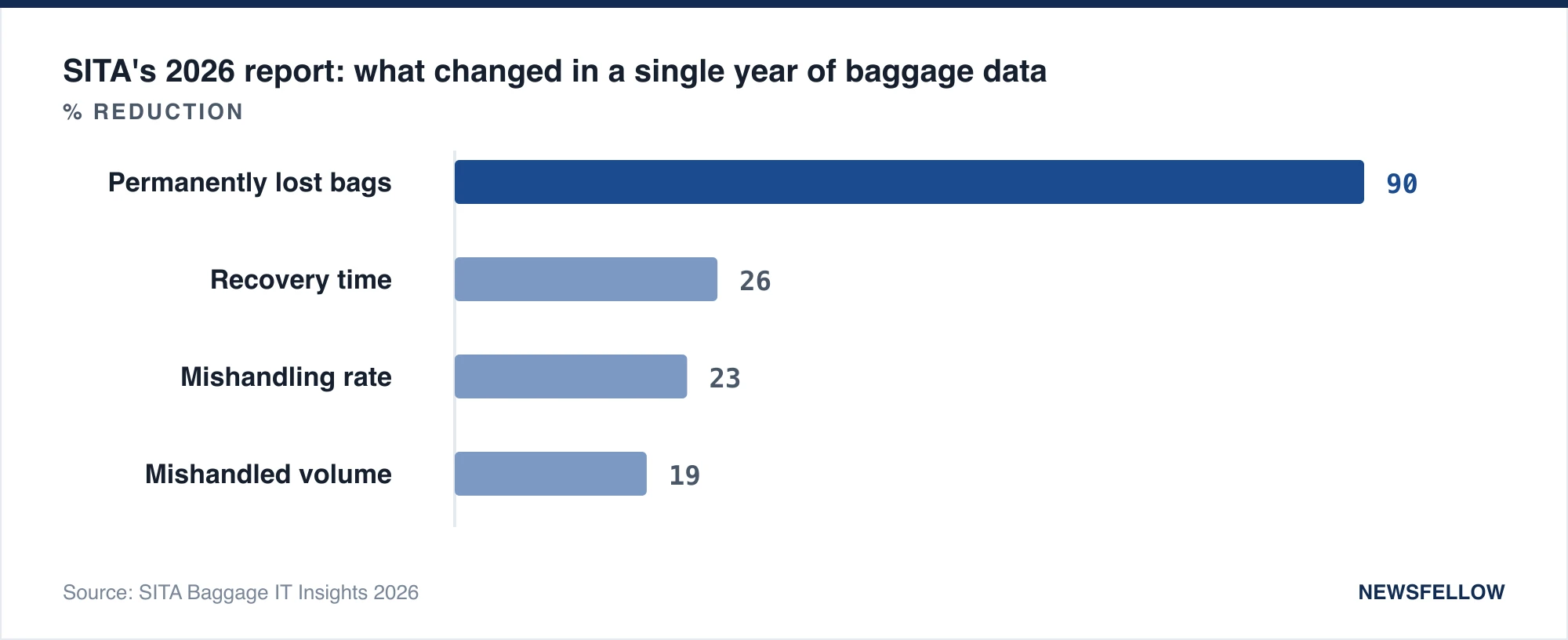
SITA's 2026 Baggage IT Insights report, published at the end of June, found that the global mishandling rate fell 23% during 2025. The absolute number of mishandled bags dropped 19%, to roughly 24 million out of about five billion passengers carried. Crucially, performance fell below pre-pandemic levels for the first time — the post-2022 recovery chaos is now formally over, and the industry is ahead of where it stood in 2019 despite handling considerably more traffic.
The rate now sits at about 4.9 bags per thousand passengers, against roughly 6.3 the year before. Measured over the long arc, mishandling has fallen around 75% since 2007.
The tracker the airline did not have to buy
The most striking figure in the report is not the headline rate. It is what happened when SITA's WorldTracer system — the industry clearinghouse that most carriers use to reconcile lost bags — was wired into Apple's Find My network via the "Share Item Location" feature.
In the first year of that interoperability, SITA reports a 90% reduction in permanently unrecoverable bags, and a 26% reduction in recovery time, with delayed bags returned roughly a full day faster on average.
The mechanism is almost embarrassingly simple. Share Item Location, introduced with iOS 18.2, lets the owner of an AirTag or any Find My–compatible tracker generate a temporary web link exposing that item's live position. The passenger files a delayed-bag report, pastes in the link, and an airline agent sees an interactive map that updates in real time. The share expires automatically after seven days, or the moment the passenger and bag are reunited, or whenever the passenger revokes it.
By April 2026 the feature was accepted by 36 airlines, a list that spans essentially every major alliance: American, Delta, United, JetBlue and Breeze in the United States; Air France, KLM, Lufthansa, SWISS, Austrian, Brussels, British Airways, Iberia, Vueling, Finnair, Turkish and Condor in Europe; Qantas, Air New Zealand, Singapore Airlines, Cathay Pacific, China Airlines and Saudia across Asia-Pacific and the Gulf; Air Canada, WestJet, Porter and Flair in Canada; Copa and LATAM in Latin America.
Air India, which integrated the feature into its app in April 2025 and claimed first-mover status in Asia, routes the link through its customer support portal under "Lost and Found Check-in Baggage."
What is worth noticing is the inversion. For most of aviation's history, the airline held the information and the passenger asked for it. Here the passenger holds better information than the airline's own systems and grants the airline temporary access to it. That is a genuinely unusual arrangement in a business built on informational asymmetry — and it works precisely because it bypasses the weakest part of the chain.
Where bags actually go wrong
The weak part is the transfer.
Transfers accounted for 39% of all mishandling cases in 2025, down only marginally from 41% the year before. Everything else in baggage — check-in acceptance, loading, arrival delivery — has improved faster than the connection. A bag that is checked once and flown once is now a well-solved logistics problem. A bag that must be pulled from one aircraft, driven across an apron, sorted against a re-timed connection and loaded onto a second aircraft, often operated by a different carrier under a different handling contract, is not.
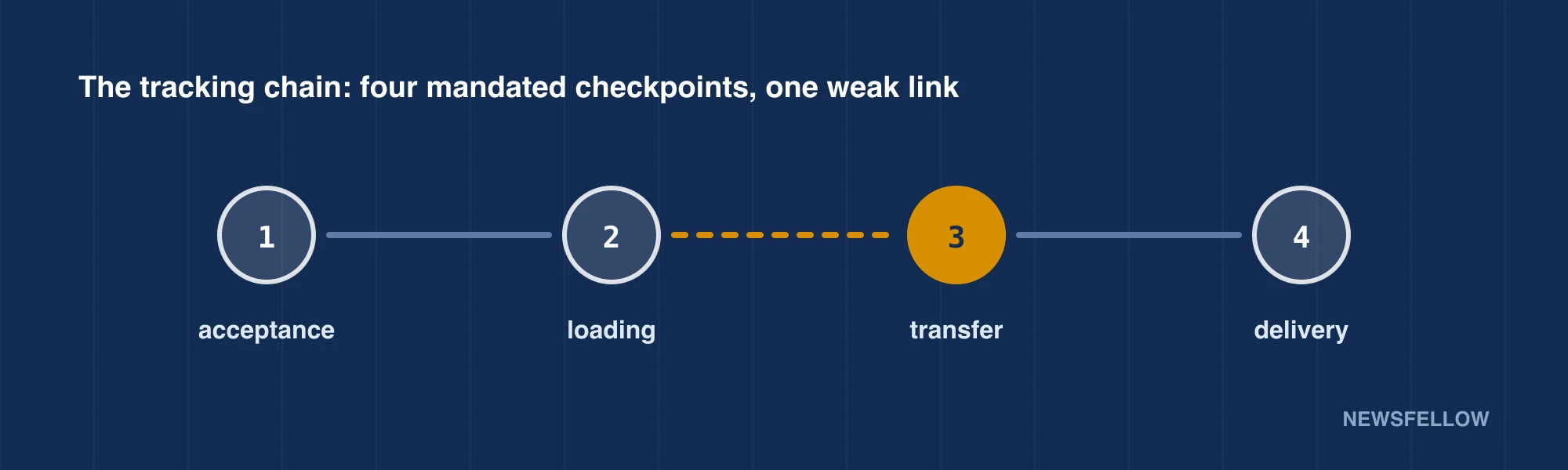
This is the gap that IATA Resolution 753 was written to close. The resolution requires member airlines to track bags at four points — acceptance, loading, transfer and delivery — and to exchange that data with the carriers they interline with. It has been on the books since 2018. Industry-wide compliance passed 50% only in 2025, and full compliance is now targeted for 2027.
Half the industry, in other words, still cannot reliably tell another airline where a bag was last seen. That is the substrate on which the 39% sits.
A $6.3 billion rounding error that isn't
The financial framing SITA uses is unusually blunt for a trade report. Mishandling still costs the industry an estimated $6.3 billion a year — around 15% of global airline profits — at an average of about $260 per mishandled bag.
Set against a net profit of roughly $8 per passenger, one mishandled bag wipes out the margin on more than thirty seats sold. Five wipe out an entire flight.
Roughly 70% of that cost sits with delayed bags rather than genuinely lost ones, and it is overwhelmingly operational: courier delivery, rerouting, staff time at the arrivals desk, the interline reconciliation paperwork. Lost and damaged bags cost less in aggregate but the money goes out as compensation, which is why they dominate the passenger-facing conversation and the regulatory one.
This is the arithmetic that explains why baggage suddenly attracts capital expenditure after years of being treated as a fixed cost of doing business. SITA found 75% of airlines plan to invest in AI-driven baggage operations within two years, and about half intend to push real-time baggage status to passengers directly.
From reporting to prevention
The next phase is the harder one, and the industry is candid that it has not arrived yet.
Everything described so far improves the response to a mishandled bag: finding it faster, returning it sooner, closing the file. It does not stop the bag being mishandled. The stated ambition is predictive intervention — using the same real-time position data to flag, before the connecting aircraft doors close, that a specific bag will not make a specific transfer, and to reflight it automatically rather than discovering the problem at the destination carousel.
There are early proof points. Thai Airways deployed an automated reflight tool across nine airports that cut the rebooking task for a misconnected bag from about three minutes of agent time to roughly one second. At scale, that is the difference between reflighting the handful of bags someone has time to touch and reflighting all of them.
"Baggage is shifting from a logistical problem to a digital service," SITA's baggage portfolio director Nicole Hogg said of the findings — a line that reads as marketing until you notice it is describing a shift in who is expected to hold the information.
The uneven map
None of this progress is distributed evenly, and passengers experience the average only as luck.
Regional divergence remains stark. On the previous year's data, Europe was running at 12.3 mishandled bags per thousand passengers — more than double the global figure — a function of dense short-haul connecting networks, congested hub infrastructure and heavy interlining. North America, with more point-to-point flying and simpler hub geometry, ran close to a third of that.
Nor is the trend monotonic in every market. The US Department of Transportation's February 2026 Air Travel Consumer Report recorded mishandled-baggage reports moving in the wrong direction against the prior period, alongside rising delays — a reminder that global averages smooth over months in which a single weather event or a handler labour dispute undoes a quarter's gains at one hub.
There is also an equity question hiding inside the good news. The 90% improvement in unrecoverable bags is unlocked by owning a tracker and an iPhone. The passenger who checks a bag without one is still filing the same form into the same partially-tracked system that half the industry has yet to fully instrument. The industry has, in effect, been handed a large free upgrade by its wealthier customers, and the 2027 Resolution 753 deadline is what determines whether everyone else gets the same service.
Airlines spent years telling passengers their bag was somewhere in the system. The passengers went out and bought the ability to prove otherwise. What happens next depends on whether carriers finish building the infrastructure that makes the tracker unnecessary.
Sources
- SITA — "Tech drove down mishandled bag rates by 23% in 2025, but mishandling still costs the industry $6.3 billion a year": https://www.sita.aero/about-us/pressroom/news-releases/tech-drove-down-mishandled-bag-rates-by-23-in-2025-but-mishandling-still-costs-the-industry-$6.3-billion-a-year
- Passenger Terminal Today — "Mishandled bag rates fell by 23% in 2025, yet still cost industry US$6.3bn": https://www.passengerterminaltoday.com/news/baggage/mishandled-bag-rates-fell-by-23-in-2025-yet-still-cost-industry-us6-3bn.html
- CAPA — Centre for Aviation — "Baggage mishandling is falling sharply, but airlines still face a USD6.3 billion problem": https://centreforaviation.com/analysis/reports/baggage-mishandling-is-falling-sharply-but-airlines-still-face-a-usd63-billion-problem-751906
- Runway Girl Network — "Mishandled bag rates dropped 23% in 2025, SITA finds": https://runwaygirlnetwork.com/2026/06/mishandled-bag-rates-dropped-23-in-2025-sita-finds/
- Simple Flying — "Apple AirTags Helped Airlines Cut Permanently Lost Bags By 90% In Just One Year": https://simpleflying.com/apple-airtags-airlines-lost-bags-90-percent-sita/
- Euronews Travel — "Tracking your luggage? You can now send the location to airlines if your bag gets lost": https://www.euronews.com/travel/2026/03/13/tracking-your-luggage-you-can-now-send-the-location-to-airlines-if-your-bag-gets-lost
- Air India Newsroom — "Air India integrates baggage tracking with Apple AirTag": https://www.airindia.com/in/en/newsroom/press-release/Air-India-integrates-baggage-tracking-via-Apple-Airtag.html
- Passenger Terminal Today — "Baggage mishandling rate improves by 26% in Europe's airports": https://www.passengerterminaltoday.com/news/baggage/baggage-mishandling-rate-improves-by-26-in-europes-airports.html
- US Department of Transportation — Air Travel Consumer Reports 2026: https://www.transportation.gov/resources/individuals/aviation-consumer-protection/air-travel-consumer-reports-2026