Laptop Fire Forces American Airlines Jet Into Emergency Landing at DFW — the 58th Battery Incident of 2026

An American Airlines flight bound for Dallas Fort Worth International Airport made an emergency landing on Friday evening after a passenger's laptop battery caught fire in the cabin, injuring at least one traveler and adding another entry to what has become the worst year on record for lithium-battery incidents aboard US passenger aircraft.
Flight 2398, an Airbus A321 carrying 133 people, had departed Hartsfield-Jackson Atlanta International Airport and was on approach to DFW when the crew reported a laptop battery fire on board. Flight attendants moved quickly to contain the device in a thermal containment bag — a fire-resistant pouch designed specifically for runaway lithium-ion batteries — while the aircraft continued toward Dallas. It touched down safely at around 6:55 p.m. local time and taxied to the gate under its own power, without need for emergency vehicles to meet it on an active runway.
At least one passenger suffered burns in the incident. According to reporting on the event, the injuries did not require hospitalization, though the traveler was treated for burns after the aircraft reached the gate. American Airlines has not released the passenger's identity, and the airline said it is cooperating with federal authorities reviewing the incident. ZeroPress could not independently verify additional details of the passenger's condition beyond what has been reported by multiple outlets, and any further medical information should be treated as preliminary pending confirmation from the airline or investigators.
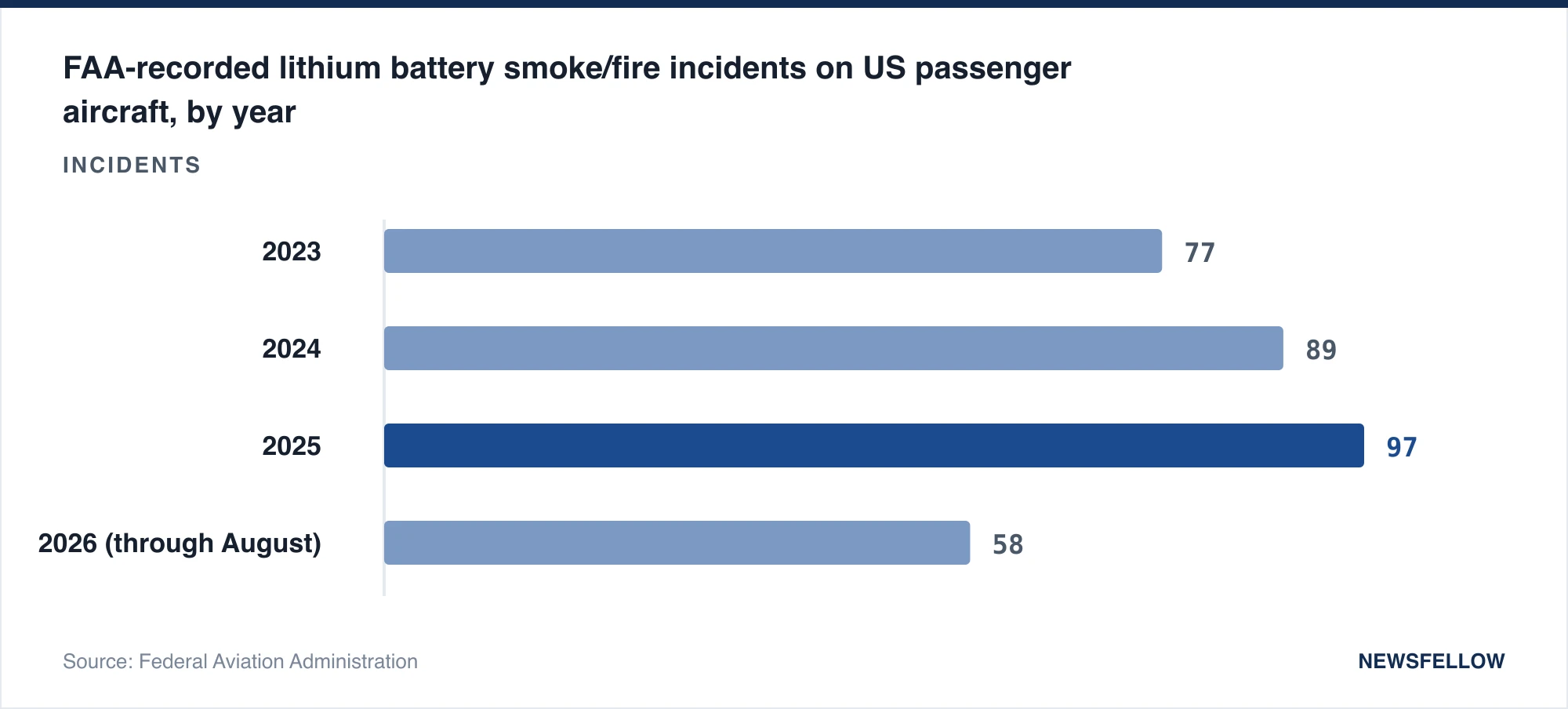
The Federal Aviation Administration confirmed it is investigating. In its accounting of the incident, the FAA situated it within a broader and growing pattern: the agency has recorded 58 verified lithium-ion battery incidents involving smoke, fire, or extreme heat aboard US passenger aircraft so far in 2026 — a pace that, if it continues, would exceed last year's total.
A Pattern the FAA Has Been Tracking for Years
Lithium-ion batteries power nearly every portable electronic device passengers now carry onto aircraft — laptops, phones, tablets, e-cigarettes, and portable chargers. Under normal conditions, these batteries are safe. But damage, manufacturing defects, or exposure to heat can trigger what battery engineers call thermal runaway: an internal short circuit that causes the cell's temperature to spike uncontrollably, often self-reinforcing until the battery vents gas, smokes, or ignites.
The FAA's own hazardous materials office has published lithium battery incident data for more than a decade, and the trend line has moved in one direction. According to figures reported this year, the agency recorded 97 such incidents in 2025, up from 89 in 2024 and 77 in 2023. The 58 incidents already logged through August 2026 suggest this year could surpass 2025's total before December.
Laptops have historically been the single largest category of device involved. Over roughly two decades of FAA record-keeping, laptop batteries account for more verified incidents than any other device type — ahead of standalone battery packs, e-cigarettes, and mobile phones combined in some tallies. Portable power banks have separately drawn scrutiny in 2026: the FAA database shows at least 10 verified portable-charger incidents on passenger flights this year, spread across Delta, United, American, Allegiant, Horizon, and Lufthansa.
Why Airlines Train Crews to React Immediately
Because a smoking or overheating lithium battery can escalate within seconds, airline safety protocols treat any such report as an emergency regardless of how contained the device initially appears. Flight attendants are trained to isolate the device — ideally by placing it in a fire-containment bag or dousing it with water or a non-alcohol-based liquid — and to keep it away from anything flammable for the remainder of the flight. Thermal containment bags, now standard equipment on many US carriers including American, are designed to smother flames and contain both heat and any toxic gases the battery releases as it burns out.
Flight crews are also trained to alert the flight deck immediately so pilots can assess whether a diversion or expedited landing is warranted, even if the fire appears to be extinguished. In Friday's case, the aircraft was already on approach to DFW, which allowed the crew to proceed directly to landing rather than diverting to an alternate airport.
Not an Isolated Case for American
Friday's fire was not American Airlines' first lithium-battery scare of the year. Industry and insurance trade coverage has noted that this marks at least the second widely reported laptop-battery fire involving an American Airlines aircraft in 2026, a repetition that insurance analysts say is beginning to influence how aviation underwriters price cabin-fire risk. Insurance Business magazine reported that the recurrence at a single carrier is "part of a pattern aviation insurers are repricing," reflecting growing industance-industry attention to lithium battery exposure as a cost-of-doing-business issue rather than a one-off anomaly.
That said, it would be inaccurate to characterize the trend as unique to American. FAA data cited above shows incidents distributed across Delta, United, Allegiant, Horizon, and Lufthansa as well, consistent with the reality that the risk originates in the passenger's device, not a specific airline's operations or fleet.
What Regulators and Airlines Are Considering
The rising incident count has already prompted operational changes at several carriers. Reporting earlier this year noted that a growing number of airlines have moved to restrict the use of portable power banks in the cabin — for instance, by requiring them to remain visible and accessible rather than stowed in overhead bins, where a fire would be harder to detect and reach. Some Asian carriers have gone further, banning charging of power banks via seatback USB ports altogether following high-profile incidents.
In the United States, the FAA has not announced a blanket rule change in direct response to the AA2398 incident, and any regulatory action would likely follow the completion of its investigation. Passengers are currently required under existing hazmat rules to carry spare lithium batteries — including power banks — in carry-on baggage only, never in checked luggage, precisely because a fire in the cabin can be detected and fought by crew, while one in the cargo hold may not be.
The Bottom Line for Travelers
Friday's incident ended without serious injury, a fire that stayed contained, and a normal landing — the outcome airline safety training is built to produce. But the frequency of these events, now averaging roughly one verified case every four to five days across the US industry in 2026, means the scenario is no longer a rare anomaly for cabin crews. Passengers can reduce personal risk by keeping an eye on unusually warm devices, avoiding cheap or damaged batteries and chargers, and following crew instructions immediately if a device begins smoking or overheating in flight.
The FAA's investigation into the specific cause of the AA2398 laptop's failure — whether manufacturing defect, physical damage, or another factor — is ongoing, and ZeroPress will update this story if the agency releases findings.
Sources
- American Airlines flight lands safely at DFW after laptop fire injury — Fox News
- Laptop Fire on American Flight 2398 Burns Passenger at DFW — Aero Crew News
- American Airlines flight lands safely after laptop battery catches fire on board; passenger injured — Yahoo News
- Second American Airlines laptop fire this year is part of a pattern aviation insurers are repricing — Insurance Business Magazine
- Laptop Fire on American Airlines Burns Passengers in Cabin: FAA Probes Cause — Travelers Today
- More Airlines Restrict Portable Chargers—After Jump In Lithium-Battery Fires On Planes — Forbes