Asiana Airlines Votes Itself Out of Existence: Korean Air Merger Set for December 17

Six years after Seoul first floated the idea as an emergency rescue plan, the merger of Korean Air and Asiana Airlines has cleared its last major hurdle. On August 12, 2026, Asiana shareholders gathered in Seoul and voted overwhelmingly — 99.3% of shares cast, representing 81.86% of total voting rights — to approve folding the carrier into Korean Air. The combination becomes official on December 17, 2026, when Asiana's brand, logbooks, and 66-year history disappear into a single operating certificate under Korean Air's sky-blue livery.
It is one of the largest airline mergers anywhere in the world this decade, and one of the longest-gestating. The deal traces back to 2020, when Asiana's chronic debt problems and pandemic losses pushed the South Korean government to engineer a state-backed bailout-by-acquisition rather than let the country's second-largest carrier collapse. What began as a rescue has, over six years of antitrust reviews across more than a dozen jurisdictions, turned into a full restructuring of South Korean aviation.
What actually changes on December 17
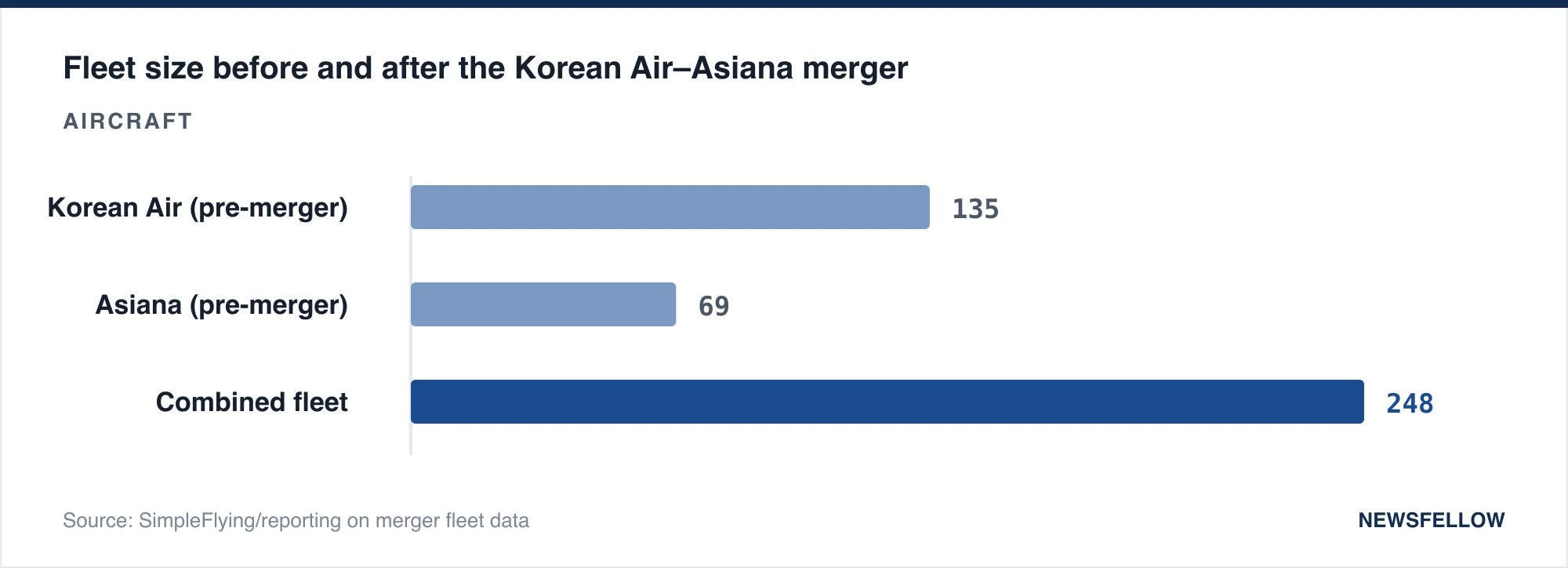
Korean Air currently operates a fleet of roughly 135 aircraft; Asiana flies about 69. Once combined, the merged carrier's fleet climbs to around 248 aircraft — enough, industry trackers say, to place it among the ten largest airlines in the world by fleet size. The new entity will control close to half of South Korea's domestic aviation market, according to reporting on the shareholder vote.
Asiana's name, logo, and separate operating certificate go away entirely. The carrier's distinctive livery and the "Asiana" brand — recognizable across Northeast Asia and on long-haul routes to Europe and North America since 1988 — will be repainted under Korean Air's identity, built around the stylized taegeuk symbol drawn from South Korea's national flag.
Alliance membership flips on the same clock. Asiana currently belongs to Star Alliance, while Korean Air is a SkyTeam member. Asiana is scheduled to exit Star Alliance on December 16, 2026 — one day before the merger closes — ending nearly two decades of Star Alliance's presence built around Asiana's Seoul Incheon hub. Frequent flyers holding Asiana Airlines Club miles face a messier transition: reporting on the deal notes that how Asiana's loyalty program folds into Korean Air's SKYPASS program remains unresolved in public statements, a detail that matters directly to travelers sitting on accumulated miles.
The price of approval: giving away routes
Regulators in South Korea, the United States, the European Union, Japan, and elsewhere spent years scrutinizing the deal before signing off, worried that combining the country's two flag carriers would hand the merged airline monopoly or near-monopoly power on dozens of international and domestic city pairs — particularly Seoul routes where Korean Air and Asiana were previously each other's only local competitor.
The remedy Korean Air agreed to: give up slots and traffic rights on 34 international and domestic routes as a condition of approval. The most closely watched of those concessions is Seoul Incheon–London Heathrow, a route Korean Air agreed to cede to Virgin Atlantic — handing a British carrier a foothold on one of the most valuable long-haul city pairs out of Northeast Asia. Other divested routes and slots have gone to smaller Korean carriers T'way Air and Air Premia, effectively seeding two budget and hybrid competitors with capacity they could not have won organically.
The restructuring goes beyond passenger routes. Korean Air is also divesting Asiana's cargo unit to Air Incheon, reshaping air-cargo logistics out of one of Asia's busiest freight hubs at a moment when global air cargo volumes have been climbing on the back of e-commerce and time-sensitive electronics shipments. And the consolidation cascades down through Korean Air's budget-carrier stable: starting in 2027, Air Busan and Air Seoul — both currently low-cost units loosely affiliated with Asiana — are to be folded into Jin Air, Korean Air's own budget subsidiary, eventually leaving South Korea with a simpler, more concentrated airline map than it has had in decades.
Why this took six years
Mergers of a country's two dominant flag carriers are rare precisely because they invite this level of regulatory friction. Unlike a U.S. merger between, say, two carriers with overlapping but not identical networks, Korean Air and Asiana were direct head-to-head competitors on many of Korea's most valuable international routes — Seoul to major hubs in North America, Europe, and Southeast Asia. Antitrust authorities in multiple jurisdictions had leverage because the merged carrier needed clearance in every market it planned to keep flying to.
The deal's long timeline also reflects the scale of the underlying problem it was meant to solve. Asiana's balance sheet had been strained since well before the pandemic, worsened by aggressive fleet expansion in the 2010s and a series of ownership disputes involving its parent conglomerate, Kumho Asiana Group. The state-backed Korea Development Bank effectively underwrote the rescue, working alongside Korean Air's parent Hanjin Group to structure a deal that both resolved Asiana's debt and satisfied competition regulators — a balancing act that took years of route-by-route negotiation to complete.
What it means for travelers and the region
For passengers, the near-term disruption is likely to be administrative rather than operational — a single check-in brand, a single loyalty program eventually, and a rationalized route map that, in theory, reduces the duplicate Seoul departures both carriers used to run in parallel. Long-haul flyers to London will see the most visible shift, moving from Asiana or Korean Air metal onto Virgin Atlantic for nonstop Heathrow service, a change that alters both the onboard product and the frequent-flyer earning calculus for anyone tied to SkyTeam or Star Alliance.
Regionally, the merger cements Korean Air as the unambiguous flag carrier of South Korea at a moment when Asian aviation is already consolidating fast — Japan Airlines and ANA long ago settled into a stable domestic duopoly, and China's major carriers operate under tight state coordination. A single, larger Korean carrier with a top-ten global fleet gives Seoul Incheon more leverage to compete as a transit hub against Tokyo, Singapore, and the fast-growing Gulf megahubs, even as it strips away the head-to-head competition on fares that two rival Korean carriers used to provide domestically and on shorter regional routes.
Whether that trade-off — a stronger, more competitive Korean flag carrier internationally in exchange for less choice domestically — proves worthwhile will become clearer only after December 17, when Asiana's aircraft begin repainting into Korean Air's colors and the two carriers' operations, IT systems, and crews start the slow work of becoming one airline.
Sources
- Asiana's Shareholders & Korean Air's Board Have Approved The Merger To Be Completed On December 17, 2026 — LoyaltyLobby
- Korean Air-Asiana Merger Gets Final Shareholder Approval for December Launch — Business Traveller
- Asiana shareholders approve merger with Korean Air — The Korea Herald
- Asiana shareholders approve merger with Korean Air — The Korea Times
- Asiana Airlines Votes Itself Out of Existence in December Merger With Korean Air — Tech Times
- Set To Merge: Comparing & Contrasting The Fleets Of Asiana Airlines And Korean Air — Simple Flying
- Korean Air & Asiana Merger Finalized, Shaking Up Aviation in Asia — One Mile at a Time