JetBlue's New 12,000-Square-Foot Boston Lounge Has a Fenway Green Monster Wall — And a Catch for Economy Flyers

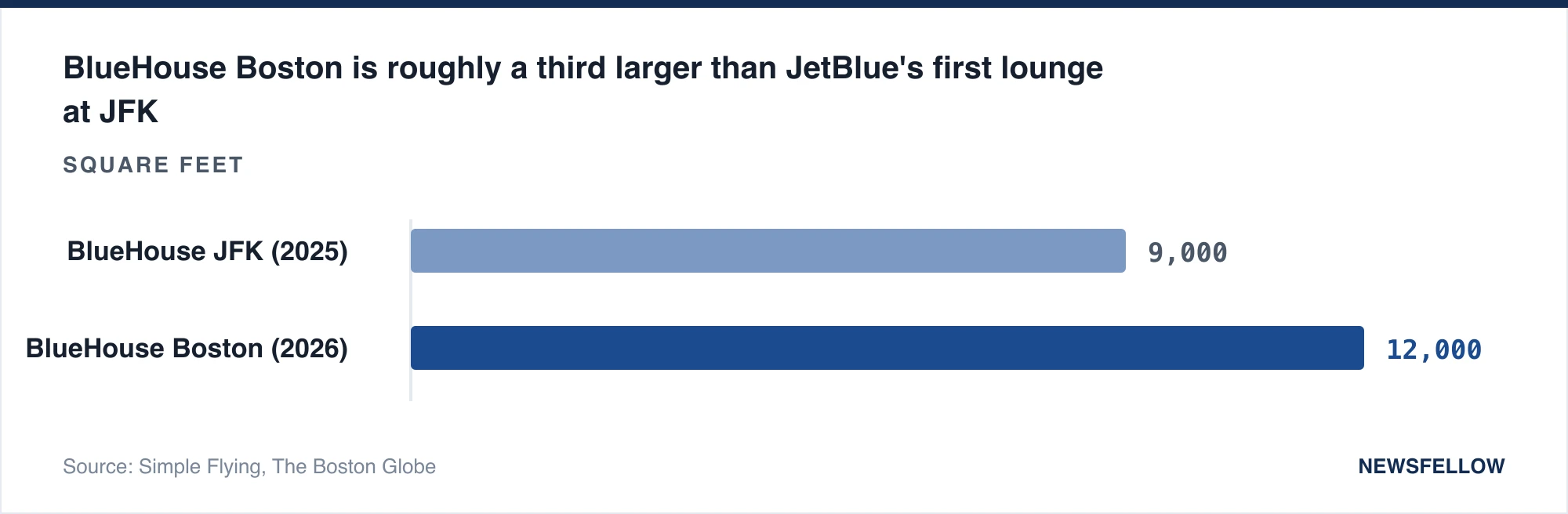
At 5 a.m. on August 27, 2026, JetBlue opens the doors on the largest airport lounge it has ever built: a 12,000-square-foot space across from Gate C25 at Boston Logan's Terminal C, anchored by a floor-to-ceiling replica of Fenway Park's Green Monster and a cocktail menu built by one of Boston's best-known bartenders. It's the airline's second BlueHouse lounge after its debut location opened at New York's JFK last December, and it's noticeably bigger — about a third larger than the roughly 9,000-square-foot JFK space, according to reporting from Simple Flying and The Boston Globe.
The lounge is a genuine bet by JetBlue that Boston travelers want a premium product with local identity rather than an interchangeable marble-and-espresso-machine space that could be anywhere. But the opening also crystallizes a tension playing out across the industry this year: as airlines build bigger, flashier lounges, they're simultaneously tightening who is allowed to use them. BlueHouse Boston is the case study.
Inside the space
BlueHouse Boston is organized into distinct zones rather than one undifferentiated seating floor: a full-service bar, a game area, a library-style quiet room, private workspaces, a dining area and enclosed private rooms, according to descriptions from NerdWallet and The Points Guy. The space is built to hold up to 204 travelers at a time — a meaningful buffer against the overcrowding that has become the most common lounge complaint industry-wide as membership rolls have outpaced square footage at legacy carrier clubs.
The local-identity theme runs through the design rather than sitting on top of it as decoration. The bar pours New England spirits and Publick House beer, and its cocktail menu was curated by longtime Boston bartender Jackson Cannon in partnership with the cocktail bar Equal Measure. Signature drinks lean into JetBlue's own branding — a "Mint to Be" named for the airline's business-class product — alongside Cannon's personally recommended BlueHouse Special, made with Triple Eight blueberry vodka from Nantucket, fresh citrus and guava soda. The Globe's writeup, headlined around the lounge's Green Monster wall, craft cocktails and what it called a "secret candy alcove," captured the space's evident intent: make it feel like Boston, not like an airport.
Who actually gets in
Here's where the story gets more complicated than the ribbon-cutting suggests. Access to BlueHouse is limited to travelers with a same-day confirmed boarding pass on a JetBlue-operated flight, and admission opens no earlier than three hours before departure. Within that group, eligibility breaks down by status tier:
- TrueBlue Mosaic 4 members, JetBlue's top loyalty tier, get in with one guest included
- Mint business-class passengers get access — but only on standard or flex fares, not the cheapest Mint fare bucket
- JetBlue Premier Card holders get in with one guest included
- Additional guests beyond the included one cost $39 each
Notably, the Boston opening comes with an explicit access expansion: BlueHouse eligibility is being widened to include domestic Mint passengers, a change from the international-only Mint access rules that applied at the JFK lounge, according to reporting from One Mile at a Time. That's a real broadening of the product — but it's still a tier-gated one. A JetBlue passenger flying economy on a domestic route, even a Mosaic-adjacent frequent flyer without top-tier status, has no path into a 12,000-square-foot lounge built partly to be a showcase for the wider flying public to see and want.
That gap between "biggest lounge JetBlue has built" and "narrowest group allowed to use it" is not unique to JetBlue. It's the defining lounge-access story of 2026 across the industry: airlines are simultaneously expanding physical lounge footprints and tightening eligibility rules, because the alternative — flat access as membership rolls grow — produces the overcrowded lounges that have generated years of complaints at Admirals Club, Delta Sky Club and United Club locations. JetBlue's Mosaic-and-Mint gating on a brand-new flagship space is a bet that a smaller, well-served group beats a larger, frustrated one.
Why JetBlue is building lounges at all
JetBlue has historically positioned itself as the no-status, all-economy-feels-good airline, so a lounge push aimed at loyalty and premium-fare travelers is a notable strategic pivot. The airline's Mint business-class product has expanded across more transcontinental and international routes in recent years, and BlueHouse is the physical infrastructure meant to make that premium fare bucket feel like a complete experience rather than just a wider seat. Boston is JetBlue's largest focus city, and Logan competitors — Delta's Sky Club expansion and various third-party lounge networks — have raised the bar on what a premium ground experience is expected to look like at a major connecting hub.
Whether BlueHouse Boston moves the needle on Mint bookings or Mosaic status-chasing is something JetBlue will only be able to measure after a full season of operation. But the opening itself, with its Fenway callback and hyper-local bar menu, is a clear statement that JetBlue wants its lounges to be a reason to choose the airline, not just an amenity buried behind status tiers that most of its customer base will never reach.
What to expect if you're flying through Logan
Travelers connecting through Boston on JetBlue after August 27 who don't hold Mosaic 4 status, a qualifying Mint fare, or the JetBlue Premier Card will not be able to walk in regardless of how much time they have before their flight — there is no day-pass or paid walk-up option described in the airline's access rules as reported. For everyone else, the practical guidance from early coverage is straightforward: arrive within the three-hour access window, expect the space to fill during Terminal C's peak banks, and budget the $39 guest fee if bringing a companion who doesn't separately qualify.
Sources
- Simple Flying: 11,000 Square Feet — JetBlue's New BlueHouse Lounge At Boston Logan Nears Opening
- The Boston Globe: JetBlue's new lounge at Logan has a Green Monster, craft cocktails, and a secret candy alcove
- The Points Guy: JetBlue opens new Boston BlueHouse lounge
- NerdWallet: Inside JetBlue's New BlueHouse Lounge in Boston
- One Mile at a Time: JetBlue BlueHouse Lounge Boston Opens, With Expanded Mint Access Rules
- Boston.com: Peek inside JetBlue's brand-new lounge at Boston Logan Airport