Istanbul Just Beat Heathrow by 300,000 Passengers — and Ended London's Three-Year Reign as Europe's Busiest Airport

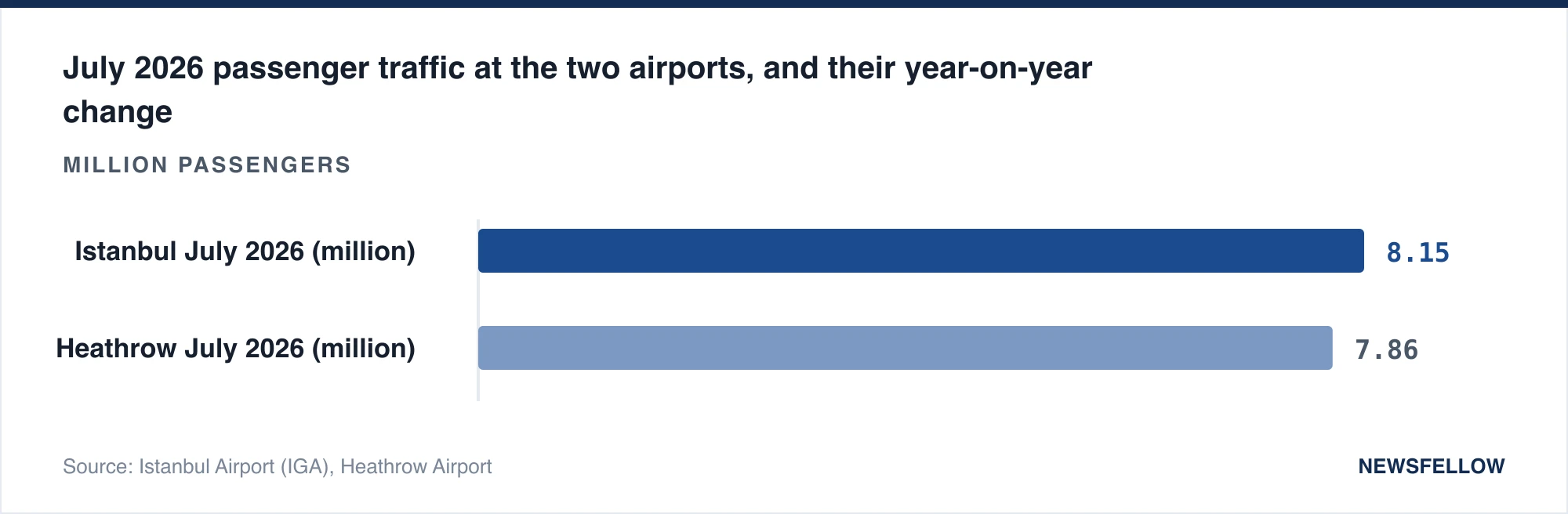
For the first time since 2023, Heathrow is no longer Europe's busiest airport. Istanbul Airport carried 8.15 million passengers in July 2026, compared with 7,859,408 at Heathrow over the same month — a gap of roughly 290,000 travelers that flipped the two airports' rankings and, according to multiple outlets covering the figures in mid-August, reopened one of London aviation's oldest arguments: whether Heathrow can expand fast enough to keep up.
The numbers, published by the two airports and reported by Euronews, RTÉ and IndexBox among others, mark a symbolic turning point. Heathrow took the European traffic crown from Paris Charles de Gaulle in 2023 as travel demand rebounded from the pandemic, and has held it every year since. Istanbul's rise to the top spot is less a story of one airport's runaway growth and more a story of two very different trajectories meeting in the middle.
The numbers, and what's really driving them
Istanbul's July total represented a 2.3% increase over the same month in 2025 — solid, but not explosive growth. Heathrow's total, by contrast, was down 1.5% year-on-year. The swing that mattered wasn't Istanbul accelerating; it was Heathrow losing ground, and losing it in a specific, identifiable place: the Middle East.
Reporting on the figures noted that Heathrow's Middle East routes were down 20.2% year-on-year, a collapse tied to the broader Iran-related regional conflict that has disrupted airspace and travel demand across the region through much of 2026. Heathrow's route network leans heavily on long-haul connections to and through the Gulf and Middle East, which made it more exposed to that disruption than a hub like Istanbul, whose own geography and route map sit closer to — but not squarely inside — the affected airspace.
Istanbul's structural advantages
Istanbul Airport's rise to contention for the title has been building for years, not months. Opened in 2018 to replace the old Atatürk Airport, the facility was designed from the outset with room to grow well beyond Heathrow's physical ceiling — a sprawling site north of the city intended to eventually support up to six runways and a theoretical capacity well north of 90 million annual passengers once fully built out, dwarfing what Heathrow's two-runway, land-constrained site at the edge of west London can ever accommodate.
Turkish Airlines' hub-and-spoke strategy has also played a direct role, using Istanbul's geographic position between Europe, Asia, Africa and the Middle East to route connecting traffic through the airport in a way that has steadily built its long-haul network over the past several years — a strategy separate from, though related to, Istanbul's rise as a leading air cargo hub over the same period. The passenger-traffic overtaking of Heathrow is the clearest marker yet that the strategy is paying off at scale.
Heathrow's response: "the case for expansion has never been clearer"
Heathrow's own statement on the figures, as quoted in coverage of the milestone, framed the loss of the title less as a defeat than as evidence for its long-running argument that it needs to grow. A spokesperson said the "case for expansion has never been clearer" — a reference to Heathrow's push, revived under the current UK government, for a third runway that has been debated, delayed and litigated for the better part of two decades.
Heathrow's argument is straightforward: with only two runways operating at close to maximum capacity for years, the airport has limited room to add flights even when demand exists, and route disruptions like the Middle East falloff hit harder because there's no slack capacity elsewhere in the network to absorb the loss. Istanbul, still filling out its planned runway and terminal capacity, has room that Heathrow structurally lacks.
A one-month snapshot, not a permanent shift — yet
It's worth being precise about what the July figures do and don't show. A single month's passenger count is a real data point, not a annual verdict — Heathrow has led Europe's traffic rankings on a full-year basis every year since 2023, and one month of Middle East-driven softness doesn't automatically translate into Istanbul holding the title for all of 2026. Several outlets covering the story, including Timeout and Travel Tomorrow, were careful to frame it as Istanbul "overtaking" Heathrow in the month's data rather than declaring a definitive new annual leader, and full-year totals won't be clear until early 2027.
Still, the trend lines matter more than any single month. Heathrow's Middle East exposure is a structural feature of its route network, not a one-off event, and the regional tensions weighing on it show no sign of resolving quickly. Istanbul's runway and terminal capacity, meanwhile, continues to expand — the airport is separately nearing completion of a fourth main runway, with temporary acceptance targeted for August 2026 and full entry into service expected in the fourth quarter, according to Aviation Week's airport-updates coverage. If that runway comes online as planned, Istanbul's capacity advantage over Heathrow only widens further, at exactly the moment Heathrow's own third-runway plans remain years from breaking ground even under the most optimistic timeline.
Why this matters beyond bragging rights
Airport traffic rankings can look like vanity statistics, but they carry real commercial weight. Busiest-airport status feeds directly into airline route-planning decisions, retail and duty-free revenue negotiations, and — critically for Heathrow — the political argument for infrastructure investment. A London hub that can point to being Europe's undisputed number one has a stronger hand in convincing government and investors to fund a third runway than one that has visibly ceded the title, even temporarily, to a rival with room to keep growing.
For Istanbul and Turkish Airlines, the milestone is a marketing and route-negotiation asset in its own right: a concrete, quotable statistic to bring into slot negotiations and codeshare talks with global carriers weighing where to route long-haul connecting traffic through 2027 and beyond.
The next real test comes with full-year 2026 figures. If Middle East route disruption eases and Heathrow's autumn and winter traffic recovers while Istanbul's growth continues at its more modest pace, Heathrow could reclaim the annual crown even after losing a single month's count. If the disruption persists — or if Istanbul's fourth runway comes online and unlocks another leg of capacity growth — July's numbers may look less like a blip and more like the start of a new normal in European aviation's pecking order.
Sources
- Istanbul overtakes Heathrow as Europe's busiest airport after London hub sees passenger numbers fall — Euronews
- Istanbul overtakes Heathrow as Europe's busiest airport — RTÉ
- Istanbul overtakes Heathrow as Europe's largest airport with 8.15m passengers in July — Travel Extra
- Heathrow Overtaken by Istanbul as Europe's Busiest Airport in July 2026 — IndexBox
- Heathrow Just Lost Its Title As Europe's Busiest Airport — Your Mileage May Vary
- Istanbul overtakes Heathrow as Europe's busiest airport, strengthening case for third runway — Travel Tomorrow
- Airport Updates: Latest News On The Global Market (W/C Aug. 24, 2026) — Aviation Week