No Longer Exceptional: Europe Rewrites the Rulebook on GPS Spoofing

There is a particular kind of regulatory document that matters far more than its tone suggests. On 3 July 2026, the European Union Aviation Safety Agency published Revision 4 of Safety Information Bulletin 2022-02, on global navigation satellite system outages and alterations leading to navigation and surveillance degradation. It is not an airworthiness directive. It compels nobody to ground an aircraft. But read alongside what preceded it, it records a change in how European aviation understands a threat it spent four years describing as exceptional.
The original bulletin was issued on 17 March 2022, weeks after the invasion of Ukraine, when GNSS interference was mostly understood as spillover from a conflict zone — something crews might encounter at the edges of a defined region and would recognise as such. Revision 3 followed in July 2024. The 2026 update arrives after a joint EASA–EUROCONTROL task force spent months analysing actual jamming and spoofing occurrences, and its content reflects a different premise: that interference is now a condition of the airspace rather than an event within it.
From nuisance to environment
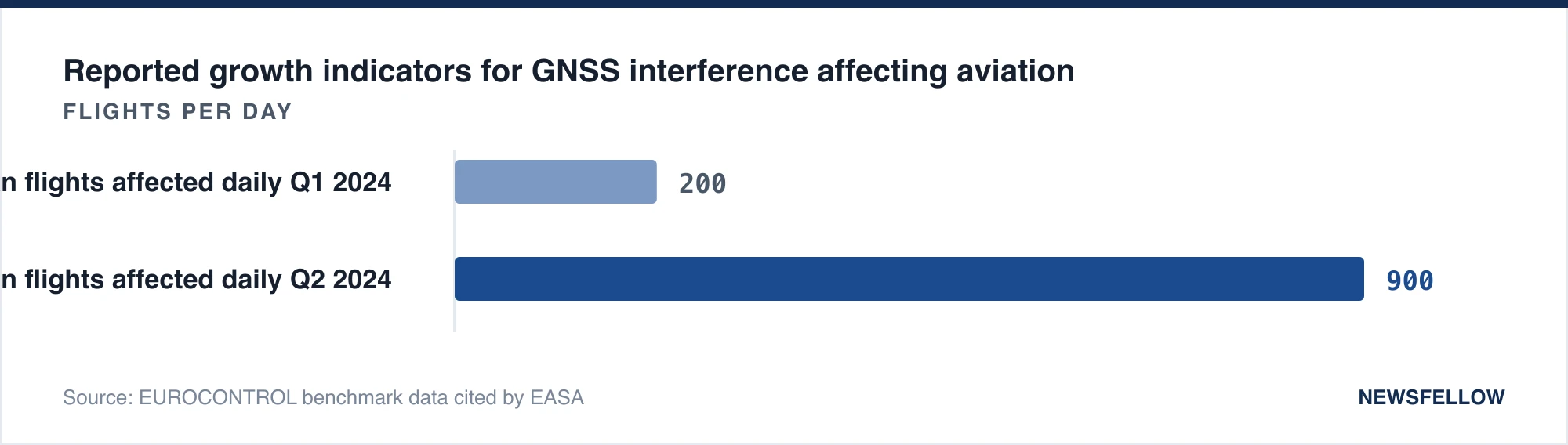
The scale is what forced the reclassification. EUROCONTROL has estimated that as much as 38 per cent of European en-route traffic operates through regions intermittently but regularly affected by radio-frequency interference. That is not a fringe. One frequently cited benchmark tracked European flights encountering GNSS interference rising from roughly 200 a day in the first quarter of 2024 to around 900 a day in the second. IATA has reported that GPS signal-loss events rose 220 per cent between 2021 and 2024.
The geography has widened too. EASA's affected-regions list now spans the Baltic, the Black Sea, the eastern Mediterranean, the Middle East and the Arctic. By March 2026 more than 700 flights in Gulf air corridors had experienced suspected spoofing events. Interference is at its most severe near conflict zones, but the physics do not respect borders — a sufficiently powerful transmitter degrades reception well beyond the area anyone intended to affect.
The political pressure tracked the data. In June 2025, thirteen EU member states wrote jointly to the European Commission calling for immediate and coordinated action on radio-frequency interference affecting GNSS-based systems. That letter produced the EASA–EUROCONTROL Action Plan published on 26 March 2026, structured around joint monitoring and a common operational picture of interference events, updated operational guidance for crews and controllers, pooled investigation expertise, better information exchange through member states, and work with manufacturers on more resilient avionics. Revision 4 of the bulletin is the first substantial operational output of that machinery.
What actually changed
Four areas of the revised bulletin are worth reading closely, because each targets a different failure mode observed in real occurrences.
Pilot–ATC phraseology. This sounds trivial and is not. When a crew loses or doubts its satellite position, the exchange with the controller has historically been improvised — descriptions of symptoms rather than a declaration of state. That costs time, invites misunderstanding across language backgrounds, and makes the event nearly impossible to count consistently afterwards. Standardised phraseology gives controllers an immediate, unambiguous signal of what the aircraft can and cannot do, and gives the safety-data system a countable event. Much of the historical uncertainty about how often spoofing happens is really uncertainty about how it was described.
Training and operational recommendations. The instinct a crew needs is not to distrust GNSS in general but to detect the specific signature of a position that is wrong while presenting itself as valid. Jamming, which denies the signal, is comparatively benign: the equipment knows it has lost the fix and says so. Spoofing is the harder problem, because a counterfeit signal produces a confident, plausible, incorrect answer. That can propagate into inertial systems, contaminate terrain and traffic warnings, and in documented cases has generated spurious ground-proximity alerts at cruise altitude. Recovery means cross-checking against inertial reference, conventional radio aids such as VOR/DME, and controller-provided radar position — and knowing which systems must be manually excluded from a corrupted fix before they can be trusted again.
Electronic flight bag use. EFBs draw position from the aircraft or from their own receivers, and a spoofed input can quietly corrupt a moving map that the crew is treating as an independent sanity check. Guidance here is about ensuring the cross-check is genuinely independent rather than a second display of the same bad number.
ATC capacity management. This is the least discussed and arguably the most consequential item. When multiple aircraft in a sector lose reliable GNSS position, the controller's workload rises sharply — more radio calls, more manual vectoring, wider separation to absorb positional uncertainty. Sector capacity falls. Interference in one corner of European airspace therefore becomes a flow-management problem for the whole network, expressed to passengers as delays with no visible cause. Building that into capacity planning treats interference as a routine variable, like weather, rather than an emergency.
"Stakeholders are encouraged to implement the recommended measures as soon as possible so as to mitigate the impact of GNSS jamming and spoofing on aviation safety," the agency said in announcing the revision.
The uncomfortable part
Two things must be held together honestly.
The first is that aircraft can fly safely without GNSS. Commercial aviation navigated for decades on inertial platforms and ground-based radio aids, and those systems remain installed, certified and taught. No modern airliner is helpless without satellites.
The second is that the entire trajectory of air navigation policy for twenty-five years has been to make GNSS the primary source and to treat the alternatives as legacy. Performance-based navigation, required navigation performance approaches, ADS-B surveillance, and the progressive decommissioning of ground navigation aids in several states all rest on the assumption of a trustworthy satellite signal. The redundancy still exists, but it is thinner than it was, less practised, and in places physically removed. Some states that had planned to retire VOR networks are reconsidering the pace.
Nor is the underlying cause something aviation regulators can fix. Jamming and spoofing near conflict zones are instruments of state electronic warfare, deployed for military reasons that have nothing to do with civil aviation and will not be withdrawn because a safety agency asks. Aviation is a bystander absorbing the externality. Every measure available to EASA, EUROCONTROL and the airlines is mitigation: detect faster, communicate more clearly, degrade more gracefully, count more accurately.
That is precisely why Revision 4 reads the way it does. It contains no announcement, no deadline and no dramatic finding. It simply folds satellite navigation interference into the ordinary machinery of flight operations — phraseology, training syllabi, EFB procedure, sector capacity — as something to be recognised, managed, reported and reviewed. Treating an abnormality as normal is usually a failure of safety culture. Occasionally, when the abnormality is not going away, it is the only responsible thing to do.
Sources
- EASA — EASA updates Safety Information Bulletin on GNSS interference
- EASA — Safety Information Bulletin 2022-02 (PDF)
- EASA — Global navigation satellite system outages and alterations
- EUROCONTROL — EASA and EUROCONTROL publish joint Action Plan to ensure safe operations during GNSS interference events
- EASA — EASA and IATA outline comprehensive plan to mitigate GNSS interference risks
- Runway Girl Network — EASA updates aircraft GNSS jamming and spoofing guidance
- AeroTime — US, Europe move on GPS spoofing and GNSS jamming threat
- Geoawesome — EASA Updates GNSS Guidance as Jamming and Spoofing Surge
- Inside GNSS — EASA Issues Updated Advisory on GNSS Outages and Navigation Disruptions
- RTÉ Brainstorm — Why planes are getting 'lost' due to GPS spoofing and jamming