Geneva Airport's Real Value Is 3.3 Billion Francs — and Nearly Half of It Lands Outside the Airport Fence

Geneva Airport has put a number on something airport operators usually only gesture at: how much the runway at the edge of Lake Geneva is actually worth to the people who live nowhere near a departure gate. According to a new independent study published on September 3, 2026, the airport generated CHF 3.3 billion (about $4.08 billion) in added value in 2024 and supported nearly 22,000 full-time-equivalent jobs — with more than a third of that impact landing outside the canton entirely, in neighboring France and the rest of Switzerland.
The study, conducted by the Zurich-based consultancy Infras, is the kind of report airports commission periodically to make the case — to regulators, to noise-weary neighbors, to national governments weighing infrastructure spending — that a hub is more than a place planes take off. What makes the Geneva numbers notable is less the headline total than the geography behind it: Geneva Airport (GVA) sits a few kilometers from the French border, in a metropolitan area that straddles two countries, and Infras set out specifically to measure how the airport's economic gravity crosses that line.
What the study found
Infras measured direct, indirect and induced effects — the classic three-tier framework used across the industry, tracing spending from the airport itself outward through its suppliers and then through the wages that flow into the broader economy. The direct effects alone were substantial: CHF 1.66 billion in added value and 11,500 full-time-equivalent jobs generated by activity actually taking place at or immediately around the airport — ground handlers, security staff, retail concessions, maintenance crews, the airport operator itself.
Layer in the indirect and induced effects — the suppliers who service those operations, and the household spending of everyone employed either directly or indirectly — and the total climbs to CHF 3.3 billion and just under 22,000 jobs. That represents 2.6% of the canton of Geneva's GDP, according to the study, a meaningful share for a single piece of infrastructure in a city whose economy is otherwise built on banking, diplomacy and pharmaceuticals.
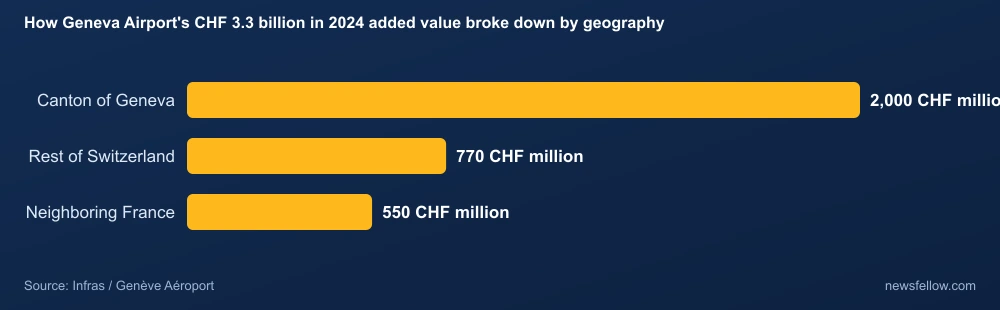
The regional breakdown is where the study earns its distinctiveness. Of the CHF 3.3 billion total, roughly CHF 2 billion stayed within the canton of Geneva itself. But more than CHF 550 million in added value was generated across the border in neighboring France, and about CHF 770 million landed elsewhere in Switzerland, outside Geneva. That cross-border figure matters in a region where a large share of the airport's workforce commutes in daily from French border towns — a dynamic Geneva shares with few other major European hubs, and one that has occasionally made the airport a point of political friction between French and Swiss authorities over commuter taxation and cross-border labor rules.
Airport CEO Jean-François de Saussure framed the findings plainly: "The direct, indirect and induced effects of the hub play a major role in the regional economy."
The freight and general aviation slices
The study also broke out two segments that rarely get separate billing in airport economic-impact reporting: general aviation and air freight. General aviation — the business jets, private charters and smaller aircraft operations that make up a visible but often under-measured share of traffic at GVA — contributed CHF 330 million in added value on its own. Air freight, meanwhile, contributed CHF 350 million, tied to roughly 96,000 tonnes of cargo moving through the airport.
Geneva has long had an outsized general aviation presence relative to its size, driven partly by the concentration of private wealth, international organizations and diplomatic traffic in the city, and Infras giving that segment its own line item suggests the airport wanted a number it can point to the next time general aviation slots or noise rules come up for debate — a topic that recurs in Swiss aviation policy given the country's dense population near several of its airports.
Scale of operations behind the numbers
The economic figures sit on top of an operational base that has kept growing. Geneva Airport handled 17.8 million passengers in 2025, served by 57 airlines flying 147 routes, with 270 separate companies operating out of the airfield in some capacity — from airlines and ground handlers to freight forwarders and retail tenants. That passenger count places Geneva among the mid-sized major hubs of continental Europe, well below giants like Frankfurt or Amsterdam Schiphol but comparable to other national or near-national gateway airports serving a metropolitan region rather than a single country's entire population.
The airport is also using the moment to signal expansion ambitions. Alongside the economic study, Geneva Airport indicated it is considering new direct routes to Singapore and São Paulo — long-haul additions that would extend its reach well beyond the short- and medium-haul European and Middle Eastern network that has traditionally defined its route map. The airport has also increased its China service, growing frequency from five to seven weekly flights, reflecting a broader pattern across European hubs of rebuilding and expanding China connectivity as demand has recovered.
Neither the Singapore nor São Paulo route is confirmed; both remain under consideration, according to the airport's own characterization, and no launch date, operating carrier or aircraft type has been disclosed. Long-haul additions of this kind typically depend on securing a carrier willing to commit the aircraft — usually a widebody twin capable of the distance — and on demonstrating sufficient point-to-point or connecting demand to justify it, so these should be read as aspirations rather than commitments at this stage.
Why airports commission these studies
Economic-impact studies are a well-worn tool in airport public relations and policy advocacy, and Geneva's is far from the first or the largest. Airport operators from Los Angeles to Mumbai have periodically released similar figures, generally timed to coincide with capital spending decisions, environmental reviews, or public debate over expansion — moments when an airport wants a defensible, third-party number to counter arguments that focus solely on noise, emissions or land use.
The methodology itself is standard for the industry: Infras used the direct-indirect-induced framework that is essentially the sector norm, comparable in structure (though not necessarily in precise multipliers) to studies commissioned by groups like Airports Council International, which publishes its own periodic global "Airport Economics Report" assessing the industry's aggregate financial health. What distinguishes one airport's study from another is usually the year of data used, the consultancy's specific multipliers, and — as in Geneva's case — how granular the geographic breakdown is.
It's worth noting the study measures 2024 activity, meaning the figures are already somewhat dated relative to the airport's current 2025 passenger count of 17.8 million; if traffic has grown between the two years, the true present-day economic contribution may be modestly higher than the CHF 3.3 billion figure, though Infras did not publish an updated estimate for 2025 activity specifically.
The cross-border dimension
Geneva's position is unusual among major European airports in how directly its economic footprint crosses an international border. The airport itself sits within Swiss territory but its runway approach and a portion of its infrastructure edge into French land, and a large share of its workforce lives in France and commutes across the border daily — a long-standing feature of the Geneva metropolitan economy that extends well beyond aviation into banking, retail and services generally.
That cross-border labor dynamic has periodically generated friction, including disputes in recent years over French taxation of cross-border workers and over compensation for French border communes affected by airport noise and traffic. By explicitly quantifying more than half a billion francs in added value landing in France, the new Infras study gives Geneva Airport a concrete figure to deploy in exactly those kinds of bilateral discussions — evidence that the airport isn't simply exporting environmental costs across the border while keeping the economic benefits on the Swiss side.
Whether the study changes the terms of any specific ongoing negotiation with French authorities is not yet clear, and the airport's public statements so far have focused on the topline economic message rather than any particular policy ask tied to the cross-border breakdown.
Sources
- Geneva Airport generates over CHF3 billion for regional economy: report — SWI swissinfo.ch
- Geneva Airport generates 3.3 billion in added value and nearly 22000 jobs — Swiss News Now
- Geneva Airport is an engine for the region, worth 3.3 billion — frontaliereticino.ch
- Airport Updates: Latest News On The Global Market (W/C Sept. 7, 2026) — Aviation Week