The FAA Just Ordered Cracks-That-Haven't-Happened-Yet Checks on 471 Boeing 737 MAXs

The Federal Aviation Administration has ordered inspections of hundreds of Boeing 737 MAX aircraft for a structural fatigue problem that, as far as regulators have confirmed, does not yet exist on a single one of them.
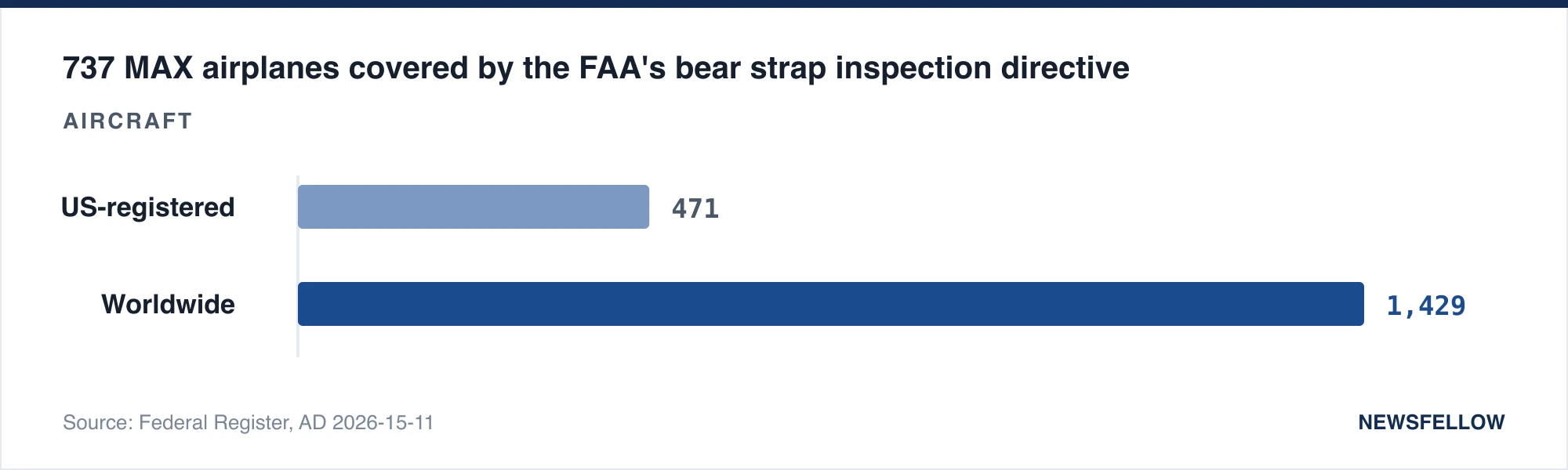
The final rule, airworthiness directive 2026-15-11, was adopted on August 3, 2026, and published in the Federal Register on August 6. It requires operators of certain 737-8, 737-9, and 737-8200 airplanes to inspect a structural fitting called a bear strap near the forward galley door for cracks. The directive covers 471 US-registered airplanes and roughly 1,429 worldwide, according to the FAA's own accounting, and takes effect September 10, 2026.
What makes the order notable is not the number of aircraft — 737 MAX fleets number in the thousands, and directives affecting hundreds of jets are common — but the reasoning behind it. The FAA is not responding to a crack found on a MAX. It is responding to a crack pattern found on the MAX's older sibling, the 737 Next Generation (NG), and extrapolating forward on the basis of shared design and shared manufacturing.
What a Bear Strap Actually Does
A bear strap is a reinforcing structural member that wraps around a cutout in an airplane's fuselage skin — a door, a window belt, an emergency exit — to carry the loads that the opening would otherwise interrupt. Cutting a hole in a stressed fuselage skin concentrates load around its edges; the bear strap redistributes that load back into the surrounding structure so the skin doesn't have to bear it alone.
The bear strap at issue on the 737 MAX sits at the forward upper corner of the forward galley door cutout, on the fuselage's right side just aft of the cockpit. It is, in FAA terminology, a "principal structural element" — a part whose failure could materially affect the airplane's ability to sustain flight loads. The directive states plainly that cracking in the fuselage skin and bear strap at that location "may lead to the inability of the principal structural element to sustain limit loads and adversely affect the structural integrity of the airplane."
That is regulatory language for a serious finding, but it describes a risk, not an event. No in-service failure, and — per the FAA's own directive language — no confirmed crack on a MAX airframe, preceded this order.
Why the NG's History Matters Here
The MAX and the NG are, structurally speaking, close relatives. Both use the same fuselage design lineage and largely the same assembly process at Boeing's Renton, Washington plant, including in the area around the forward galley door. That kinship is precisely why the FAA moved on the MAX now.
Boeing first flagged the underlying condition on the NG fleet in 2019. The company issued Alert Requirements Bulletin 737-53A1407 RB on December 20, 2022, describing the cracking and prescribing inspections. The FAA made those inspections mandatory for NG operators through AD 2024-06-01, effective May 22, 2024 — meaning the NG fleet has already been living under a version of this same order for more than two years.
The agency's logic in extending the requirement to the MAX, first floated in a notice of proposed rulemaking published November 25, 2025, is that a fatigue-driven cracking mechanism tied to a specific design and build process doesn't respect a model-year boundary. If the geometry and the manufacturing method are shared, the agency argues, the airplane can eventually develop the same problem even without a documented case yet — it's a matter of accumulated flight cycles, not a defect unique to one variant. Boeing, for its part, has acknowledged sharing the design and build process across the two families, which is part of what let the FAA build its case for extending the rule without waiting for a MAX-specific crack to surface.
What Operators Now Have to Do
The directive requires operators to inspect the fuselage skin and the bear strap and stub frame at the forward galley door cutout for cracking and for any existing repairs in that area, then to repeat the inspection at set intervals afterward. Reported compliance windows for the broader bear-strap inspection program on 737 variants have ranged from roughly 3,000 to 30,000 flight cycles depending on an aircraft's specific configuration and accumulated usage — a range wide enough that a newly delivered MAX and a heavily cycled one could face very different timelines to first compliance.
Carriers are folding the work into existing maintenance planning rather than treating it as an emergency grounding matter. Southwest Airlines, one of the largest MAX operators, has said it is reviewing the directive's requirements against its fleet. United Airlines has indicated it plans to carry out the inspections during already-scheduled heavy maintenance visits rather than pulling airplanes out of service specifically for this check — a routine approach for a directive of this type, where compliance windows are measured in months or years rather than days.
That measured pace is itself informative. When the FAA has judged an unsafe condition to be imminent, it has moved with far shorter compliance windows, and in extreme cases ordered aircraft grounded outright. A directive with a five-week runway to effectiveness and multi-thousand-cycle compliance windows signals an agency managing a known long-term fatigue risk on its own schedule, not responding to an in-flight event.
The Wider Pattern for 737 Oversight
This directive lands amid an unusually active stretch of FAA structural oversight across the 737 and 787 programs, with multiple fuselage- and wing-related directives issued across 2026 alone. None of that activity implies a common root cause — fatigue cracking, manufacturing tolerance issues, and wing structure inspections are each distinct engineering findings — but taken together they reflect a regulator that has shifted toward proactively extending inspection mandates across shared airframe families rather than waiting for each variant to produce its own incident history.
For passengers, the practical takeaway is unglamorous but reassuring: this is exactly the kind of directive the airworthiness system is designed to produce — a shared design flaw identified on one variant, addressed there, then extended pre-emptively to a related variant before a matching failure has to occur on it first. The bear strap correction on the NG fleet has been underway for more than two years without incident; the MAX fleet is now being brought under the same discipline on the same theory, ahead of any confirmed problem rather than behind one.
Sources
- Federal Register: Airworthiness Directives; The Boeing Company Airplanes (2026-15936)
- AeroCorner: FAA Orders 737 MAX Fuselage-Crack Inspections
- The Flight Brief: FAA Orders 737 MAX Bear Strap Inspections
- Aerotime: New FAA directive requires checks on 471 Boeing 737 MAX jets
- Tech Times: FAA Orders 737 Max Fuselage Checks