The Engine Crisis Is Ending. The Engine Problem Is Just Beginning

Rick Deurloo had a number to sell at Farnborough this year, and it was a good one. Pratt & Whitney's commercial engines president told the show that aircraft-on-ground counts tied to the GTF were "down almost 40%" from last year's peak, and repeated a commitment the company first made in November 2025: A320neo family groundings in single digits by the end of 2026.
Coming from a manufacturer that spent three years as the industry's designated problem, that is a genuine turnaround. At the worst of it, in March 2025, 648 GTF-powered aircraft — roughly 28% of the entire delivered fleet — sat on the ground waiting for shop slots, spare engines or parts. Entire carriers rebuilt their networks around engines they did not have.
The recovery is real and it is measurable. It is also, according to IATA, almost beside the point. Because the maintenance volume that broke the system in 2024 and 2025 is a fraction of what is coming.
What actually got fixed
Two separate things went wrong with the current generation of narrowbody engines, and they are being fixed at different speeds.
The first was a discrete manufacturing defect: contaminated powder metal in GTF high-pressure turbine and compressor discs, which forced a global inspection campaign that pulled hundreds of engines off wing simultaneously. That is a finite population, and it is working through.
The second is durability — engines that simply do not stay on wing as long as their business cases assumed, particularly in hot and sandy operating environments. That one is being engineered out. Pratt's answer is the GTF Advantage, a more durable PW1100G variant whose first shipset went to Airbus in May 2026, with full cutover to Advantage-standard deliveries targeted for early 2028. For the in-service fleet there is "Hot Section Plus," a retrofit that grafts 35 hot-section components from the Advantage onto existing engines. CFM has taken the same route on the LEAP-1B, securing FAA and EASA certification for a high-pressure turbine durability kit that the company expects to roughly double time on wing, with full production cutover from the start of 2027.
Meanwhile the shops caught up. Pratt increased MRO output 26% last year and expects comparable or better growth in 2026. On the CFM side, LEAP shop visit turnaround has come down to about 100 days — more than two weeks faster than a year ago — and the number of LEAP aircraft grounded specifically for engine availability has fallen to nearly none. GE Aerospace's second quarter showed spare parts sales up more than 25% on improved material availability, with over 95% of spare parts revenue already in backlog entering the third quarter.
That last detail is the interesting one. It means the aftermarket is not demand-constrained in any sense. Everything that can be built is already sold.
The arithmetic nobody has solved
IATA released a study in June, at its inaugural World Maintenance and Engineering Symposium in Madrid, that reframes the whole conversation. The current crisis is a defect crisis. The next one is a volume crisis, and it is entirely predictable.
Annual LEAP shop visits ran somewhere between 600 and 800 in 2025. IATA projects more than 5,000 a year by 2040. GTF shop visits go from roughly 1,000 to more than 2,000 over the same period. Engine deliveries settle at around 3,700 a year through 2030–2040 — about 2,500 LEAP and 1,200 GTF — and every one of those engines eventually needs a shop.
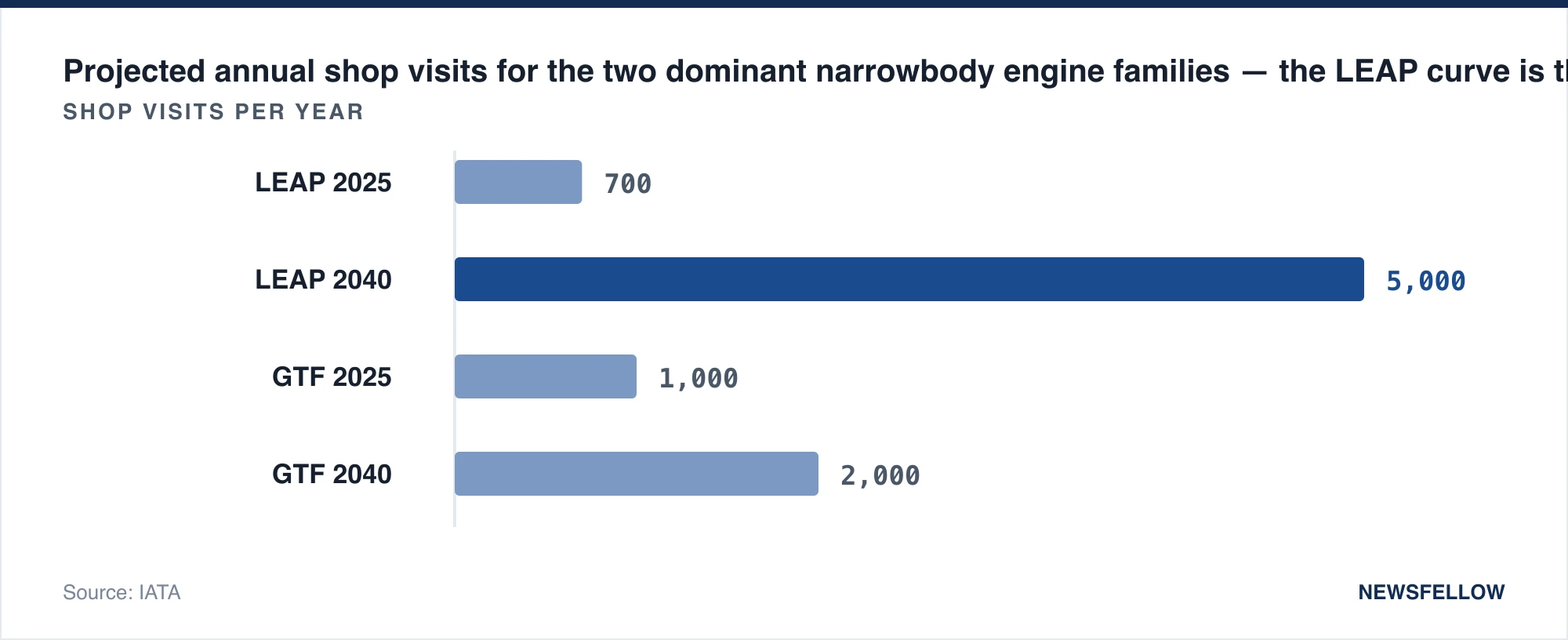
A sevenfold increase in LEAP shop visits is not a bottleneck that better scheduling clears. It requires physical capacity — test cells, tooling, certified stands, and above all licensed engineers — built over a decade and a half, against a labour market that is already short.
And the current infrastructure is not idle waiting for it. Roughly 3,700 LEAPs across 150 operators are entering mid-life care right now, competing for the same shops that the enormous installed base of CFM56 and V2500 engines still occupies. The legacy fleets were supposed to be retiring by now. Groundings of newer aircraft delayed those retirements, so the old engines keep consuming slots that the new engines need. It is a queue that feeds itself.
The access question
IATA's four recommendations are notable less for what they ask than for who they are aimed at. Expand parts availability through repair approvals and licensed production. Guarantee fair market access for independent MRO providers. Secure long-term parts pricing inside aircraft and engine purchase agreements. Adopt competitive aftermarket practices across all OEMs.
Every one of those is a request that engine manufacturers loosen their grip on the aftermarket. That is not incidental. The modern engine business model sells hardware at thin or negative margin and recovers it over decades of parts and shop visits, which gives OEMs a structural interest in controlling who may repair what, which parts are approved, and what they cost. During normal times airlines grumble about it. During a capacity crisis it becomes an operational constraint: an independent shop with an empty test cell cannot help if it lacks the licence, the tooling data or the parts.
Willie Walsh's framing at the launch was that engine MRO bottlenecks are disrupting airline operations, and that "capacity alone will not be enough." Read that as an argument about who is allowed to build the capacity, not merely how much of it exists.

The price of scarcity
The financial market has already repriced all of this. Spare turbofan lease rates have roughly doubled, with mid-life narrowbody engines now leasing in the range of $200,000 to $350,000 a month. Serviceable GTFs are scarce enough that a pair can command around $400,000 a month — which in some cases exceeds the lease cost of the airframe they are bolted to.
That inversion is the clearest signal in the market. When the engines are worth more than the aircraft, capital reallocates: aircraft lessors are moving into spare-engine leasing precisely because MRO delays and parts shortages have made the asset scarce. IBA has characterised the current environment as a lessors' market, with engine values and lease rates escalating.
For airlines this is a straightforward cost. For anyone modelling narrowbody economics over the next decade, it is something more awkward — a structural increase in the maintenance reserve required per aircraft, arriving at the same time as elevated capital costs and a fleet plan that assumes the neo and MAX generations deliver on their fuel-burn promise. Fuel savings that are handed back in shop visit costs are not savings.
What to watch
Deurloo's single-digit AOG pledge for the end of 2026 is now four months from its deadline, and it is the industry's most concrete near-term test. He has also, fairly, pointed out that widely quoted Cirium AOG tallies include aircraft grounded for non-engine reasons — a caveat worth holding onto when the year-end numbers are argued over.
Beyond that, three markers matter more than the headline grounding count. Whether LEAP turnaround times keep falling below 100 days once the durability-kit retrofit campaign adds volume to the same shops. Whether the GTF's full performance restoration turnaround — which has run in the 300-day range in the tightest conditions — compresses on the timeline the OEM promises rather than the one the analysts model. And whether any of IATA's access recommendations produce actual licensing changes, or whether the industry simply agrees they are sensible and carries on.
The crisis of the last three years was caused by things going wrong. The one being forecast for the 2030s will be caused by everything going right — more aircraft, flying more, on engines that all come due at once. That is a much harder problem to argue your way out of at an airshow.
Sources
- IATA, "Urgent Action Needed to Ease Engine MRO Bottlenecks" — https://www.iata.org/en/pressroom/2026-releases/06-24-urgent-action-needed-to-ease-engine-mro-bottlenecks/
- MRO Business Today, "IATA study warns engine MRO bottlenecks could worsen as next-gen fleets expand" — https://mrobusinesstoday.com/iata-study-warns-engine-mro-bottlenecks-could-worsen-as-next-gen-fleets-expand/
- Aviation Business News, "FIA 2026: Pratt & Whitney hails 'dramatic' improvement in A320 AOGs" — https://www.aviationbusinessnews.com/industry-news/fia-2026-pratt-whitney-hails-dramatic-improvement-in-a320-aogs
- FlightGlobal, "Pratt & Whitney targets end of decade for full GTF recovery" — https://www.flightglobal.com/engines/2026/02/pratt-whitney-targets-end-of-decade-for-full-gtf-recovery/
- GE Aerospace, "CFM Secures Certification for LEAP-1B Durability Upgrades" — https://www.geaerospace.com/news/press-releases/cfm-secures-certification-leap-1b-durability-upgrades
- GE Aerospace, "GE Aerospace Announces Second Quarter 2026 Results" — https://www.geaerospace.com/news/press-releases/ge-aerospace-announces-second-quarter-2026-results
- IBA Group, "Engine Shortages and MRO Backlog Keep Values and Lease Rates Elevated" — https://www.iba.aero/about/news/aircraft-engine-values-2026/
- IBA Group, "Engine MRO: Rising Demand, Limited Capacity" — https://www.iba.aero/resources/articles/engine-mro-rising-demand-limited-capacity/