Emirates Just Gave Premium Economy Its Own Door — With a Motor Behind It

For years, the pitch for Premium Economy has been a modest one: a few extra inches of legroom, a wider seat, better food than the back of the plane, all at a price well short of business class. Emirates is now adding something the category has never had at all — a physical, motorized barrier between you and the stranger next to you. On September 3, 2026, the airline unveiled what it calls the industry's first electrically operated, full-height privacy screen for a Premium Economy seat, installed aboard its newest Airbus A350 aircraft.
The screen rises and locks into place at the touch of a seat control, extending to the full height of the seatback rather than the small fold-out dividers or fixed armrest partitions that have occasionally appeared in premium economy cabins elsewhere. Passengers can raise it while working, eating, or sleeping, and lower it again at will — a level of on-demand separation that, until now, has generally been reserved for business class suites with sliding doors.
What's Actually New Here
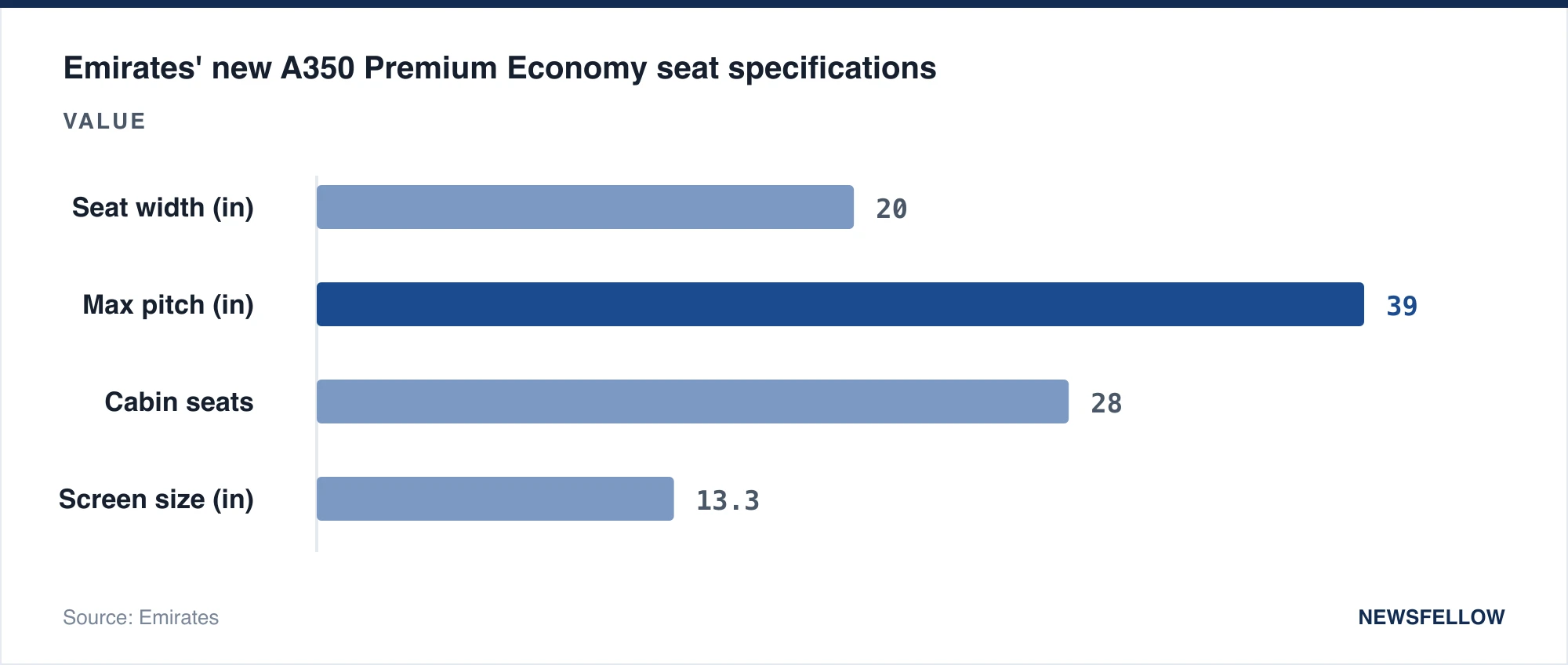
The privacy screen sits inside a broader redesign of Emirates' Premium Economy product for the A350, which the airline has installed in a 2-3-2 layout across a 28-seat cabin. The seats are 20 inches wide with a pitch of up to 39 inches, and mark Emirates' first fully electrically powered Premium Economy offering — meaning recline, and now the privacy divider, are both motor-driven rather than manually adjusted. According to Emirates, the seat reclines into a "cradle" position designed so that reclining does not encroach on the space of the passenger seated behind, a persistent complaint in coach and even some premium-economy cabins on long-haul flights.
The hardware around the seat has been upgraded as well: a 13.3-inch 4K HDR touchscreen for inflight entertainment, wireless device charging built into the seat, and a tray table with an integrated phone holder that lets passengers use a mobile device as a secondary screen alongside the main display. The seats also carry a Safran Seats U-Dream adjustable leather headrest and a manually operated leather footrest — details that place the finish closer to a premium cabin than a standard economy upgrade tier.
Why Airlines Are Racing to Reinvent Premium Economy
Premium Economy has quietly become one of the more profitable segments of long-haul cabin design over the past several years, occupying a price point well above economy but a fraction of business class fares, while requiring far less cabin real estate per seat than a lie-flat suite. Airlines have increasingly treated it as a design laboratory rather than an afterthought — a place to test features, like enhanced entertainment screens or improved recline mechanisms, that eventually migrate either upward into business class or downward into standard economy.
A full-height privacy divider is a meaningful step in that direction because it borrows a feature set previously associated almost exclusively with premium suites — the enclosed, do-not-disturb sense of your own space — and brings it to a cabin sold at a comparatively accessible fare. For an airline like Emirates, which has built much of its consumer brand around cabin hardware and in-seat technology across all classes, the move also functions as a signal that Premium Economy is being treated as a genuine standalone product line rather than merely "economy plus."
Where the Seats Are Flying First
The new Premium Economy cabin is installed on Emirates' newly delivered A350 aircraft, which the airline has been progressively bringing into its fleet as part of a long-planned widebody renewal and expansion program. Emirates has not published a complete route-by-route rollout schedule for the new A350 Premium Economy configuration in the material reviewed for this story, so travelers hoping to book the new seat should check Emirates' own fleet and route pages for specific aircraft assignments rather than assuming system-wide availability. As with most cabin hardware rollouts, expect the feature to appear first on a limited set of A350 routes before expanding as more aircraft are delivered and enter service.
The Competitive Picture
Emirates' move lands amid a broader wave of premium cabin investment across the industry this year, with multiple carriers unveiling new business class suites for delivery in 2026 and 2027 — from expanded lie-flat products on the Boeing 787 to new 1-2-1 configurations on the Airbus A330. Against that backdrop, a privacy-focused upgrade specifically targeted at Premium Economy stands out because most of the current cabin-investment cycle has concentrated on business class. By moving first and distinctively in the premium economy tier, Emirates is betting that the next competitive battleground for long-haul carriers is not only who has the best suite up front, but who can make the middle of the cabin feel meaningfully different from the back of it.
What Passengers Should Expect
Passengers booking the new seat should not expect a fully enclosed pod: the screen provides a vertical divider between adjoining seats within the 2-3-2 configuration, not a surrounding shell or door of the kind found in business class suites. It is best understood as an upgraded, motorized version of a partition, aimed at reducing shoulder-to-shoulder contact and offering a greater sense of personal space during meals, work, or rest — not full suite-level privacy. Emirates has not disclosed pricing specifics for Premium Economy fares tied to the new A350 configuration relative to its prior Premium Economy product, so cost comparisons should be treated as unconfirmed until the airline publishes fare details for the relevant routes.
How This Fits Emirates' Wider A350 Push
Emirates has been one of the last major long-haul carriers to bring the A350 into its fleet, having spent years operating an almost entirely 777- and A380-based widebody strategy. The A350's arrival has given the airline a fresh aircraft type on which to introduce cabin concepts without the constraints of retrofitting an older fuselage, and Emirates has used it as the launch platform for several new product tiers across its cabin hierarchy, not just Premium Economy. That pattern — using the newest aircraft type in the fleet as the venue for the newest cabin ideas — is common across the industry, since a clean-sheet delivery avoids the cost and downtime of pulling widebodies out of service purely to swap seats.
The privacy screen itself relies on an electric actuator integrated into the seat structure, the same category of engineering used for powered recline and adjustable headrests already common in business class. Bringing that actuator technology down into a Premium Economy seat is as much a cost and manufacturing story as a design one: powered seat components have become cheaper and more reliable over the seat-manufacturing industry's recent product cycles, making features once reserved for premium cabins more viable to include further back in the aircraft.
The Broader Question for Long-Haul Travelers
Whether a motorized privacy screen meaningfully changes the long-haul flying experience will depend heavily on execution — how reliably the mechanism functions after months of daily passenger use, how airlines maintain and repair it across a fleet, and how travelers weigh it against other factors like price, seat pitch, and route network when picking a Premium Economy fare. Cabin hardware announcements are also, inherently, forward-looking marketing moments: the seats shown in an unveiling are typically the newest, best-maintained examples in the fleet, and real-world wear over years of service is not something any announcement can demonstrate.
Still, the direction of travel is clear. As airlines compete less on baseline safety and reliability — where most major carriers now perform comparably — and more on the texture of the actual flying experience, incremental hardware differentiators like a powered privacy screen are becoming one of the more visible battlegrounds. Emirates has effectively wagered that being first to bring suite-like privacy control to a mid-tier cabin is worth the manufacturing and maintenance complexity of adding another powered, moving part to every seat in a 28-seat section of every relevant aircraft.
Sources
- Emirates Media Centre: Powering Privacy in Premium Economy — Emirates Unveils the World's First Electric Premium Economy Seat With Full-Height Privacy Screen
- The National: Emirates unveils world's first electric premium economy seat with privacy screen
- Globetrender: Emirates adds privacy screens to new premium economy seats
- 2PAXfly: Emirates — Premium Economy gets an electric privacy screen
- Emirates 24|7: Emirates unveils world's first electric premium economy seat with full-height privacy screen