The A320 Recall Isn't Over: EASA's New Order Rewrites the Fix for a Solar-Radiation Cockpit Scare

Nearly a year after an Airbus A320 pitched itself downward without warning at cruising altitude, European regulators have issued a new directive refining how the industry must guard against a repeat. The European Union Aviation Safety Agency (EASA) has published Airworthiness Directive 2026-0134, which supersedes the emergency order it issued last November in response to the incident aboard JetBlue Flight 1230.
The new AD does not lift the underlying requirement. Instead, EASA says it "provides clarifications and offers alternative methods of compliance" for operators working through the fleet-wide fix — a sign that, even as the immediate emergency has passed, the industry is still working out exactly how to close the door on the failure mode for good.
What happened on Flight 1230
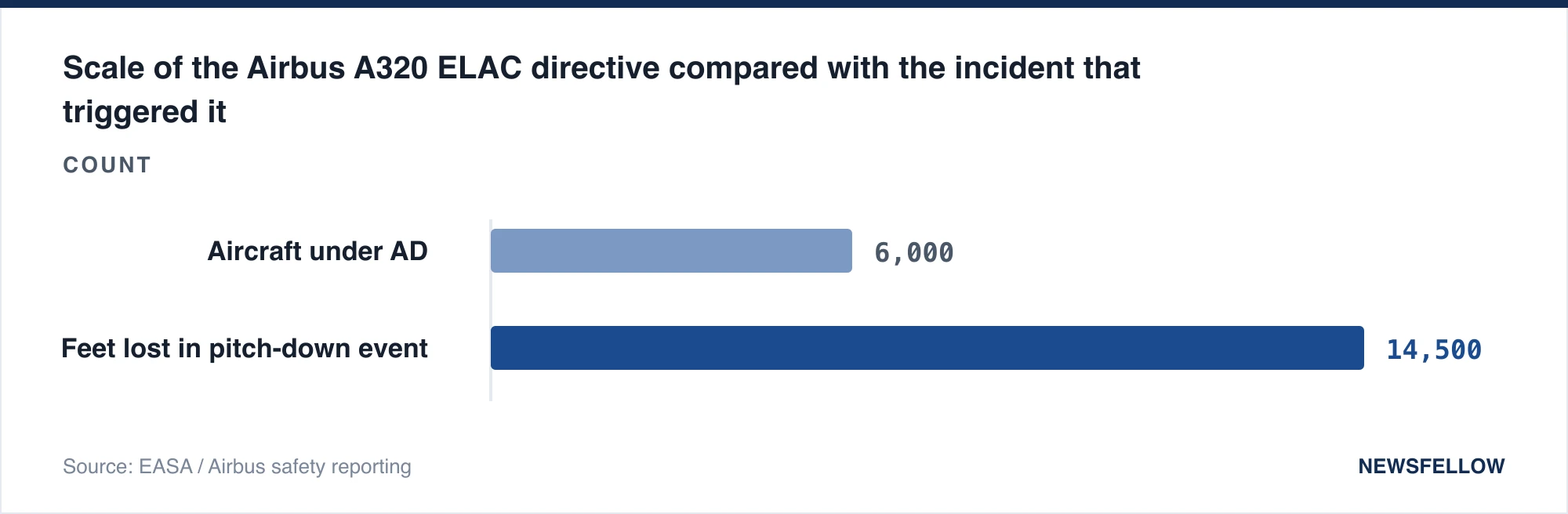
The event that triggered all of this unfolded on October 30, 2025. JetBlue Flight 1230, an A320 flying from Cancún to Newark, was cruising near flight level 350 — about 36,000 feet — when the aircraft experienced a sudden, uncommanded pitch-down that lasted four to five seconds. According to tracking data cited by aviation safety outlets, the aircraft lost roughly 14,500 feet in the following minutes before the crew regained full control, declared an emergency, and diverted to Tampa. Reports on injuries have varied by source, with figures cited in the 15-to-20-passenger range for those who required treatment for minor injuries; ZeroPress is not independently confirming an exact casualty count and treats those figures as still-developing.
Airbus's technical investigation traced the malfunction to the aircraft's Elevator Aileron Computer, or ELAC — one of the flight-control computers that translates pilot and autopilot inputs into movement of the elevators and ailerons. The affected units were running a software version identified as L104. Investigators found the software was vulnerable to a phenomenon known as a single-event upset: a burst of cosmic or solar radiation striking a microchip and flipping a single bit of stored data, corrupting values the computer relies on to compute control commands. In this case, that corruption is believed to have generated an erroneous pitch command the aircraft then briefly executed.
From emergency order to standing directive
Airbus issued an urgent software fix in the weeks after the JetBlue event, and on November 28, 2025, EASA followed with Emergency Airworthiness Directive 2025-0268-E, mandating the update across the affected fleet. The scale was unusual for a single-type order: roughly 6,000 A320-family aircraft — more than half of the type's global in-service fleet — fell within its scope, forcing airlines worldwide to schedule the update on an accelerated timeline.
AD 2026-0134 is the next chapter in that process. Superseding the emergency order, it keeps the core corrective action in place while giving operators additional, EASA-approved alternative methods of compliance — effectively more than one accepted path to satisfying the requirement, useful for carriers managing the update across mixed fleets or constrained maintenance schedules. The shift from an emergency AD to a standard superseding AD typically signals that a regulator has had time to review implementation data and refine the technical language, even though the safety requirement itself remains mandatory.
Why a single bit-flip grounded half a fleet
Single-event upsets are a known, if rare, hazard in aviation electronics. Cosmic radiation intensifies with altitude, and modern aircraft spend long stretches at cruise altitudes where shielding from the atmosphere is thinner than at sea level. Most flight-critical systems are designed with redundancy and error-checking specifically to catch this kind of corruption before it can affect control surfaces. What made the JetBlue event significant to regulators was that the L104 software version appeared to have introduced a new susceptibility — meaning a previously acceptable safeguard had, through a software update, developed a gap.
That is also why the response was so broad. Rather than limiting corrective action to the specific tail number involved, Airbus and EASA treated the vulnerability as a fleet-wide software characteristic, applicable to any A320-family aircraft running the affected ELAC software — hence the roughly 6,000-aircraft scope of the original emergency directive.
What the new directive changes
EASA's description of AD 2026-0134 frames it as a refinement rather than a reversal: the same underlying software fix remains required, but the agency has added clarifying language and alternative compliance paths. For airlines, that can mean added flexibility in how or when the required software load is verified and installed, without altering the safety objective. It also suggests EASA is continuing to monitor implementation across the global fleet nearly a year after the initial event — a reminder that closing out a major airworthiness directive is often an iterative process, not a single mandate followed by silence.
The FAA, which mirrors many EASA directives for U.S.-registered aircraft under the two agencies' bilateral safety agreements, has also been moving in parallel: several EASA-originated ADs affecting Airbus and Airbus Helicopters products took effect on the FAA's U.S. registry in the same window, according to Federal Register filings, underscoring how closely the two regulators are coordinating on Airbus fleet issues this year.
The bigger picture for A320 operators
The A320 family is the backbone of dozens of the world's largest airline fleets, and a single-event-upset vulnerability in a flight-control computer touches an unusually large cross-section of global air travel. For passengers, the practical takeaway is reassurance rather than alarm: the corrective software has already been distributed and installed across most of the affected fleet in the ten months since the emergency order, and AD 2026-0134 is aimed at tidying up the compliance framework rather than responding to a new incident.
For the industry, the episode is likely to reinforce scrutiny of how software updates to flight-critical computers are validated against radiation-induced data corruption — a risk that has long been managed through hardware-level redundancy but that this case suggests can be reintroduced through a software change if not fully re-tested against it.
ZeroPress will continue to track EASA and FAA filings on this directive as further compliance data becomes available.
Sources
- EASA issues AD 2026-0134 superseding Emergency Airworthiness Directive 2025-0268-E for Airbus 320 family
- 2026-0134: Flight Controls – Elevator Aileron Computer — EASA Safety Publications Tool
- A320's Sudden Descent Linked to Faulty Computer — Airline Geeks
- Incident: Airbus A320-232 N605JB, Thursday 30 October 2025 — Aviation Safety Network
- JetBlue Flight Plunge Triggers Airbus A320 Emergency Airworthiness Directive And Massive Global Grounding — AvGeekery