Dubai Readies $15 Billion in New Contracts to Build the World's Biggest Airport

Dubai is about to spend even more on the airport it hopes will one day be the busiest on Earth. Dubai Airports plans to award roughly Dh55 billion ($14.9 billion) in new construction contracts by the end of 2026 to keep building Al Maktoum International Airport (DWC), the emirate's second hub southwest of the city, according to The National.
The figure comes on top of Dh13 billion in contracts already awarded so far this year, and it lands at a moment when much of the aviation world is watching the Gulf's biggest carriers navigate regional turbulence. Dubai Airports says construction at DWC has continued unhindered by that broader instability — a signal the emirate is treating the project as a decades-long bet rather than something to pause for short-term headlines.
A Terminal Roughly Four Times the Size of Heathrow's
The scale of what's being built is difficult to compare to anything else in commercial aviation. Al Maktoum Airport's master plan calls for a Western Passenger Terminal, a fourth aircraft concourse, and structural frameworks spanning approximately 1.5 million square metres of buildings — contracts for all of which are part of the current and upcoming award rounds. Beyond the terminal shell itself, upcoming packages cover a baggage handling system, an automated people mover, power generation, district cooling, building facades and roofing.
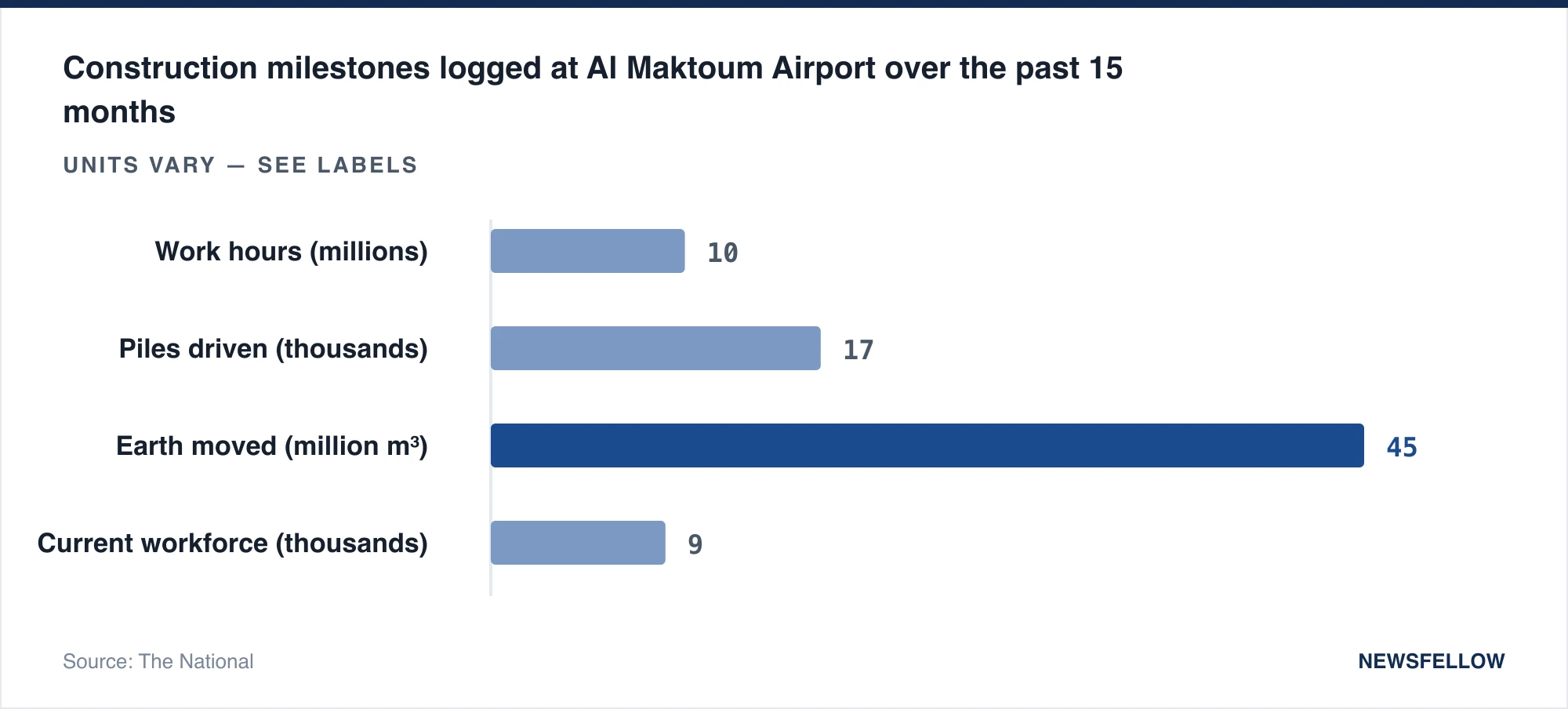
Dubai has already put real numbers behind the ambition. Over the last 15 months alone, the project has logged 10 million work hours, driven 17,000 piles into the ground, and moved 45 million cubic metres of earth. Around 9,000 workers are currently on site, a figure Dubai Airports expects to swell to as many as 120,000 at peak construction — a workforce roughly the size of a mid-sized city, assembled to build a single airport.
Why DWC, Not Dubai International
Dubai International Airport (DXB) remains one of the world's busiest hubs for international passenger traffic, but it sits hemmed in by the city that grew up around it, with little room left to expand. Al Maktoum International, by contrast, was built on open desert land near Jebel Ali, giving planners a blank canvas to design an airport from scratch for aircraft, cargo volumes, and passenger numbers that don't yet exist anywhere else.
That's the logic behind Dubai's decision, first outlined by Sheikh Mohammed bin Rashid Al Maktoum, to eventually shift the bulk of the emirate's civil aviation operations — including flag carrier Emirates — to DWC once it's built out. The project's full build-out is expected to run through 2032, with the airport ultimately designed to handle up to 260 million passengers annually once all five terminals and runways are complete, a figure that would dwarf every airport operating today. Istanbul Airport, currently among the world's busiest by some measures, handled around 85 million passengers in a recent year — meaning DWC's eventual design capacity is roughly triple that.
The Money Behind the Megaproject
The overall investment envelope for Al Maktoum Airport has been estimated at more than $35 billion across its full construction timeline, funded by the Dubai government and Dubai Airports rather than external investors — a structure that lets the emirate move at its own pace without needing to satisfy outside capital partners on shorter timelines. That funding model is part of why contracts keep flowing even as some Gulf carriers have had to suspend or reroute flights over regional airspace concerns this year: the airport's construction schedule and the airlines' day-to-day operating environment are, for now, running on separate tracks.
Contractors already active on site or newly awarded work include major regional and international construction and engineering firms handling everything from earthworks to the automated people mover system — a driverless rail network that will move passengers between concourses too far apart to walk, a design feature common at other supersized hubs like Denver International and Hamad International in Doha, but planned here at a considerably larger scale.
What to Watch Next
The immediate signal to watch is whether Dubai Airports actually gets the full Dh55 billion in contracts out the door by December, as planned. Megaprojects of this size routinely see award timelines slip, and construction procurement markets in the Gulf have been under strain from competing demand across giga-projects in Saudi Arabia and elsewhere in the UAE. If Dubai hits its year-end target, it will have committed close to Dh68 billion — over $18 billion — in contracts within a single calendar year, an extraordinary pace even by the standards of the region's infrastructure spending.
The next concrete milestones to track are the awards for the Western Passenger Terminal substructure and the automated people mover, both flagged as upcoming in Dubai Airports' latest disclosures. Those contracts, once signed, will offer the clearest indication yet of whether the 2032 completion target for DWC's next phase is realistic — or whether, like many airport megaprojects before it, the timeline will need to stretch.
Sources
- Dubai to award Dh55bn in contracts by year-end for Al Maktoum Airport expansion – The National
- Dubai's Al Maktoum Airport expansion on track for 2032 launch with Dh55bn of contracts to be awarded this year – The National
- Dubai's New DWC Mega-Airport to Award Dh55 Billion in Construction Contracts by Year-End – Gulf News
- Dubai awards Al Maktoum airport passenger system contract – AGBI