Delta Quietly Raises SkyMiles Earning Rates on Aeroméxico, Aerolíneas Argentinas and LATAM

Delta Air Lines has raised the rate at which SkyMiles members earn miles on flights operated or marketed by three of its Latin American partner airlines — Aeroméxico, Aerolíneas Argentinas and LATAM — for tickets issued on or after September 10, 2026. The change, which surfaced in Delta's partner earning charts and was first detailed by loyalty-program trackers this week, increases earning percentages across most fare classes rather than cutting them, a departure from the string of program devaluations that have defined much of the airline loyalty sector's news in 2026.
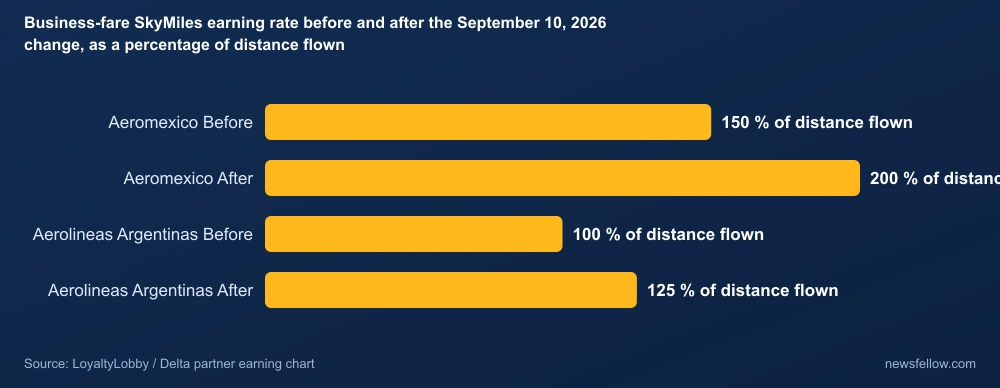
The most concrete shift is on Aeroméxico. For Delta-ticketed, Aeroméxico-marketed flights booked from September 10 onward, SkyMiles will calculate earning as a percentage of distance flown based on the fare class purchased, rather than as a percentage of the ticket's purchase price — a structural change in how the mileage is calculated, not just how much of it a passenger gets. As part of that shift, Aeroméxico's discounted business fare classes D, I and Z have been reclassified from "Discounted Business" to full "Business" in Delta's earning chart, and the corresponding earning rate rises from 150% to 200% of distance flown.
What changes for Aerolíneas Argentinas flyers
On Aerolíneas Argentinas, the increases run across nearly the full fare ladder. Business and premium economy fare classes I, D, J, C, W and S move from earning 100% of distance flown to 125%. Standard economy fare classes M and B move from 50% to 100% — a doubling of the earning rate on some of the most commonly booked coach fares. Mid-tier discounted economy classes K, U, H, L and Q rise from 50% to 75%. The one exception moving in the opposite direction is the deepest-discount economy class, T, where earning drops from 10% to 5% of distance flown — a modest reduction confined to the cheapest fare bucket, and one that mirrors a pattern seen across airline alliances where a program raises earning in the middle of the fare ladder while trimming it at the very bottom to preserve some differentiation between fare types.
LATAM's earning classes move too
Delta's chart changes extend to LATAM as well, with several fare classes reclassified in a similar direction to Aeroméxico's — discounted business fare buckets moved into the full "Business" earning category, lifting their earning rate from 150% to 200% of distance flown for tickets issued from the same September 10 effective date. LATAM is one of Delta's most consequential international partnerships: Delta holds a minority equity stake in the Chile-based carrier and the two airlines operate under a joint venture across North and South America, making changes to how SkyMiles are earned on LATAM metal a matter that touches a large share of Delta's premium transborder traffic between the United States and South America.
Why Delta's Latin America partners carry outsized weight
Delta's relationships with these three carriers are not interchangeable codeshare arrangements — each sits inside a deeper commercial structure that makes changes to their earning charts more consequential than a routine partner update. Delta and Aeroméxico have operated a joint venture across the US-Mexico transborder market since 2017, coordinating schedules, pricing and, historically, marketing on shared routes between the two countries, a partnership regulators reviewed closely given how much of the Mexico City–United States corridor the two carriers control together. LATAM is a similar case at larger scale: Delta holds a minority equity stake in LATAM Airlines Group and the two operate a joint venture spanning flights between North and South America, positioning LATAM as Delta's primary gateway into a continent where Delta itself flies a comparatively thin long-haul network. Aerolíneas Argentinas, Argentina's flag carrier, connects into that same joint-venture structure as a SkyTeam alliance member, giving Delta loyalty members a third distinct path to reach South American cities that neither Delta's own metal nor LATAM's network always covers directly.
Because all three carriers feed traffic into Delta's US gateways — Atlanta, New York-JFK, Los Angeles and others — a change to how generously SkyMiles rewards travel on their metal affects not just point-to-point flyers within Latin America, but US-based SkyMiles members connecting onward through these partners' hubs in Mexico City, Buenos Aires, Santiago and São Paulo. A business traveler flying Atlanta–Mexico City–Guadalajara on an Aeroméxico-marketed segment, for instance, now earns SkyMiles on that connecting leg calculated the same way Delta calculates earning on its own regional fare classes, rather than under the price-based formula that applied before September 10.
Why this looks different from Delta's other 2026 moves
The timing matters. Delta spent much of 2026 working through a run of SkyMiles and Medallion program changes that drew enough customer pushback that the airline walked back some of the more unpopular elements, including adjustments to Sky Club access rules and Medallion Qualification Dollar thresholds, after members and frequent-flyer media criticized the changes as reducing the value of loyalty status relative to what it cost to earn. Against that backdrop, a change that raises earning rates on three international partners — with only a narrow reduction on the single cheapest economy fare bucket on one of them — reads as a rare instance this year of a major US carrier's loyalty program moving in travelers' favor rather than against them.
It is also consistent with how full-service carriers manage their partner networks over time. Earning charts for codeshare and joint-venture partners are periodically revised to better align what a partner's fare class is actually worth — in terms of the flexibility, refundability, and service level attached to it — with how many miles a SkyMiles member earns for buying it. When a partner's internal fare structure changes, or when an alliance renegotiates how partner-earned miles are calculated, the home program's earning chart is updated to match, which is the most likely explanation for why Aeroméxico's calculation method shifted from price-based to distance-and-class-based at the same time its business fares were reclassified upward.
What it means for travelers booking now
For a SkyMiles member who books Aeroméxico, Aerolíneas Argentinas or LATAM flights regularly — common itineraries include Mexico City and Buenos Aires connections to Atlanta, New York-JFK, and other Delta domestic hubs, as well as LATAM's extensive South American network feeding Delta's Santiago, São Paulo and Lima joint-venture flying — the practical effect is that tickets purchased in the affected fare classes from September 10 onward earn more SkyMiles than the same ticket would have earned a week earlier. Passengers who already hold tickets booked before the effective date are not affected retroactively; the new earning rates apply based on ticket issue date, the standard practice for airline earning-chart revisions.
The change does not alter Medallion Qualification Mile or Medallion Qualification Dollar accrual rules, elite-status thresholds, or redemption pricing — it is specific to how many base SkyMiles a ticket earns, not to elite-status progress or how many miles it costs to book an award seat on these carriers. Members wanting to confirm the exact earning percentage for a specific fare class on Aeroméxico, Aerolíneas Argentinas or LATAM can check Delta's published partner airline earning charts, which the airline updates directly on delta.com, rather than relying on the fare class letter alone, since airlines routinely remap which letter codes fall into "Business," "Discounted Business," "Full Fare Economy" and other earning tiers.
Delta has not issued a standalone press release framing this specifically as a customer-facing enhancement, and the change surfaced primarily through the airline's own partner earning documentation and loyalty-program trackers that monitor those pages for updates — a reminder that airlines routinely revise partner earning charts without the fanfare of a formal announcement, in contrast to headline-grabbing changes like new elite tiers or fee increases. For frequent flyers on these three Latin American routes, though, the effect is a straightforward one: more miles for the same ticket, starting with anything booked from September 10, 2026.