Appeals Court Throws Out DOT Order Killing the Delta–Aeroméxico Joint Venture

The US Court of Appeals for the Eleventh Circuit has vacated the Transportation Department order that would have forced Delta Air Lines and Aeroméxico to dismantle their transborder joint venture, ruling on 20 August 2026 that the agency's decision to strip the pair of antitrust immunity was arbitrary and capricious.
The effect is immediate and simple: the joint venture and the antitrust immunity underpinning it remain in force. Delta and Aeroméxico may continue to coordinate schedules, fares and capacity on flights between the United States and Mexico, as they have since the DOT granted immunity in 2016.
Aeroméxico disclosed the ruling in a filing to investors, confirming that the venture and its antitrust immunity remain operational. Delta welcomed the outcome. The Transportation Department said it was reviewing the ruling and considering its legal options.
What the DOT had ordered
The chain of events began outside the airlines entirely, in a government-to-government dispute over access at Mexico City's Benito Juárez International Airport (MEX). Mexican authorities cut slots at the congested airport and relocated dedicated cargo operations away from it — measures the US administration argued disadvantaged American carriers while leaving Aeroméxico, the dominant home carrier at MEX, comparatively insulated.
In September 2025 the DOT issued a final order terminating the antitrust immunity, framing the move as a response to those Mexican policies. The airlines were given until 1 January 2026 to unwind their coordinated operations. Delta and Aeroméxico challenged the order in court, and in November 2025 obtained a stay that prevented enforcement while the case was heard. That stay is now moot: the underlying order has been vacated.
Critically, terminating immunity would not have severed the two airlines' commercial relationship outright. Codesharing and frequent flyer reciprocity can survive without antitrust immunity. What immunity uniquely permits is the part that makes a joint venture a joint venture — the ability of two competitors to sit in the same room and jointly set schedules, price the market and share revenue, conduct that would otherwise expose both to antitrust liability.
Why the court sided with the airlines
The panel's objection was procedural rather than substantive. It did not rule that the joint venture serves the public interest, nor that the DOT lacks the power to withdraw immunity. It ruled that this particular withdrawal was not adequately reasoned.
Two failures stood out in the court's analysis. The first concerned the scope of the market study. When the DOT approved the immunity in 2016, it examined the full US–Mexico market — some 1,687 city pairs. When it moved to terminate in 2025, it looked essentially at Mexico City airport alone, which accounts for roughly 21% of flights between the two countries, without refreshing market share data or analysing effects on individual city pairs. The court held the department did not reasonably explain why it conducted a far more limited market analysis than it had in comparable cases.
The second concerned consistency. The DOT has repeatedly approved and maintained immunised alliances between US and Japanese carriers despite severe slot constraints at Tokyo Haneda — a structurally similar situation to the one the department cited as disqualifying at Mexico City. The judges questioned why a stricter standard was being applied here.
As the court put it: "We are not a rubber stamp."
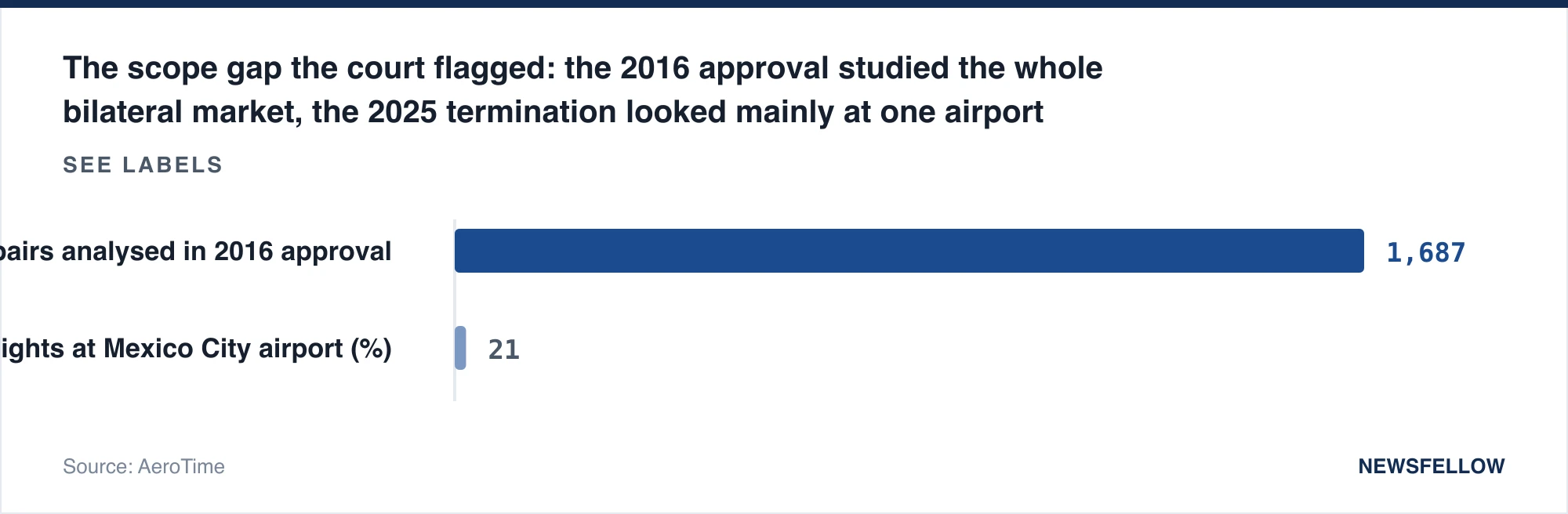
That second figure is a percentage rather than a count, so the two bars are not directly comparable in magnitude — but together they capture the asymmetry the panel described: an approval built on a market-wide record, and a termination built on a fraction of it.
What the venture actually does
Delta holds a longstanding equity position in Grupo Aeroméxico alongside the commercial tie-up, and the two have operated their transborder flying as a single coordinated network for close to a decade. Over that period the partners have added dozens of routes, including services from Mexico City to Phoenix Sky Harbor, Raleigh-Durham and Tampa — the sort of medium-density transborder city pairs that are marginal for either carrier alone but viable when both feed and share the revenue.
Together the two hold roughly 20% of total seats on US–Mexico routes. American Airlines holds about 21%. That comparison matters to the competitive question: the immunised venture is not the largest single presence in the market it operates in.
Delta has estimated consumer benefits from the venture at as much as $800 million a year through lower fares, new routes and improved connections. That figure is the airline's own estimate and should be read as an advocacy number rather than an independent finding; the court did not endorse it, and its reasoning did not turn on it.
Regulatory whiplash for a transborder market
For airlines, the practical value of this ruling is less about the immunity itself than about planning horizon. A transborder joint venture is a multi-year commitment: aircraft assignments, slot holdings, sales agreements, joint IT and revenue-accounting infrastructure. The prospect of an unwinding deadline on 1 January 2026 forced both carriers to plan for two futures at once through most of last year.
There is a broader signal here for the industry. Antitrust immunity has increasingly been treated by regulators on both sides of the Atlantic as leverage in disputes that have little to do with the airlines that hold it — a bargaining chip in intergovernmental arguments over slots, market access and cargo policy. The Eleventh Circuit's ruling does not close that door. It says only that if the department wants to walk through it, it must do the analytical work first and apply the same standard it applies elsewhere.
What happens next
The DOT retains the authority to try again. Nothing in the ruling bars a fresh termination order; the department would have to build one on a broader market analysis and explain any departure from how it has treated comparable alliances. It could also seek further review. Its public position — reviewing the ruling and considering its legal options — leaves both paths open.
The underlying bilateral friction has not gone away either. The Mexico City slot reductions and the cargo relocation that triggered the original review are matters of Mexican aviation policy, unaffected by a US appellate decision. Capacity at MEX remains constrained, and Felipe Ángeles International Airport north of the capital has not absorbed demand at the pace Mexican planners hoped. Any durable resolution runs through the two governments, not through an American courtroom.

For now, travellers between the two countries see no change. Schedules, codeshares, reciprocal SkyMiles and Club Premier earning, and the joint pricing that has shaped transborder fares since 2016 all continue. The airlines get to keep operating the network they have built while the regulatory argument goes on above their heads — which, for a market that has spent a year under a demolition notice, counts as the significant news of the weekend.
Sources
- AeroTime — "US appeals court allows Delta-Aeroméxico joint venture to continue": https://www.aerotime.aero/articles/us-appeals-court-allows-delta-aeromexico-joint-venture-to-continue/
- Paddle Your Own Kanoo — "Delta Air Lines Wins Major Court Victory as DOT's Aeromexico Antitrust Order Is Vacated": https://www.paddleyourownkanoo.com/2026/08/21/delta-air-lines-wins-major-court-victory-as-dots-aeromexico-antitrust-order-is-vacated/
- GlobeNewswire — "Aeromexico Announces Court Decision on Aeromexico-Delta ATI": https://www.globenewswire.com/news-release/2026/08/20/3348859/0/en/aeromexico-announces-court-decision-on-aeromexico-delta-ati.html
- The Points Guy — "Court overturns DOT termination of Delta-Aeromexico pact": https://thepointsguy.com/news/delta-air-lines-aeromexico-joint-venture-termination-order-dismissed/
- Upgraded Points — "Court Overturns DOT Ruling on Delta-Aeromexico Joint Venture": https://upgradedpoints.com/news/delta-aeromexico-joint-venture-appeals-court/
- Delta News Hub — "US Department of Transportation issues final order to terminate the Delta-Aeromexico joint venture": https://news.delta.com/us-department-transportation-issues-final-order-terminate-delta-aeromexico-joint-venture
- Eckert Seamans — "Federal Circuit Court Stays DOT Order Terminating Delta/Aeromexico Antitrust Immunity": https://www.eckertseamans.com/stay-informed/blogs/aviation/federal-circuit-court-stays-dot-order-terminating-delta-aeromexico-antitrust-immunity
- AeroTime — "Delta, Aeroméxico challenge US order to end joint venture": https://www.aerotime.aero/articles/delta-aeromexico-court-challenge-joint-venture