Delhi Airport Maps a Route to 140 Million Passengers — With a Pier, a People Mover and a Fourth Terminal

India's busiest airport is preparing to tell the market how it intends to stay that way. Delhi International Airport Ltd (DIAL), the GMR Group-led consortium that operates Indira Gandhi International Airport, is finalising a master plan covering 2026 to 2036 that would take the airport's annual handling capacity from roughly 106 million passengers today to about 140 million — a target built not on a single dramatic terminal opening but on a sequence of incremental, awkward, expensive works layered onto an airfield that cannot stop operating while they happen.
The outline that has emerged over August is unusually specific for a plan not yet formally published. It has three load-bearing elements: a new Pier E attached to Terminal 3, an airside automated people mover linking the three terminals, and a Terminal 4 that would eventually take the place of the ageing Terminal 2. Each of them answers a different constraint, and the order in which they are built matters more than the headline number.
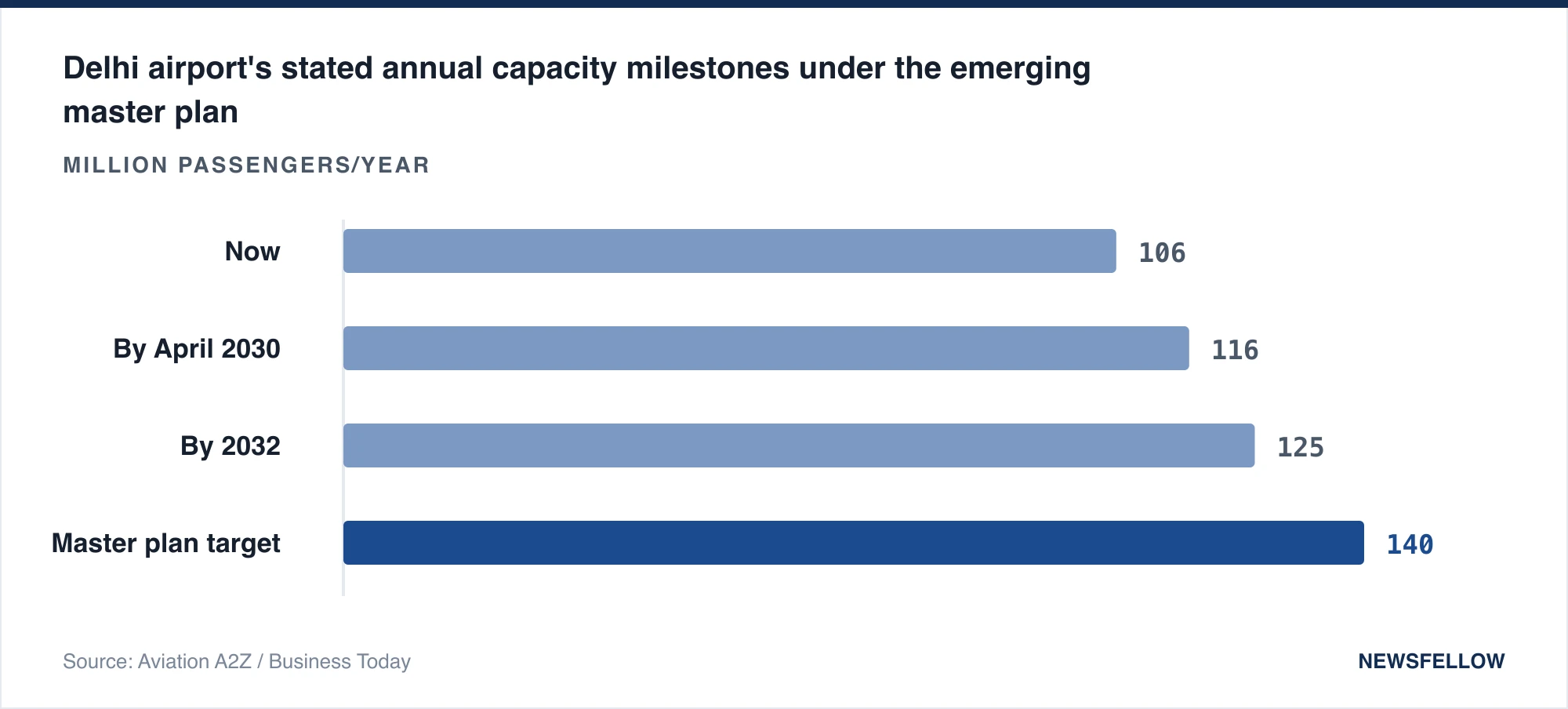
The near-term number is 125 million, not 140
The 140 million figure is the end state of the decade-long plan. The nearer, harder commitments are smaller and dated.
DIAL is working towards about 116 million passengers of annual capacity by April 2030, and roughly 125 million by 2032, according to reporting on the operator's current planning. The step from today's figure to the 2030 target is carried largely by Pier E, a new concourse at Terminal 3 expected to be completed by April 2030 and to add on the order of 10 million passengers a year of handling capacity.
That is worth putting against the existing terminal split. Terminal 1, rebuilt and expanded in recent years, is rated at about 42 million passengers annually. Terminal 2 — the oldest of the three and long treated as a stopgap — is rated at about 14 million. Terminal 3, the international flagship, is rated at about 50 million, handling in the region of 19 million domestic and 31 million international passengers a year.
Those ratings explain why Pier E is a T3 project rather than a greenfield one. Delhi's growth is disproportionately international, and international passengers consume far more terminal area per head than domestic ones: immigration halls, transfer security, longer dwell, larger gate lounges, wider aircraft stands. DIAL has already converted Pier C at Terminal 3 to international operations, a change reported to have lifted the airport's international handling capacity from around 20 million to around 30 million a year. Pier E continues that logic. It is, in effect, a bet that the binding constraint at Delhi is not runway movements but international processing area and contact stands.
The air train returns from the dead
The second element is the one Delhi passengers will notice most, and the one that has failed before.
DIAL is reviving a proposal for an elevated automated people mover — an "air train" — connecting Terminal 1, Terminal 2 and Terminal 3 across roughly nine kilometres. The project has been on and off for years, most recently shelved on cost grounds. Both Air India and IndiGo have been pressed for its approval, a rare instance of India's two largest carriers pushing the same infrastructure item, and DIAL's planning documents reportedly reserve a 7.5-kilometre right of way for the system. No construction timeline has been confirmed.
The airlines' interest is not aesthetic. Delhi's terminals are physically separated in a way that forces connecting passengers landside, onto a shuttle bus, through the road network, and back through full security screening. For a hub airport that is a structural handicap: it inflates minimum connect times, makes misconnections expensive, and pushes carriers towards operating parallel networks out of a single terminal rather than a genuine wave-structured hub. Air India in particular has spent the past three years trying to build a Delhi hub that captures Europe–Southeast Asia and North America–India traffic that currently routes through Dubai, Doha and Abu Dhabi. Those Gulf competitors do it from single-terminal campuses where a connection is a walk.

Two other changes point the same way. Trials of airside baggage drop for international-to-domestic connections have been approved by the Bureau of Civil Aviation Security, and approval for full airside passenger transfers — allowing connecting passengers to move between terminals without repeating security screening — is understood to be pending. Those regulatory approvals are, in practical terms, a precondition for the people mover to deliver what the airlines want from it. A train between terminals that still dumps passengers into a security queue solves a walking problem, not a hubbing problem.
Terminal 4 and the T2 question
The third element is the least defined and the most consequential. Terminal 2 is expected to remain in service until at least 2030, with demolition following after that. A new Terminal 4 would take its place, and it is that terminal — not Pier E — that closes the gap between 125 million and the 140 million target.
This is where the plan gets genuinely difficult. Removing 14 million passengers of capacity from the system in order to build something larger on the same footprint means Delhi has to absorb the loss somewhere. Pier E's roughly 10 million and continued optimisation of T1 and T3 have to be in place first, which is why the sequencing — Pier E by 2030, T2 retirement after 2030 — reads as a hard dependency rather than a coincidence of dates. Any slip in Pier E pushes Terminal 4 out with it.
DIAL has also signalled that the master plan will lean on non-aeronautical development, expanding the Aerocity commercial district with additional hotels and business parks. That is standard for privatised Indian airports, where regulated aeronautical returns are thin and the land bank does the earning. It is also a reminder that a master plan is a financing document as much as an engineering one.
Growth is real, but no longer explosive
The traffic backdrop is solid rather than spectacular. Delhi handled about 6 million passengers in July 2026, up 3.7 percent year on year, and roughly 26.4 million in the first four months of the 2026-27 financial year. On seat capacity, Delhi remains comfortably India's largest airport in August 2026, with about 2.88 million scheduled seats against Mumbai's 1.78 million.
A 3.7 percent monthly growth rate is not the double-digit expansion of the post-pandemic rebound, and that softening is part of the argument for a ten-year plan rather than a crash programme. It also sits against a competitive change that DIAL cannot control. Navi Mumbai International Airport is expected to open in early October 2026 and Noida International Airport at Jewar later that month. Jewar in particular sits within Delhi's catchment, and while its early schedule will be modest, its existence changes the calculus for how much capacity DIAL needs to build and how quickly.
The honest reading is that Delhi is planning for a decade in which it stays India's primary international gateway but no longer holds a monopoly on the National Capital Region. Pier E defends the international franchise. The air train defends the hub. Terminal 4 defends the raw headroom. Whether all three arrive is the open question — the air train has been announced and abandoned before, and the master plan itself has not yet been formally released.
What to watch
DIAL's plan is expected to be announced within one to two months of early August, which places publication somewhere in September or October 2026. Three things will indicate whether the 140 million target is a plan or an aspiration: a committed construction start date and budget for the automated people mover; formal BCAS approval for full airside transfers between terminals; and a dated commitment on Terminal 2's closure. Until those exist, the only firmly scheduled item on the list is Pier E in April 2030.
For airlines building networks on ten-year aircraft order books — Air India and IndiGo between them hold well over a thousand aircraft on order — the sequencing is not an abstraction. Aircraft arrive whether or not the piers do.
Sources
- Business Today, "Delhi airport is getting an air train, Terminal 4 and 140 million capacity — here's the full plan," 3 August 2026 — https://www.businesstoday.in/latest/trends/photo/delhi-airport-is-getting-an-air-train-terminal-4-and-140-million-capacity-heres-the-full-plan-546979-2026-08-03
- Aviation A2Z, "Delhi Airport to Expand Capacity to 125 Million Passengers by 2032," 17 August 2026 — https://aviationa2z.com/index.php/2026/08/17/delhi-airport-to-expand-capacity-to-125-million-passengers-by-2032/
- OAG, Indian aviation market data — https://www.oag.com/indian-aviation-data
- Gulf News, "Delhi and Mumbai to get new airports this month, marking a major shift in Indian aviation" — https://gulfnews.com/business/aviation/delhi-and-mumbai-to-get-new-airports-this-month-marking-a-major-shift-in-indian-aviation-1.500295129
- Delhi International Airport Ltd (DIAL) / Delhi Airport official site — https://www.newdelhiairport.in/