Dallas Councils Clear $2.54 Billion Love Field Rebuild and DFW's $194 Million Hotel Buyout

Two Dallas airports, one council meeting, billions of dollars
On September 10, 2026, the Dallas City Council moved two of North Texas's biggest airport financing packages forward on the same agenda. The council authorized the Love Field Airport Modernization Corporation to issue up to $150 million in commercial paper notes to bankroll early work on a $2.54 billion overhaul of Dallas Love Field, and separately approved Dallas Fort Worth International Airport's $1.62 billion fiscal 2027 budget — a spending plan that includes buying the 811-room Hyatt Regency hotel on airport property for as much as $193.65 million.
Neither action is the final word. The bond authorization clears the way for interim financing while a full parameters ordinance and a competitive municipal bond sale, expected around November 12, work through the approval process in October. The Fort Worth City Council, which co-owns DFW Airport with Dallas, was slated to take up its own version of the measures the following week. But the September 10 vote is the clearest sign yet that both of Dallas-Fort Worth's commercial airports are entering a multi-year capital spending cycle simultaneously, with a combined price tag that dwarfs most single-airport projects underway anywhere in the country.
Love Field's $2.54 billion problem: more passengers, no more gates
Love Field is a peculiar airport to spend $2.54 billion rebuilding, because the thing most airports buy with that kind of money — more gates — is off the table. A federal agreement known as the Wright Amendment framework and subsequent city ordinances cap Love Field at 20 gates, all but one of which are controlled by Southwest Airlines, which accounts for roughly 98% of the airport's passenger traffic. The airport currently handles about 18 million passengers a year and is trying to grow to 24 million without adding a single gate.
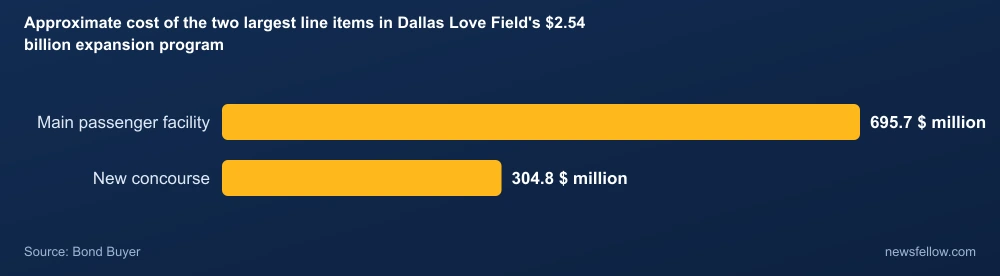
That constraint is why the expansion program, known internally as the Love Field Expansion Aviation Program (LEAP), is built around efficiency rather than square footage for its own sake. The two largest individual line items identified in city financing documents are a rebuilt main passenger facility at $695.7 million and a new concourse at $304.8 million, with the remaining money spread across a slate of 14 separate projects — modernized security checkpoints, reconfigured baggage systems, updated boarding bridges, and utility and infrastructure work that has to happen underneath a terminal that never stops operating.
Patrick Carreno, Dallas's director of aviation, has described the program to the city council as necessary to keep Love Field functional as Southwest's traffic continues to grow inside a footprint that was never designed for today's passenger volumes. The airport currently carries $434.8 million in outstanding general airport revenue bonds, and the new financing plan layers commercial paper — short-term debt that can be rolled over or refinanced as the airport figures out its longer-term bond structure — on top of that base, with eventual repayment expected to come from a mix of long-term general airport revenue bonds with maturities of 20 to 30 years, airport capital funds, passenger facility charges collected from ticketed travelers, and federal grants.
The timeline is deliberately slow by construction-project standards. City documents show the FAA has essentially signed off on Love Field's master plan, but final environmental approvals aren't expected until fall 2026. A design package is due back to the city council by January 2027, with enabling work and demolition not starting until late 2027 and full construction beginning in 2028. In an industry where major terminal projects routinely slip by a year or more once shovels are actually in the ground, a program projected to run past 2030 in its current form is not unusual — but it does mean the $150 million commercial paper authorization approved this month is really just a down payment, both financially and in terms of how much of the disruption is still ahead of Love Field's daily 200-plus Southwest departures.
DFW's budget grows 18.4% on debt service alone
Across the Metroplex, Dallas Fort Worth International Airport's fiscal 2027 budget tells a different but related story. At $1.62 billion, the budget includes an 18.4% jump in debt service, to $801.1 million, driven primarily by a planned $2 billion bond issuance the airport expects to bring to market in January 2027. DFW, one of the busiest airports in the world by aircraft movements, has been running an extended capital program of its own — new terminal capacity, concourse renovations, and infrastructure work tied to its long-range "DFW 2.0" master plan — and the debt service jump reflects that the airport is now servicing the bonds it has already sold to pay for it, on top of borrowing more.
The more unusual line item in the DFW budget is the hotel purchase. DFW's Public Facility Improvement Corporation, a nonprofit board that already owns and operates three hotels on airport property — the Grand Hyatt, the Hyatt Place, and a Hyatt House scheduled to open in 2027 — voted on July 29 to acquire the Hyatt Regency DFW International Airport, situated next to Terminal C, from its current owner, Woodlake HRDFW Hotel Owners LLC, for up to $193.65 million. The DFW board of directors approved the purchase at its August 6 meeting, and the September 10 Dallas City Council action, along with the pending Fort Worth vote, represents the last layer of the multi-city sign-off required because Dallas and Fort Worth jointly own the airport.
The property itself — commonly referred to internally as the East Tower — has 811 rooms, more than 92,000 square feet of meeting space, an outdoor pool and on-site dining. Hyatt will continue to manage the hotel under the new ownership structure, meaning day-to-day operations and staffing are expected to look unchanged to guests. For the airport, the logic of owning rather than leasing the land under one of its busiest hotels is the same logic behind most airport real estate consolidation: a fixed, high-occupancy asset next to a major terminal generates steady non-aeronautical revenue that doesn't depend on airline traffic swings, and it keeps a piece of prime on-campus real estate under long-term public control rather than a private landlord's.
Two airports, two financing philosophies
The contrast between how Love Field and DFW are approaching their respective capital needs is a useful snapshot of two different models under one metro area's aviation authority. Love Field, gate-constrained and functionally a single-airline hub for Southwest, is spending nearly all of its money on the terminal and concourse infrastructure that let it squeeze more passengers through a fixed number of gates. DFW, unconstrained by gate caps and already one of the largest airports in the country by physical footprint, is spending on both continued terminal expansion and a bet that airport-adjacent hospitality real estate is worth owning outright.
Dallas's bond professionals for the broader November sale — Bracewell and West & Associates as co-bond counsel, Norton Rose Fulbright as disclosure counsel, and Hilltop Securities and Estrada Hinojosa as co-financial advisors — are also handling a separate, non-airport piece of the same November 12 competitive sale: up to $312 million in general obligation refunding and improvement bonds and $36 million in equipment acquisition contractual obligations, including refinancing up to $58 million of the city's outstanding 2017-series general obligation bonds. That the city is bundling its general municipal debt sale with its airport financing timeline is not unusual for a AAA- or AA-rated issuer looking to minimize the number of times it goes to market in a given fiscal year, according to the bond documents reviewed by Bond Buyer.
None of the financing figures reported here are final. City council resolutions of this kind authorize staff to prepare the definitive bond parameters and proceed toward a sale; the actual amount borrowed, the interest rate achieved, and the exact project scope can still shift before bonds price in November. The Fort Worth City Council's concurrence on the DFW budget and hotel purchase was pending as of this writing, a formality expected given the two cities' history of aligning airport votes, but not yet complete. Similarly, Love Field's environmental review — a prerequisite for the FAA to sign off fully on the master plan — was not expected to conclude until later in the fall.
What is clear is the scale: combined, the two authorizations moved through Dallas's council chambers this month touch more than $2 billion in near-term financing and set up roughly $4.15 billion in total project and debt-servicing activity across Love Field and DFW over the coming years — a reminder that for North Texas travelers, the airport disruption of the next several years is not a single project but two simultaneous ones.
Sources
- Dallas City Council advances competitive bond sale in fall — Bond Buyer
- Dallas Love Field eyes bonds for $2.54 billion expansion program — Bond Buyer
- DFW Airport Slated to Pay $193.6M for Hyatt Hotel — Connect CRE
- Dallas Fort Worth International Airport buys hotel for $193 million — Community Impact
- Dallas Fort Worth Airport board approves up to $193.65 million Hyatt Regency acquisition — Airport Information
- Love Field's $2.5 Billion Face-Lift Sets Stage For Gate Showdown — Hoodline