The C919 Crosses a Border: What COMAC's First Scheduled International Flight Actually Proves

On 12 August, Air China flight CA723 left Beijing Capital International Airport in the mid-afternoon and landed at Chinggis Khaan International Airport in Ulaanbaatar shortly before 5pm local time, carrying 121 passengers. The aircraft was a COMAC C919, and the flight was the first scheduled international passenger service ever operated by a Chinese-built large commercial airliner.
That sentence is doing a lot of work, and it is worth being precise about which parts of it are new. The C919 has flown outside mainland China before — cross-boundary services to Hong Kong began in January 2025. What had not happened until this month was a scheduled commercial service between mainland China and another sovereign state. Air China now operates the Beijing–Ulaanbaatar rotation as CA723/CA724 daily, replacing a Boeing 737 MAX 8 on the route.
For a programme whose entire commercial existence has so far been domestic, and whose order book is almost entirely Chinese, that is a genuine threshold. It is also a threshold crossed by a specific and limited mechanism, which is the part of the story most worth understanding.
How it got there: bilateral recognition, not certification
The C919 holds a type certificate from the Civil Aviation Administration of China. It holds no type certificate from the European Union Aviation Safety Agency and none from the US Federal Aviation Administration.
The Ulaanbaatar service was made possible by bilateral airworthiness recognition between China and Mongolia — an arrangement under which Mongolia accepts the CAAC's certification of the type for operations into its airspace and airports, without independently certificating the aircraft itself. This is not a loophole; bilateral aviation safety agreements are ordinary instruments of international air law, and states routinely accept each other's airworthiness determinations. But the arrangement's reach is exactly as wide as the set of states willing to sign one.
That is the structural point. COMAC does not need EASA or FAA approval to fly the C919 internationally. It needs it to fly the C919 into Europe and North America, and — more importantly for the manufacturer's commercial prospects — to sell the aircraft to operators outside China's diplomatic and financial orbit, most of whom will not order a type that cannot be leased, insured, financed and remarketed under the certification frameworks the global leasing industry is built on.
Estimates of when EASA approval might arrive are long and uncertain. Industry assessments published this year put it somewhere between 2028 and 2031, a span of three to six years from now, and analysts have consistently treated the later end as more plausible than the earlier. No firm date has been set by EASA and none should be inferred.
The production problem is the real one
Certification is the visible obstacle. Output is the binding one.
COMAC delivered 16 C919s in 2025, according to Caixin. Cumulative deliveries had reached the low thirties by the end of that year, with a further handful handed over in the first half of 2026. The consultancy IBA expects around 25 C919 deliveries across the whole of 2026. COMAC's stated ambition is an annual production rate of 50 aircraft, a target constrained by its supply chain — the C919 depends heavily on Western systems and, critically, on CFM International LEAP-1C engines.
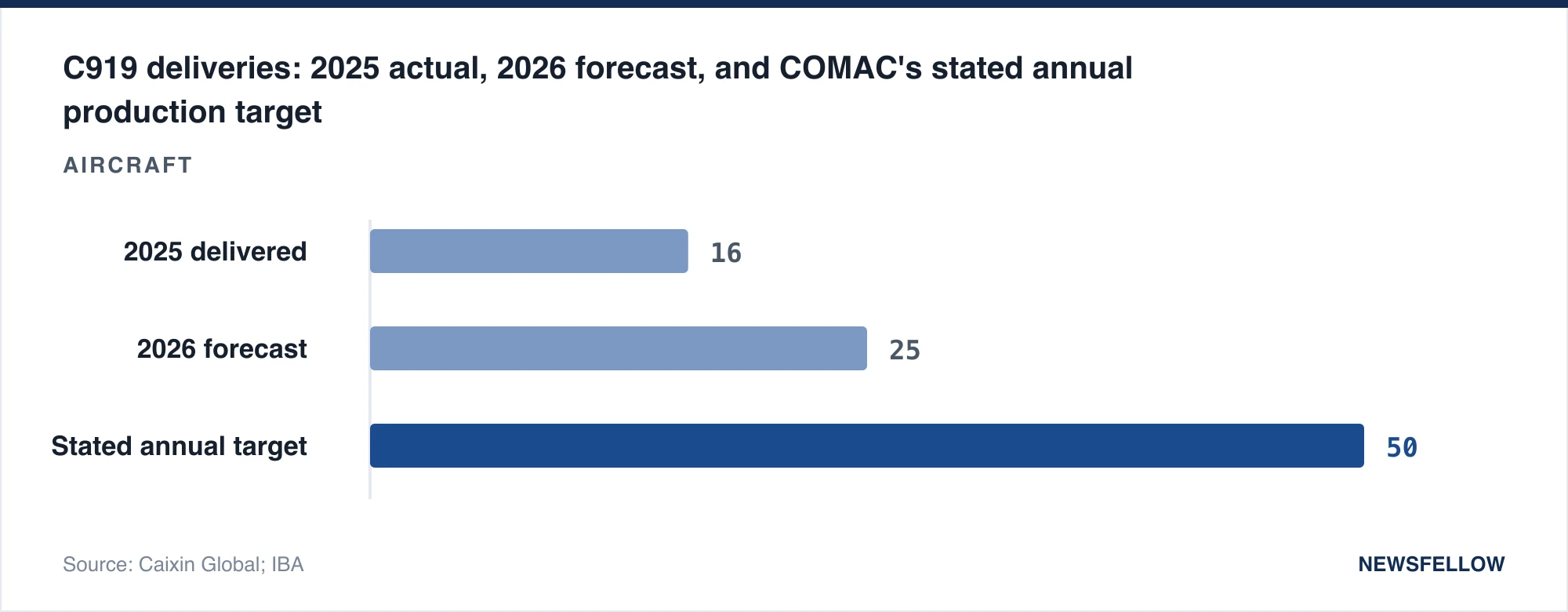
Set that against the comparison Caixin itself draws: Airbus delivered roughly 100 narrowbodies into China in 2025 alone. The C919's order book — reported at more than 1,200 aircraft, with a backlog exceeding 1,000 frames entering 2026 — is concentrated almost entirely among Chinese state-owned airlines and leasing companies. At 25 deliveries a year, that backlog is measured in decades.
The operating record, by contrast, is accumulating faster than the fleet. The C919 has now flown more than 12,000 flights and carried around 1.6 million passengers across more than ten routes within China. For a manufacturer trying to build the in-service data that certification authorities and lessors will eventually scrutinise, utilisation of the small fleet matters as much as the size of it — and this is precisely why an international rotation, even a short one to a neighbouring capital, is worth doing.
What it means from Delhi, Dubai and Singapore
For readers in this region the relevant question is not whether COMAC can build an aeroplane. It is whether the C919 becomes a third option for the fastest-growing narrowbody markets on earth.
The near-term answer is no. India's carriers have committed to Airbus and Boeing on a scale that leaves no room and no need for a third type: IndiGo and Air India together hold orders for well over a thousand aircraft, overwhelmingly A320-family and 737 MAX, and India's regulatory relationship with Chinese-certificated aircraft is not one that supports a near-term type acceptance. Gulf carriers operate widebody-heavy fleets where the C919 has no product at all; the C929 widebody, shown as a model at the 2026 Singapore Airshow, remains a development programme rather than a purchasable aircraft.
Southeast Asia is the plausible testing ground, and COMAC has said as much — it has prioritised the region for expansion, building on the smaller C909 regional jet's presence with operators in Laos, Indonesia and Vietnam. Those placements have generally involved state-to-state facilitation rather than open commercial competition, and they are better read as certification and support-network groundwork than as market share.
There is also a geopolitical current running underneath all of this. Reporting this year has suggested China slowed regulatory approvals for Airbus aircraft while COMAC pursues EASA certification — a claim that should be treated as attributed rather than established, since neither the CAAC nor Airbus has confirmed it. If accurate, it would indicate that market access is being negotiated as a package rather than assessed on technical merit, which would in turn make Western certification of the C919 a slower and more political process, not a faster one.
The honest scorecard
What happened on 12 August is a real milestone and a narrow one.
Real, because a first scheduled international service is not something a manufacturer can fake. It requires an operator willing to put the type on a route with an alternate-airport plan, a foreign regulator willing to accept the aircraft, ground handling and maintenance arrangements at a station outside the home network, and enough dispatch reliability confidence to schedule it daily rather than run it as a demonstration. Air China has done all of that.
Narrow, because Ulaanbaatar is roughly two hours from Beijing, the arrangement rests on one bilateral agreement, and the aircraft replacing a 737 MAX on the route was itself built with a Western engine and a substantially Western systems set. The C919 has demonstrated that it can operate abroad. It has not yet demonstrated that it can be bought abroad.
For the aviation duopoly, the meaningful date is not 12 August 2026. It is whenever COMAC's delivery rate stops being the story — and on current evidence, that is still years away.
Sources
- Caixin Global, "China's C919 Completes First Scheduled International Commercial Flight," 14 August 2026 — https://www.caixinglobal.com/2026-08-14/chinas-c919-completes-first-scheduled-international-commercial-flight-102473917.html
- CNBC, "China's answer to Boeing and Airbus makes first international flight — could COMAC challenge the aviation duopoly?", 12 August 2026 — https://www.cnbc.com/2026/08/12/china-comac-boeing-airbus.html
- Global Times, "C919 completes first scheduled international commercial service," August 2026 — https://www.globaltimes.cn/page/202608/1368097.shtml
- Aviation A2Z, "China's C919 Finally Goes International with First Commercial Flight to Mongolia," 13 August 2026 — https://aviationa2z.com/index.php/2026/08/13/chinas-c919-finally-goes-international/
- IBA, "COMAC Aircraft Programmes — Status & Outlook" — https://www.iba.aero/resources/articles/comac-aircraft-programmes-status-outlook/
- AeroTime, "China reportedly slowed Airbus approvals" — https://www.aerotime.aero/articles/china-airbus-approvals-comac-c919-certification
- Comac C929, Wikipedia (Singapore Airshow 2026 model display) — https://en.wikipedia.org/wiki/Comac_C929