Cathay Pacific and Google Just Ran 80 Flights to Test Whether Contrails Can Be Steered Away

A Hong Kong carrier joins a fast-growing climate experiment
Cathay Pacific and Google announced on September 7, 2026, that they have completed the first phase of a joint trial aimed at reducing the warming effect of aircraft contrails — the thin ice-crystal trails that form behind jets at cruising altitude. Cathay says it is Google's first commercial airline partner in Asia-Pacific for the technology, and the first airline anywhere to test contrail avoidance specifically on ultra-long-haul flights, a category that includes some of Cathay's longest routes across the Pacific.
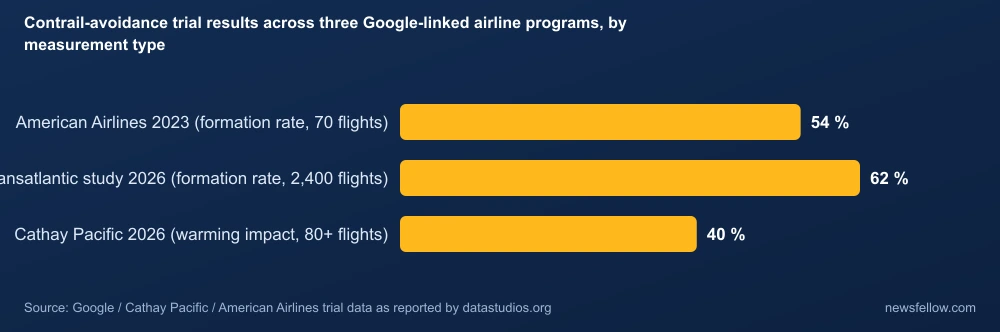
The trial began operationally in late 2025 with a target of more than 100 participating flights across Cathay's network. More than 80 flights ultimately flew contrail-avoidance routing, including services on the Hong Kong-Singapore corridor, an airspace corridor that Cathay and Google identified as one where atmospheric conditions frequently favor the formation of long-lived, heat-trapping contrails. Google says its modeling estimates those 80-plus flights achieved roughly a 40% reduction in the warming impact of the contrails they produced, compared with the flights' original, unmodified routings.
Why contrails matter to an industry focused on carbon
Airlines have spent the past decade building their climate narratives almost entirely around carbon dioxide — sustainable aviation fuel, fleet renewal, more efficient engines. Contrails are a different problem, and in some ways a bigger one over shorter timescales. When a jet crosses air that is already cold and saturated with moisture, the water vapor and soot particles in its exhaust can freeze into ice crystals that persist as visible white trails, sometimes spreading into cirrus-like cloud cover that lingers for hours. Climate scientists have argued for years that this "contrail cirrus" effect may contribute as much to aviation's net warming impact as its direct CO2 emissions, even though it comes from a comparatively small share of flights that happen to cross the wrong patch of sky at the wrong altitude.
The appeal of contrail avoidance, as opposed to fuel-burn reduction, is that it does not require new aircraft, new fuel, or years of fleet turnover. It requires better forecasting of where contrail-forming conditions exist, and a willingness to nudge a flight a few thousand feet up or down to avoid them — sometimes at a small fuel penalty, sometimes at none at all if the alternate altitude is otherwise efficient.
How the system works
Google's contribution combines AI-based predictive modeling, satellite imagery of existing contrail formation, and weather intelligence to forecast which corridors of airspace are likely to produce persistent, warming contrails on a given day. Cathay's role is operational: the airline routes those forecasts to its cockpits through its Electronic Flight Folder system, delivered over in-flight connectivity, letting pilots make real-time or pre-flight altitude adjustments where operationally feasible.
Lawrence Fong, Cathay Pacific's director of digital and IT, said in the companies' joint statement that "aviation needs solutions to address climate change, and AI is accelerating that progress." Google Hong Kong managing director Michael Yue said the company believes "AI has the power to help address complex environmental challenges," framing the Cathay partnership as an extension of Google's existing contrail research with other carriers.
That existing research gives useful context for how to read Cathay's 40% figure. Google ran an earlier trial with American Airlines in 2023 covering 70 test flights, which produced a measured 54% reduction in contrail formation rate, at a cost of roughly 2% additional fuel burn on the flights that were rerouted. A separate, much larger 2026 transatlantic study using integrated flight-planning software across 2,400 flights found a 62% reduction in contrail formation rate. Cathay and Google are careful to note that their 40% figure measures something different — modeled reduction in warming impact, not simply a reduction in how often contrails form — which is a harder number to verify independently and one that depends heavily on the underlying climate model's assumptions. Neither company has published a fuel-burn penalty figure for the Cathay trial.
What comes next
Cathay says a second phase will expand the trials across its broader Asia and transpacific networks, including some of the ultra-long-haul sectors that distinguish its route map — flights where fuel reserves, step-climb planning, turbulence avoidance and air traffic coordination across multiple regulatory jurisdictions make altitude changes more operationally complex than on a short regional hop. The stated goal of that second phase is to generate enough operational data to determine whether contrail avoidance can become a routine, scaled part of flight planning rather than a bounded research exercise.
That distinction matters because contrail avoidance, unlike a fleet order or a route launch, does not produce a single clean before-and-after number the way a delivery ceremony does. Its value depends on forecasting accuracy holding up across thousands of flights and dozens of air traffic control regions, on regulators being comfortable with pilots deviating from filed altitudes for climate reasons, and on airlines accepting a fuel penalty — even a small one — as a cost of the program rather than a barrier to it. None of that is guaranteed to scale simply because a pilot trial produced an encouraging modeled result.
The wider race among Asian and Gulf carriers on sustainability positioning
Cathay's announcement lands amid a broader push by Asia-Pacific and Gulf carriers to stake out visible sustainability initiatives beyond fuel-efficiency talking points, as regulators in the EU and elsewhere tighten scrutiny of aviation's climate claims. Being first in the region to test the technology, and first anywhere to test it on ultra-long-haul sectors, gives Cathay a specific, defensible claim rather than a general one — useful in an environment where "green" airline marketing has drawn increasing skepticism from climate researchers and regulators alike.
Whether the approach reaches other carriers in the region will likely depend on how phase two performs, and on whether Google's forecasting model can be validated by parties outside the two companies running the trial. For now, the concrete facts are these: more than 80 Cathay Pacific flights flew altered routes based on AI contrail forecasts between late 2025 and the trial's completion; Google estimates a roughly 40% cut in those flights' modeled warming impact; and Cathay has not disclosed what that cost the airline in additional fuel.
Why airlines keep coming back to Google for this specific problem
Google's contrail work did not start with Cathay Pacific, and that history is part of why the airline chose this partner rather than building forecasting tools in-house. The company has spent several years assembling a dataset built from satellite imagery, weather models and flight-plan records specifically to identify where in the atmosphere a jet's exhaust is most likely to freeze into a long-lived, heat-trapping cloud rather than dissipating harmlessly within seconds. That is a narrower and more specialized modeling problem than general aviation weather forecasting, and it is one reason a search and cloud-computing company rather than an aerospace supplier has ended up as the common thread across several of the industry's highest-profile contrail trials.
For an airline the appeal is that the marginal cost of participating is low relative to other climate initiatives. Sustainable aviation fuel remains expensive and scarce; new, more efficient aircraft take years to deliver and billions of dollars to acquire; but plugging a third-party forecast into an existing electronic flight folder and asking pilots to occasionally fly a few thousand feet higher or lower is comparatively cheap to trial, even if scaling it reliably across a global network turns out to be much harder than running a bounded pilot program.
The verification gap regulators are likely to press on
Aviation climate claims have come under heavier scrutiny in the past two years, particularly from European regulators who have pushed back on airlines advertising fuel-efficiency or offset claims without independent verification. A modeled 40% reduction in warming impact, produced jointly by the airline and the technology vendor with no third-party audit disclosed, sits in a category regulators are increasingly likely to ask about directly: is the number reproducible by an outside climate scientist using the same flight data, and does it hold up once the trial moves from a controlled, high-attention pilot phase into routine daily operations, where forecasting errors, air traffic control refusals, and fuel-planning conservatism are more likely to erode the benefit. Cathay and Google have not said whether they plan to submit the trial's methodology or results for independent peer review, and neither company's public statement addressed the point directly.
That gap does not make the underlying trial meaningless — contrail science is a real and increasingly well-documented area of climate research, and the mechanism Cathay and Google describe is consistent with published academic work on contrail cirrus formation. But it does mean the 40% figure, like similar figures from earlier Google-linked trials, should be read as a company-reported estimate from an active pilot program rather than a peer-reviewed, audited result.
Sources
- Cathay Pacific and Google Partner to Research and Trial AI-Powered Contrail Avoidance — Cathay Pacific Newsroom
- Cathay Pacific partners with Google on contrail research — Business Travel News Europe
- Google, Cathay Pacific Expand Contrail Avoidance Trials in Asia-Pacific — Unite.AI
- Google and Cathay Pacific Expand AI Contrail Trials: 40% Estimated Warming Reduction, Predictive Flight Routing, and Aviation Climate Tech — Data Studios
- Cathay Pacific joins Google in global trial of AI-powered contrail avoidance to address climate impact — Dim Sum Daily