Boeing and Its Engineers Reach a Tentative Deal — With a 737 MAX 10 Certification Clock Still Running
Boeing and the Society of Professional Engineering Employees in Aerospace reached a revised tentative contract agreement on September 12, according to multiple reports, offering a sweetened wage package to roughly 17,000 engineers and technical workers just weeks before a strike could have begun. The union's bargaining teams are recommending members vote yes, but the deal still requires ratification, and it arrives with an unusually consequential deadline attached: SPEEA members are central to certifying both the 737 MAX 10 and the 777-9, two widebody and narrowbody programs already running years behind schedule.
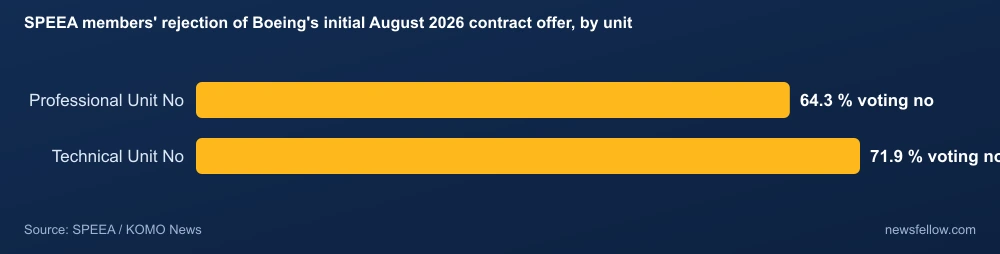
The tentative agreement follows a bruising month for Boeing's labor relations. On August 21, members of SPEEA's Professional Unit — nearly 13,000 engineers and scientists — rejected the company's initial contract offer by a 64.3% no vote, 7,238 to 4,027. The union's Technical Unit, representing more than 4,000 analysts, designers and technicians, rejected its own offer even more decisively, at 71.9% no, 2,795 to 1,094. In the same vote, members authorized a strike: 87.8% of Professional Unit voters and 89.7% of Technical Unit voters backed authorization, on a turnout SPEEA said reached 92% of eligible members. Under the union's contract calendar, no walkout could begin before the existing agreements expire on October 6, meaning October 7 was the earliest possible strike date.
What changed in the new offer
The gap between the rejected offer and the new one is centered on wages. Boeing's original proposal included only 3% general wage increases, a figure SPEEA members and bargaining teams characterized publicly as inadequate given inflation and the physical toll of a company still working through the aftermath of the 2024 machinists' strike and a string of manufacturing-quality problems. The revised four-year package pairs a 10% guaranteed wage increase effective October 16 with a further 4% guaranteed increase during the annual compensation review in March 2027, followed by 6% annual wage pools in 2028, 2029 and 2030 — each of which itself includes a 4% guaranteed increase for all members, with the remainder distributed on a merit basis. Combined across the life of the contract, some reporting has characterized the cumulative wage growth on offer as approaching 29% to 35%, depending on how merit pools are counted.
Beyond pay, the new offer revises work-from-home policy language and adjusts overtime limits for Professional Unit members — both sticking points that surfaced repeatedly in members' public comments after the August rejection, alongside pay. Boeing's vice president of production engineering, Ben Nimmergut, said the company's offer "addresses the top priorities identified by our employees and SPEEA's bargaining teams, including an immediate wage increase and larger wage pools with guarantees." SPEEA's negotiating team, in messaging to members, credited the shift directly to the August vote: "We heard you clearly... We took your words with us back to the table, and they shaped every conversation we had with Boeing executives." The union's team also cautioned that the deal "isn't everything we'd asked for," describing it instead as "a real step forward."
Why this fight matters beyond payroll
SPEEA's roughly 17,000 members are concentrated in the Puget Sound region of Washington state, where Boeing's commercial aircraft engineering and technical workforce has been based since the company's founding, and the union has not negotiated an entirely new contract — as opposed to extensions — since 2012. That thirteen-year gap between fresh negotiations is itself part of the backdrop to members' frustration: the 2016 and 2020 rounds were contract extensions rather than newly negotiated terms, meaning this year's talks represented the union's first real opportunity in over a decade to reset wages and working conditions from scratch.
The stakes extend well past the Puget Sound labor market. SPEEA's Professional and Technical Unit members are directly involved in the engineering and certification work behind Boeing's most schedule-sensitive programs. The 737 MAX 10, the largest variant of the MAX family, has faced repeated delays in securing FAA certification, and the 777-9, Boeing's next-generation widebody, has likewise slipped years past its original target entry-into-service date. A strike beginning October 7 would have pulled engineering and technical staff off certification-support work at precisely the moment both programs are trying to clear their final regulatory hurdles — a scenario Boeing had been visibly bracing for. In the weeks before the tentative deal, the company began hiring contractors into engineering and technician roles specifically to blunt the operational impact if a walkout occurred, a preparation that itself signaled how seriously Boeing management was taking the strike threat.
The shadow of 2024
Boeing's approach to these negotiations has been shaped by the far larger and costlier 2024 machinists' strike, when roughly 33,000 members of the International Association of Machinists and Aerospace Workers walked out for weeks, halting 737, 767 and 777 production and costing the company billions of dollars at a moment when it could least afford it. That strike ended only after Boeing returned with a substantially improved wage offer of its own, a precedent SPEEA members have referenced in pushing back on the company's initial, more modest engineering proposal. Boeing management, for its part, appears to have moved more quickly this time to head off a repeat: the revised SPEEA offer arrived roughly three weeks after the August rejection vote, well ahead of the October 6 contract expiration, rather than waiting until a strike was actually underway.
Whether that faster response succeeds now depends on a membership ratification vote. Reports of the September 12 tentative agreement did not specify an exact ratification date, though the timeline is necessarily compressed: with the current contract expiring October 6, SPEEA needs to complete voting and communicate results before that date to avoid triggering the strike window regardless of how members ultimately feel about the improved terms. Union bargaining teams recommending a "yes" vote does not guarantee members will agree — the same teams presumably recommended or at least presented the original 3%-raise offer without securing member buy-in — but the scale of the wage improvement, roughly tripling the initial guaranteed increase, gives the revised deal a materially different starting point than the offer members rejected by wide margins three weeks earlier.
What happens next
If SPEEA members ratify the agreement, Boeing avoids what would have been its second major labor disruption in roughly two years, and certification work on the MAX 10 and 777-9 continues without the added complication of an engineering and technical staff walkout. If members reject it, the union returns to a strike-eligible position starting October 7, with the added leverage of having already demonstrated near-unanimous strike authorization support in August. Boeing has not publicly indicated what, if anything, it would offer beyond the current package should this tentative deal also fail to win ratification.
For now, the immediate crisis has been deferred rather than resolved: a vote still has to happen, a deadline still looms on October 6, and two of Boeing's highest-profile, most delay-prone aircraft programs remain dependent on the outcome.
How close the certifications actually are
The timing of the labor fight is especially sensitive because both programs SPEEA members support are, for the first time in years, plausibly close to the finish line rather than mired in open-ended delay. The 737 MAX 10 completed its final certification test flight on July 28, 2026, closing out a flight-test campaign that ran to 976 flights and more than 2,060 flight hours, plus roughly 1,040 hours of ground testing. With flight testing done, the remaining work is exactly the kind of desk-bound engineering effort SPEEA members perform: closing development assurance reviews, completing system safety assessments, and assembling the final documentation package the FAA needs before issuing a type certificate. Boeing and the FAA have both pointed to an early-fall 2026 certification target for the MAX 10, with commercial deliveries expected to begin in 2027 — assuming no new interruption to that documentation and review work.
The larger 777-9 widebody sits a step behind. Airlines awaiting the jet are now planning around a second-quarter 2027 delivery start, with Boeing targeting a type certificate either in late 2026 or early 2027. The FAA has structured its review sequence so that the 737 MAX 7 and MAX 10 clear certification before the 777-9, meaning SPEEA's engineering and technical staff are currently central to two overlapping, sequential regulatory pushes rather than one — a narrowbody program in its final documentation sprint and a widebody program still working through its own safety assessments behind it. A strike removing thousands of engineers and technicians from that work, even briefly, would have landed at the least convenient possible moment for a company that has spent much of 2026 rebuilding credibility with regulators, airline customers and its own workforce after years of manufacturing-quality and schedule problems.
Sources
- Boeing and engineers' union reach tentative contract agreement — GV Wire
- Working to Avoid Strike, Boeing Advances Another SPEEA Offer — Leeham News and Analysis
- Boeing and SPEEA Reach Revised Four-Year Tentative Deal With 10% Raise Set for Oct. 16 If Approved — Traders Agency
- Boeing makes final SPEEA offer with an immediate 10% guaranteed raise after August rejection — Lynnwood Times
- Engineers reject contract, authorize strike at Boeing — NW Labor Press
- Boeing engineers, technical workers reject contracts, could strike after fall deadline — KOMO News
- Boeing's 737 MAX 10 Completes Final Test Flight — AirlineGeeks
- 737-10 completes final certification flight — Boeing
- Here's Exactly What's Left Before Boeing's 777-9 & 737 MAX 10 Enter Service In 2027 — Simple Flying