17,000 Boeing Engineers Just Rejected a 28.5% Raise — and Voted to Strike Instead
Engineers and technicians who design and certify Boeing's commercial jets have rejected the company's "best and final" contract offer and voted overwhelmingly to authorize a strike, setting up a potential second major labor confrontation at the planemaker in as many years.
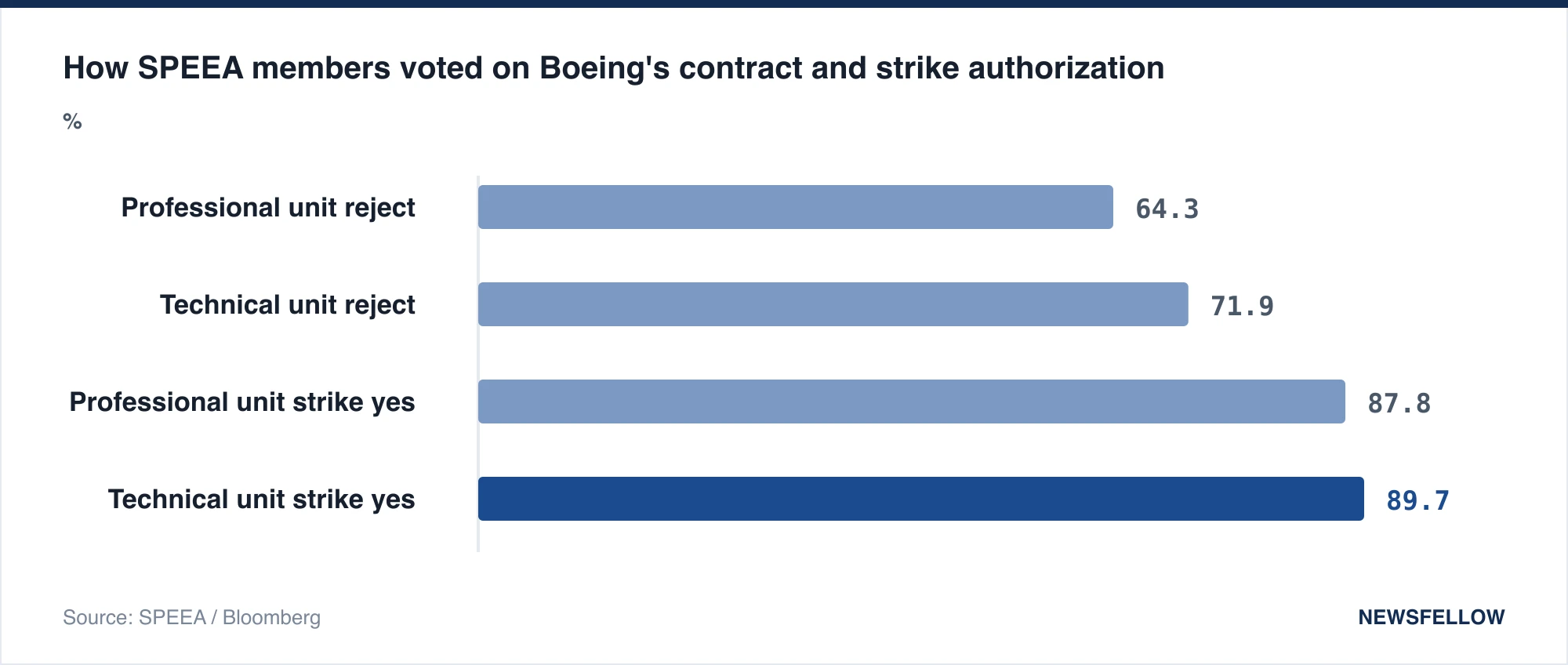
The Society of Professional Engineering Employees in Aerospace (SPEEA), which represents roughly 17,000 Boeing engineers, scientists, technicians and other technical staff in Washington state and nearby facilities, announced the results on August 21. Members in the professional unit — about 13,000 engineers and scientists — rejected Boeing's offer by 64.3%. Members in the technical unit, which covers roughly 4,000 analysts, technicians, planners and specialists, rejected their offer by an even wider 71.9% margin.
Both units then voted separately to authorize a strike if a deal isn't reached before their current contracts expire on October 6. That authorization passed by 87.8% among professional-unit members and 89.7% among technical-unit members, with SPEEA reporting roughly 92% of eligible members turning out to vote. Under the union's own rules, the earliest any walkout could legally begin is October 7 — talks are set to resume before then.
What Boeing put on the table
Boeing had billed its offer as a "Best and Final Offer" (BAFO), typically a signal that a company does not intend to negotiate further before a deadline. The proposal covered a four-year deal running through 2030 and included a 3% general wage increase upon ratification, retroactive to February 20, 2026, followed by a 7% increase to salary pools in March 2027 and 5.5% annual increases each year after that — a headline wage increase Boeing put at 28.5% over the life of the contract, or as much as 31.9% once performance bonuses and promotion-related pay are factored in.
The offer also included provisions aimed at two of the workforce's longer-standing grievances: a letter of understanding from Boeing executives affirming commitment to keeping engineering work in the Pacific Northwest, and a joint Boeing-union committee to field safety concerns raised by employees without fear of retaliation.
Despite the raise, members in both units rejected the terms by wide margins — a result Leeham News described as having been foreshadowed by "lingering resentment" among the rank and file heading into the vote.
Boeing's response
Boeing said it was disappointed by the outcome and confirmed it is activating its strike contingency plan. In a statement following the vote, the company said funds it had earmarked for the SPEEA workforce — including retroactive pay tied to ratification and a higher incentive-plan target for 2026 — are "no longer available" now that the offer has been turned down, a warning that any future deal is unlikely to improve on the rejected terms.
SPEEA's negotiating team said it plans to survey members on what changes would make a contract acceptable, then seek to resume bargaining with Boeing — now backed by the standing authority to call a strike without a further membership vote if talks stall.
Why the timing matters
The vote lands at a sensitive moment for Boeing. The company is in the final stages of certifying new aircraft variants, including the long-delayed 737 MAX 7 and MAX 10, and is working to stabilize 737 and 787 production and delivery rates after years of manufacturing and regulatory setbacks. SPEEA's professional and technical staff perform the engineering, testing and certification work that underpins those programs — a walkout, unlike a machinist strike, would hit Boeing's ability to move aircraft through the certification pipeline rather than just its factory floor output.
It is also a fresh test of labor relations at Boeing less than two years after more than 33,000 members of the International Association of Machinists and Aerospace Workers (IAM) walked out for seven weeks in the fall of 2024, halting 737, 767 and 777 production and costing the company billions of dollars before workers ratified a new contract that November.
SPEEA itself has a long history of contentious bargaining with Boeing but has not struck the company since a 40-day walkout by its engineers in 2000. This is the union's first full renegotiation of its contract with Boeing in 14 years, according to regional reporting on the talks.
What happens next
With the current contract's October 6 expiration now the operative deadline, both sides have roughly six weeks to reach a new agreement before a strike becomes legally possible. Boeing has not said whether it will return with a revised offer or hold to the terms already rejected. SPEEA leadership has signaled it wants to keep talking rather than force an immediate walkout, but the strength of the strike-authorization vote gives its negotiators significant leverage heading into the next round.
Sources
- Engineers, Technicians reject Boeing's "Best and Final Offer"; authorize strike; talks to resume — Leeham News and Analysis
- Boeing Engineers Union Reject Contract Offer, Votes to Strike — Bloomberg
- Boeing engineers, technical workers reject contracts, could strike after fall deadline — KOMO News
- Boeing, SPEEA contract offers nearly 29% pay bump — The Spokesman-Review
- Pontifications: Lingering Resentment Overhangs SPEEA Vote; Contract Defeat Seems Likely — Leeham News and Analysis