Boeing Hands Its Flying-Car Bet to a Startup — and Takes a Fifth of the Company Instead

Boeing spent close to a decade and, by outside estimates, well over a billion dollars trying to own a piece of the future of urban flight. This month it decided the better bet was to own a piece of someone else's company instead.
On August 10, Boeing and Archer Aviation announced a definitive agreement under which Archer will acquire three Boeing subsidiaries — Wisk Aero, Insitu and SkyGrid — in a transaction Boeing says is worth up to $1 billion. In return, Boeing will receive approximately 19.75% of Archer's Class A shares, along with options to buy more over the next four years, and has committed to invest up to $55 million in stock in Archer's next funding round. The deal is expected to close by the end of 2026, pending antitrust clearance and national-security review.
It is an unusual trade for an aerospace giant that has spent recent years trying to sell things, not businesses that build the future of flight — and it tells you something about how far electric air taxis still are from paying their own way.
What Boeing is actually giving up
The three companies moving to Archer are not interchangeable. Wisk Aero, Boeing's most visible eVTOL bet, has spent years developing a fully autonomous, self-flying air taxi — a harder technical and regulatory problem than the piloted eVTOLs most competitors, including Archer's own Midnight aircraft, are pursuing. Wisk was originally a joint venture between Boeing and Kitty Hawk, the eVTOL company backed by Google co-founder Larry Page, before Boeing took full ownership in 2023.
SkyGrid is smaller and less well known outside the industry: it builds airspace-management and traffic-deconfliction software intended to let large numbers of autonomous aircraft — air taxis, delivery drones, military systems — operate safely in the same low-altitude airspace without a human air traffic controller for every flight.
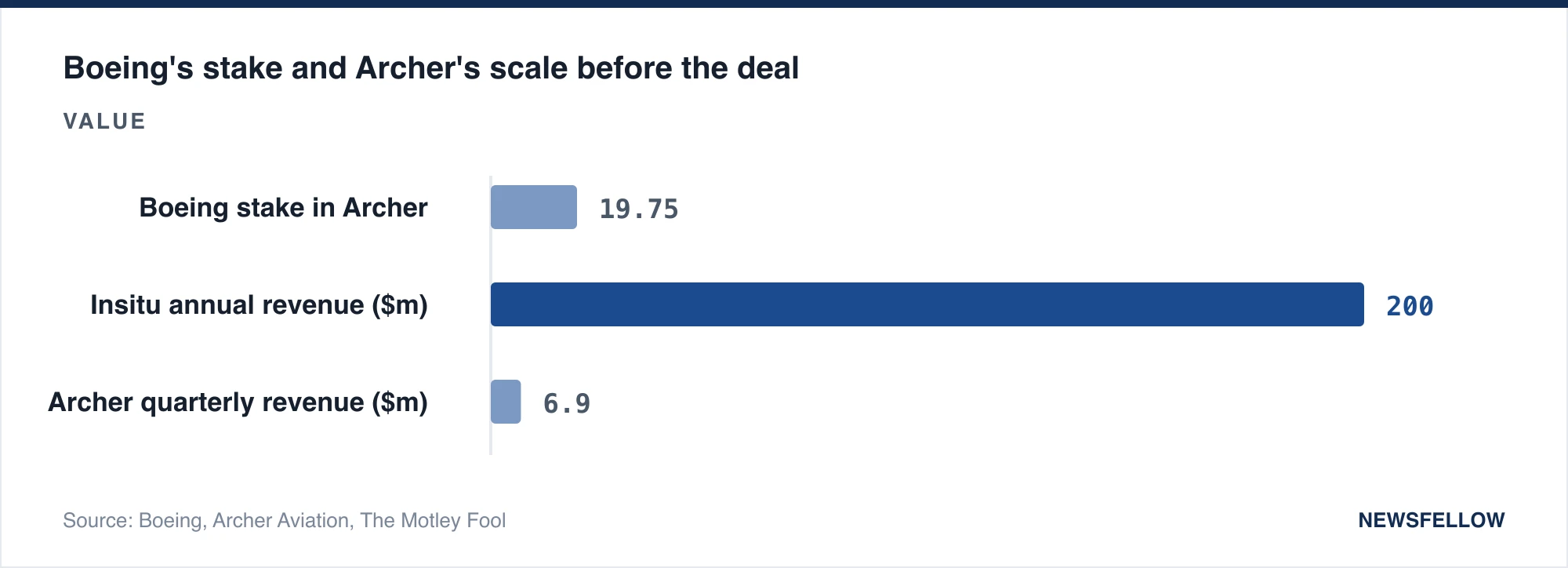
Insitu is the outlier, and arguably the most financially significant piece of the deal. Unlike Wisk and SkyGrid, which are pre-revenue research bets, Insitu is an established, profitable business making uncrewed aircraft — its ScanEagle and Integrator drones have been used for surveillance and reconnaissance by the U.S. Navy and allied militaries for years. Insitu generates roughly $200 million in annual revenue, according to reporting on the deal, which dwarfs Archer's own top line: the company posted just $6.9 million of revenue in its most recent quarter, per public disclosures. Folding a profitable $200 million defense-adjacent business into a company that small is, on its own, a significant change to Archer's financial profile — and a reason some analysts read this less as an "eVTOL merger" and more as Archer buying a revenue stream with Boeing's blessing.
Why Boeing is doing this
Boeing's core commercial and defense businesses have had a rough several years — production quality problems on the 737 MAX and 787 lines, a machinists' strike, and years of cash burn have left the company more focused on discipline than on speculative side bets. Autonomous eVTOL flight was always a long-dated, capital-intensive wager with no clear path to certification revenue this decade. Divesting Wisk, Insitu and SkyGrid lets Boeing convert years of sunk R&D spending into an equity stake it can carry on its balance sheet, rather than a cost center it has to keep funding through FAA certification, which for a fully autonomous aircraft is likely still years away.
Crucially, Boeing isn't walking away from the technology entirely. As part of the agreement, Boeing has secured a collaboration and technology-sharing arrangement that keeps it access to Wisk's core autonomous-flight software — the piece Boeing's defense and future-mobility units are most likely to want back if autonomous systems become commercially or militarily important later this decade.
Why Archer wants it
Archer, based in San Jose, California, has been racing rival Joby Aviation to be first to commercial eVTOL service with a piloted aircraft, its Midnight air taxi. Acquiring Wisk gives Archer a fully autonomous aircraft program and years of FAA engagement on self-flying certification — a capability it would otherwise have had to build from scratch. SkyGrid adds airspace-management software that becomes more valuable the more aircraft, crewed or not, Archer eventually has in the sky. And Insitu's defense contracts and steady revenue give Archer, a company still years from meaningful commercial air-taxi revenue, a way to show investors cash flow today rather than only promises.
The market's initial verdict was enthusiastic. Archer's stock climbed sharply in the days after the announcement, part of a broader run that saw shares rise from around $4.50 to nearly $7 over the following weeks, helped by the Boeing news alongside other defense-related announcements from the company. By late August, analysts were framing the transaction as a rare example of a deal that "de-risks" both companies simultaneously — giving Boeing an equity claim on eVTOL upside without the R&D bill, and giving Archer technology and revenue it could not have built or bought cheaply on its own.
The catch: this still isn't a done deal, and eVTOL still isn't commercial
Nothing about this transaction changes the fundamental fact that no eVTOL company — not Archer, not Joby, not any competitor — has a fully certified, revenue-generating passenger air-taxi service operating in the United States today. The FAA's certification path for powered-lift aircraft remains a work in progress, and a fully autonomous, pilotless air taxi like the one Wisk has been developing faces an even steeper regulatory climb than the piloted aircraft closer to market.
The deal itself also isn't final. It requires antitrust clearance and is subject to national-security review given Insitu's defense-technology profile and Boeing's continuing involvement through its retained equity stake and technology-sharing agreement. Both companies have targeted a close by the end of 2026, but large industrial-defense transactions of this kind have been slowed or reshaped by regulatory review before.
For now, the deal is best read as a signal about where each company sees its advantage: Boeing betting it can profit from urban air mobility without carrying the R&D risk, and Archer betting that owning more of the technology stack — autonomy, airspace management, and a profitable drone business — is worth diluting itself by roughly a fifth to Boeing.
Sources
- Boeing sells eVTOL subsidiaries, takes stake in Archer — CNBC
- Boeing to sell three subsidiaries to eVTOL firm Archer — Breaking Defense
- Boeing sells eVTOL subsidiaries to Archer, acquires stake — ch-aviation
- Archer Aviation Has $6.9 Million of Revenue. It's Buying a Boeing Business With More Than $200 Million. — The Motley Fool
- A Win-Win Deal: Here's Why the Archer Aviation and Boeing Deal Adds Value to Both Stocks — The Motley Fool
- ACHR Stock Skyrockets as Boeing Takes 20% Stake in Archer Aviation — Yahoo Finance