India Just Retired an Airport's Identity: Why VTZ Now Belongs to a Runway 45 Km Away

For decades, the three letters VTZ meant one specific patch of tarmac on India's east coast: Visakhapatnam Airport, a shared civilian-military facility that had served the port city since the jet age. On August 17, 2026, that code moved. Commercial aviation shifted wholesale to a brand-new airport 45 kilometres up the coast, and the old Visakhapatnam Airport stopped handling scheduled passenger flights altogether.
The new facility is the Alluri Sitarama Raju International Airport at Bhogapuram, in Andhra Pradesh's Vizianagaram district. Prime Minister Narendra Modi inaugurated it on August 1, and commercial operations began 16 days later, with the IATA code VTZ transferring from the old airport to the new one — a rare instance of an Indian city's aviation identity being physically relocated rather than simply expanded.
A Greenfield Built to Outgrow Its Own Opening Numbers
Bhogapuram was developed on 2,200 acres under a public-private partnership led by GMR Visakhapatnam International Airport Limited, a subsidiary of GMR Group, which also operates Delhi and Hyderabad airports. The foundation stone was laid in May 2023, with a formal Bhoomi Pujan ceremony that November — meaning the airport went from groundbreaking to commercial flights in roughly three years, finishing, according to project reporting, several months ahead of schedule.
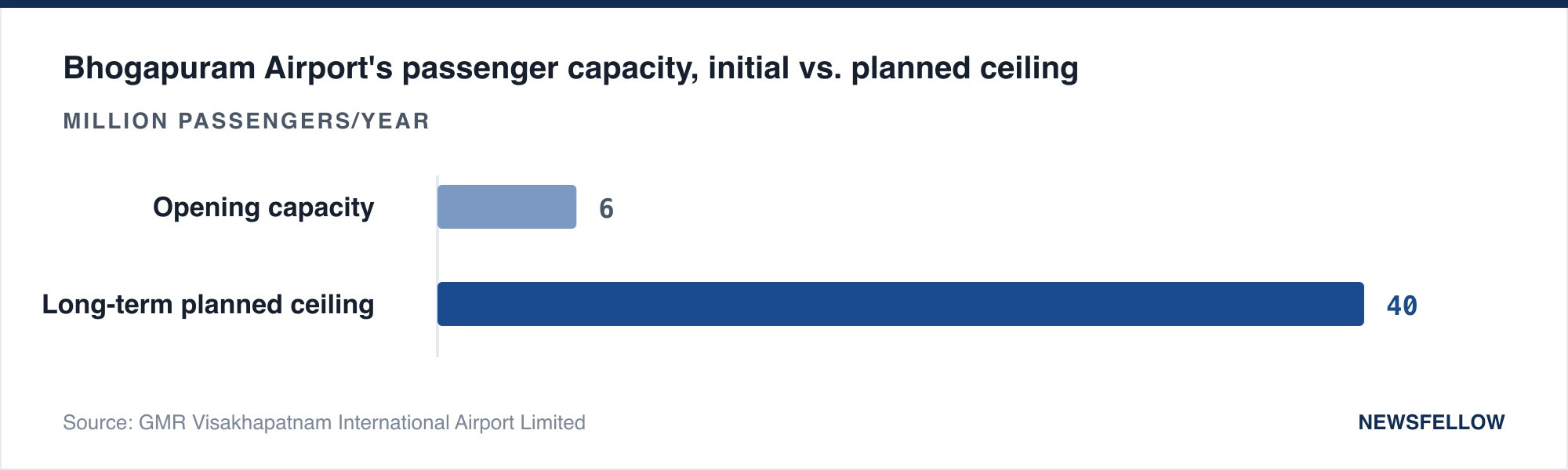
The integrated passenger terminal covers 77,342 square metres and opens with capacity for 6 million passengers annually. That is only the starting point: the design allows for phased expansion up to more than 40 million passengers a year, a ceiling that puts Bhogapuram's long-term ambition in the same bracket as some of India's largest metro airports, though reaching it will depend on demand materializing over years, not months. GMR has indicated the airport is expected to reach its initial 6-million design capacity within four to five years of opening, driven by tourism, cargo and regional economic growth along the northern Andhra coast.
Project cost estimates vary by source and reporting date, ranging from roughly Rs 4,592 crore to figures closer to Rs 5,640 crore — a spread that likely reflects different scopes (initial phase versus full build-out) and the point in construction at which each estimate was made. NewsFellow was unable to independently confirm a single authoritative final cost figure at time of publication.
Why Move the Code At All
Airport code transfers are unusual precisely because they carry commercial weight: travel agents, booking systems, cargo manifests and years of search-engine indexing are all built around a three-letter identifier. Shifting VTZ from the old Visakhapatnam Airport to Bhogapuram signals that Indian aviation authorities and GMR intend Bhogapuram to be understood, immediately and unambiguously, as Visakhapatnam's airport — not a secondary or overflow facility.
The old Visakhapatnam Airport had operated as a joint civil-military base, a common arrangement at Indian airports where the Air Force or Navy retains primary control of the airfield and civilian operations run alongside it under capacity and scheduling constraints. A dedicated civilian greenfield airport removes those constraints and gives Andhra Pradesh's coastal economy a facility built solely around passenger and cargo growth rather than shared with defence operations.
What It Means for the Region
Bhogapuram is positioned to serve not just Visakhapatnam city but the broader coastal belt of northern Andhra Pradesh and southern Odisha, a stretch of India with significant port, steel and petrochemical industry alongside a growing tourism base built around the Eastern Ghats and coastline. A modern international terminal — as opposed to a shared military strip — is intended to support direct international routes and cargo capacity that the old airport's constraints made difficult.
The airport's naming, finalized in September 2024, honors Alluri Sitarama Raju, the Indian revolutionary and freedom fighter whose resistance campaign against British rule was centered in the hill tracts of what is now Andhra Pradesh — a naming choice that ties the state's newest piece of infrastructure to a specifically regional historical figure rather than a generic geographic label.
The Broader Pattern
Bhogapuram's opening fits a wider trend in Indian civil aviation: greenfield airports built well outside city cores and designed from day one for capacity far beyond initial demand, betting on India's aviation growth curve to catch up to the infrastructure rather than the reverse. Whether Bhogapuram's 40-million-passenger ceiling is reached in five years or fifteen will depend on factors well outside any single announcement — airline route decisions, regional economic growth and how quickly GMR builds out the phases beyond the initial terminal.
For now, the immediate, verifiable fact is simpler: as of August 17, 2026, a flight booked to VTZ lands 45 kilometres from where it would have a month earlier.
Sources
- Alluri Sitarama Raju International Airport — Wikipedia
- PM Modi inaugurates Alluri Sitarama Raju International Airport at Bhogapuram — Travel Trade Journal
- Alluri Sitarama Raju International Airport at Bhogapuram opens August 17 — NewsBytes
- Bhogapuram Airport starts flights with 60 lakh capacity — Multibagg Market Pulse
- Bhogapuram International Airport – Status, Master Plan & Design — The Metro Rail Guy
- Air India rationalises international route network through August 2026 — Air India Newsroom