Mexico's ASUR Closes $992 Million Deal for 20 Airports Across Brazil, Ecuador, Costa Rica and Curaçao

A nearly billion-dollar handover, one runway at a time
Grupo Aeroportuario del Sureste — the Mexican airport operator known as ASUR, which already runs Cancún and eight other airports in southeastern Mexico plus fields in Colombia and Puerto Rico — has closed its acquisition of Motiva's airport interests across Brazil, Ecuador, Costa Rica and Curaçao. The deal, worth about $992.2 million after customary closing adjustments, closed on September 1, 2026, and hands ASUR interests in 20 additional airports, according to the company's own disclosures and reporting from Reuters, Aviation Week and the trade outlet AviNews.
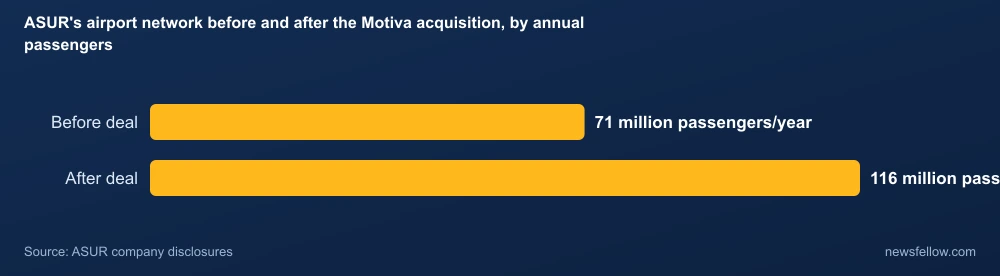
It is one of the more consequential ownership changes in Latin American aviation this year, not because any single airport in the portfolio is a global mega-hub, but because of how much territory it adds at once. The new airports collectively handle roughly 45 million passengers a year, according to ASUR's figures, which pushes the company's combined network above 116 million passengers annually based on recent traffic levels — a jump of nearly 65% in one transaction.
What ASUR actually bought
The portfolio breaks down into 17 airports in Brazil plus one airport each in Ecuador, Costa Rica and Curaçao:
- Brazil: 17 airports formerly held by Motiva Infraestrutura de Mobilidade (the transportation-infrastructure arm of the Brazilian conglomerate previously known as CCR), including Joinville-Lauro Carneiro de Loyola Airport in Santa Catarina state, which changed operators on the ground on September 4, 2026, according to Rio Times Online.
- Ecuador: Quito International Airport, one of the country's two primary international gateways.
- Costa Rica: Juan Santamaría International Airport, the main airport serving San José and the country's principal point of international entry.
- Curaçao: Curaçao International Airport (Hato), the Dutch Caribbean territory's only commercial airport.
The deal was first agreed in November 2025, with ASUR arranging a loan facility at the time it submitted its offer for Motiva's airport business. Regulatory approvals and other closing conditions took roughly ten months to clear before the transaction finalized this month. Notably, ASUR has said 17 of the 20 acquired airports have more than 15 years remaining on their operating concessions — a detail that matters because it determines how long ASUR can extract airport revenue (landing fees, retail, parking, cargo handling) before having to renegotiate or hand facilities back to the relevant governments.
Why Brazil is the headline, not the footnote
Of the four countries involved, Brazil is by far the most consequential addition. It is Latin America's largest aviation market by passenger volume, and ASUR previously had zero presence there — its existing network was concentrated in Mexico (Cancún, Mérida, Oaxaca, Veracruz and others), Colombia, and San Juan, Puerto Rico. Adding 17 Brazilian airports, even mostly smaller regional ones rather than São Paulo or Rio's primary hubs, gives ASUR its first operational foothold in a market that has been steadily privatizing and re-tendering airport concessions over the past decade.
The Motiva side of the transaction reflects an ongoing simplification within Brazilian infrastructure conglomerates. Motiva (the renamed CCR group) has been narrowing its focus toward core toll-road and urban-mobility concessions, and offloading its regional airport interests fits that broader strategic retrenchment rather than any distress signal specific to the airports themselves. Reporting from Rio Times Online and the Moodie Davitt Report both frame the sale as part of Motiva's portfolio-rationalization strategy rather than a forced disposal.
For the Caribbean and Central American pieces of the deal — Curaçao and Costa Rica — the stakes are smaller in absolute passenger terms but potentially larger in tourism-dependency terms. The Caribbean Journal noted that a change of operator at Curaçao's only airport could have knock-on effects for how the island manages seasonal tourist traffic and connectivity, since a single operator's investment priorities can shape route development, terminal capacity and ground-handling efficiency for years. Juan Santamaría, meanwhile, is Costa Rica's primary gateway for both leisure tourism and business travel, handling the bulk of the country's international arrivals alongside the smaller Daniel Oduber Quirós airport in Liberia.
The financing and the multiple
ASUR financed the roughly $992 million purchase price through a loan facility it arranged at the time of its original November 2025 offer, rather than issuing new equity — a structure that keeps existing shareholders' stakes from being diluted but does add leverage to the balance sheet. The company has not disclosed a full post-closing debt schedule, and neither ASUR's press materials nor the wire coverage reviewed for this article specify the exact multiple paid relative to the acquired airports' combined EBITDA, so that figure should be treated as unconfirmed pending ASUR's next quarterly filing.
What is confirmed is the operational transition plan: ASUR and Motiva have both said the changeover is proceeding "with operational continuity," meaning existing airport staff, ground-handling contracts and day-to-day management structures are staying in place in the near term rather than being replaced en masse. That is a common approach in airport M&A, where abrupt operational disruption risks safety and service issues that regulators — particularly Brazil's ANAC and Costa Rica's civil aviation authority — would scrutinize closely.
A pattern bigger than one deal
The ASUR-Motiva transaction sits inside a broader wave of airport consolidation and privatization activity across Latin America and the Caribbean, where governments have increasingly turned to long-term concessions with private operators — rather than direct state ownership — to fund runway, terminal and technology upgrades they cannot easily finance through public budgets alone. Mexico's own airport groups (ASUR, GAP and OMA) have themselves been the product of a 1990s-era privatization wave, and this deal effectively exports that Mexican operating model into Brazil, Ecuador, Costa Rica and the Dutch Caribbean in one step.
For travelers, the practical effects will likely be gradual rather than immediate: no terminal reopens overnight under new signage, and existing airline schedules and routes are unaffected by a change in majority ownership. The more meaningful long-term question is whether ASUR brings the same commercial playbook it has used at Cancún — aggressive retail and duty-free concessions, parking revenue optimization, and steady capital investment tied to passenger growth targets — to airports that have historically been run under different Brazilian and Central American ownership philosophies. That verdict will take years, not weeks, to render.
For now, the immediate fact is straightforward and well-documented: as of September 1, 2026, one Mexican company controls interests in airports spanning five countries and roughly 116 million annual passengers, having added 45 million of those passengers in a single transaction closed this month.
How ASUR fits among Mexico's airport groups
ASUR is one of three publicly traded Mexican airport groups that emerged from the country's 1998 privatization of its federal airport system, alongside Grupo Aeroportuario del Pacífico (GAP) and Grupo Aeroportuario Centro Norte (OMA). All three were built around bundles of regional airports sold off by the Mexican government and have since pursued different international-expansion strategies: GAP moved into Jamaica and the US Pacific Northwest with its stake in Montego Bay and a minority position tied to Jacksonville-adjacent operations, while OMA has stayed comparatively close to home. ASUR's own international push began with San Juan's Luis Muñoz Marín International Airport in Puerto Rico, which it has operated under a long-term concession since 2013, and Colombia, where it holds airport concessions including Cartagena's Rafael Núñez International Airport. The Motiva transaction is easily the largest single step ASUR has taken outside Mexico, both in dollar terms and in the number of airports added at once.
That expansion strategy mirrors a broader trend among airport operators worldwide: rather than building new capacity from scratch, established operators increasingly grow by acquiring concessions or equity stakes in airports that governments elsewhere have already built and are now willing to hand to private management. Groupe ADP, Vinci Airports and Fraport have all pursued similar strategies across Africa, Asia and Latin America over the past fifteen years, competing for many of the same concession auctions ASUR, GAP and OMA bid on.
The Brazilian privatization backdrop
Brazil's own path to private airport operation has been more halting than Mexico's. The federal government began auctioning airport concessions in earnest starting in 2011, beginning with Brasília, then Guarulhos (São Paulo) and Viracopos (Campinas) in 2012, and continuing through successive rounds that eventually covered dozens of regional airports, including many of the fields Motiva held before this sale. CCR — Motiva's predecessor name — built its airport portfolio through those concession rounds over roughly a decade, acquiring operating rights to airports across states including Santa Catarina, Bahia and Ceará. The rebrand from CCR to Motiva in 2024 accompanied a broader strategic review across the conglomerate's toll-road, mobility and airport units, and the sale of its airport interests to ASUR is the clearest outcome yet of that review: airports, it turns out, were judged a better fit for a specialist international operator than for a company whose core competency and capital allocation instincts lie in Brazilian toll roads and urban transit.
For Brazil's civil aviation regulator, ANAC, transfers of concession control such as this one require formal review and approval, since the government retains a direct interest in who operates critical transport infrastructure even after selling the concession rights. That regulatory process is one reason the deal took roughly ten months from initial agreement to close, and it is also why ASUR and Motiva have both emphasized "operational continuity" — regulators are far more comfortable approving a change of ownership when the incoming operator commits to keeping existing staff, safety systems and ground-handling arrangements intact during the transition rather than restructuring immediately.
What history suggests happens next
Past ASUR-style airport-ownership transitions offer a rough guide to what travelers and local officials in Brazil, Ecuador, Costa Rica and Curaçao might expect. When ASUR took over operations in Puerto Rico and Colombia, the company's playbook typically unfolded over several years rather than months: initial focus on safety and operational continuity, followed by a slower rollout of the commercial upgrades — expanded retail and food concessions, renegotiated parking arrangements, and targeted terminal capital investment — that have driven strong non-aeronautical revenue growth at ASUR's flagship Cancún airport. Analysts covering ASUR, including those cited in the Investing.com and StockTitan coverage of the deal's closing, have generally framed the Motiva airports as an opportunity to apply that same commercial-revenue model to airports that, under previous ownership, may not have prioritized retail and parking optimization to the same degree.
Sources
- ASUR Closes $992M Motiva Airport Acquisition — StockTitan
- ASUR completes acquisition of 20 airports for $992 million — Investing.com
- ASUR Expands Latin America Portfolio With 20 Airport Deal — Aviation Week Network
- Brazil: ASUR Takes Over Joinville Airport in Portfolio Deal — Rio Times Online
- A Nearly $1 Billion Airport Deal Could Have Big Implications for Caribbean Travel — Caribbean Journal
- ASUR to acquire Motiva's airport stakes across Brazil, Ecuador, Costa Rica and Curaçao — Moodie Davitt Report
- ASUR completes acquisition of Motiva airports for R$5.1 billion and debuts in Brazil — AeroFlap