Mayday Over Myrtle Beach: Inside the Bird Strike That Sent Flames Shooting From an American Airlines 737
The mayday call came less than a minute after wheels-up.
"Mayday, mayday, mayday — we've got an engine problem here," the pilot of American Airlines Flight 1760 told air traffic control on the morning of Monday, August 10, 2026, moments after the Boeing 737 had lifted off from Myrtle Beach International Airport bound for Charlotte, North Carolina. Passengers and eyewitnesses on the ground captured video that appeared to show flames shooting from the aircraft's left engine as it climbed away from the coast. The jet, carrying 172 people, turned back and landed safely at Myrtle Beach a short time later. American Airlines confirmed there were no injuries and said the aircraft was taken out of service for inspection by its maintenance team.
The scene — an engine visibly flaring against the sky, a mayday transmission broadcast in real time on aviation-radio feeds, a plane full of passengers turning back toward the runway it had just left — was alarming enough to go viral within hours. But what actually happened inside that engine is a well-understood, if still dramatic, mechanical event: a bird strike triggering a compressor stall, not an uncontained engine fire.
What Happened on the Climb-Out
Flight 1760 had just become airborne from Myrtle Beach when it flew through what officials described as a flock of birds. Bird ingestion into a jet engine disrupts the smooth, high-speed airflow moving through the compressor stages at the front of the engine core. When that airflow is interrupted sharply enough, it can cause a compressor stall or surge — a condition in which high-pressure air that should be flowing rearward through the engine instead reverses and blows back out the intake, often accompanied by a loud bang and a visible burst of flame from unburned fuel igniting outside the combustor.
To anyone watching from the ground or filming from a cabin window, that burst can look exactly like an engine fire. It is a startling visual, and the crews who experience it are trained to treat it with the seriousness it deserves — which is precisely why the crew of Flight 1760 declared an emergency rather than waiting to see whether the engine indications resolved on their own.
American Airlines said in a statement that there was no indication the engine itself was on fire, consistent with a compressor surge event rather than a sustained combustion event. The flight crew shut down the affected engine, ran the appropriate checklist for a single-engine landing — a routine and well-rehearsed procedure on modern twin-engine airliners, which are certified to fly and land safely on one engine — and returned to Myrtle Beach without further incident.
A Routine Procedure, Handled as Trained
It is worth being precise about what "flames shooting from an engine" does and does not mean in this context. A compressor stall is a known engine response to a sudden disruption of airflow, whether from a bird strike, foreign object ingestion, or in rarer cases a mechanical fault, and it is one of the emergency scenarios that pilots train for repeatedly in the simulator. The appropriate response — reducing thrust on the affected engine, and shutting it down if the surge does not clear — is a checklist item, not an improvisation.
Twin-engine jets like the 737 are certified under ETOPS-adjacent single-engine performance standards that assume exactly this kind of failure can occur at the least convenient moment, on takeoff, and require the aircraft to climb, maneuver, and land safely on the remaining engine. That certification standard is why an event that looks catastrophic from outside the aircraft resolved, from the flight deck's perspective, as a checklist-driven return to the departure airport.
Passengers aboard Flight 1760 were deplaned normally at Myrtle Beach and, according to the airline, transferred to another aircraft to complete their trip to Charlotte. The 737 involved was pulled from service for a post-event inspection, standard practice after any bird strike or engine anomaly, regardless of how minor the resulting damage turns out to be.
Bird Strikes Are Common — and Getting Counted More Carefully
Flight 1760's mayday made headlines because of the video, but the underlying event category is not rare. The FAA's National Wildlife Strike Database, maintained in partnership with the U.S. Department of Agriculture, has logged nearly 8,300 reported wildlife strikes on U.S. civil aircraft so far this year, with birds accounting for roughly 97 percent of those reports. The vast majority cause no damage at all and go unnoticed by passengers; a small fraction, like the Myrtle Beach event, produce a visible or audible engine response dramatic enough to prompt a return to the airport.
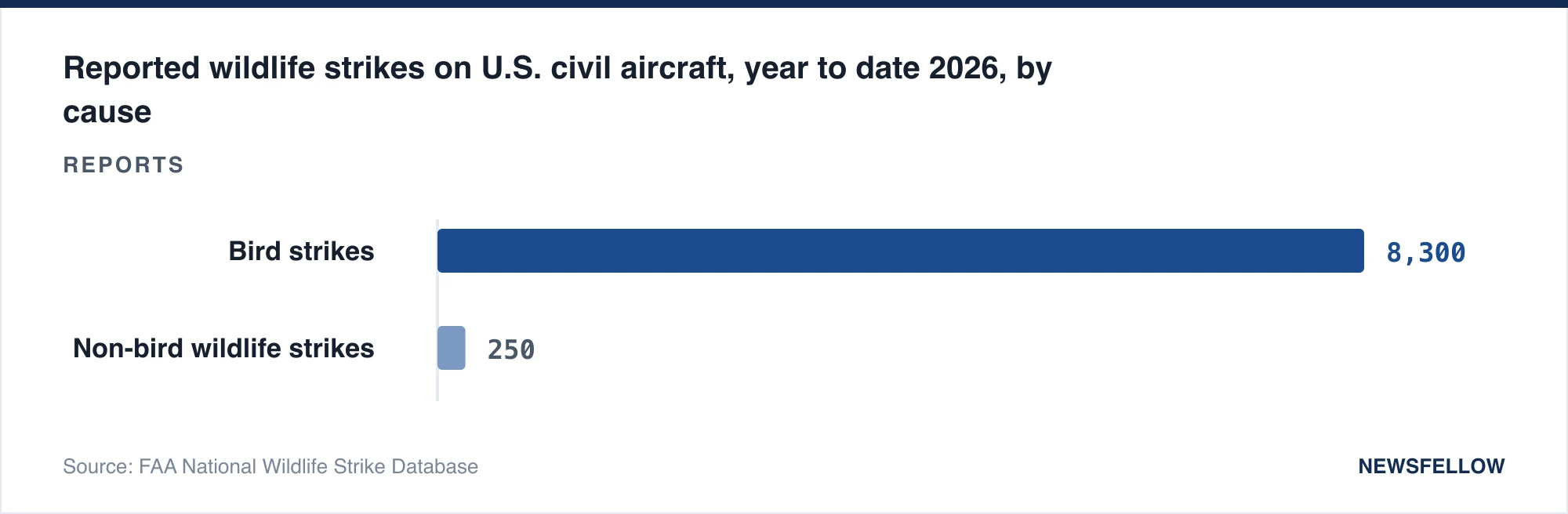
That volume reflects both the scale of U.S. commercial aviation — tens of thousands of takeoffs and landings every day — and decades of improved reporting culture, in which airlines and pilots are encouraged to log even minor strikes so the FAA and airport wildlife-management programs can track patterns by airport, season, and species. Coastal and near-water airports like Myrtle Beach sit along migratory paths that can put them at elevated risk during certain parts of the year, one reason airports maintain dedicated wildlife-hazard management plans that include habitat modification, deterrent systems, and in some cases active harassment or removal programs coordinated with wildlife biologists.
None of that changes the arithmetic for an individual crew in the moment: an engine indication anomaly on takeoff gets a mayday call and a return to the field, full stop, regardless of the eventual cause. That conservative posture is precisely what worked as intended over Myrtle Beach.
What Comes Next
Post-incident, American Airlines' maintenance inspection of the affected 737 will examine the engine — most likely a CFM56 or LEAP-1B depending on the specific aircraft variant assigned to the route — for blade damage, foreign object debris, and any other findings consistent with a bird ingestion event. Airlines typically report bird strikes to the FAA's wildlife strike database regardless of severity, and any strike involving substantial damage or an emergency landing is also subject to standard incident-reporting requirements to the FAA.
Because there were no injuries and the aircraft landed under crew control with no indication of an uncontained engine failure, the event falls well short of the threshold that would trigger a formal NTSB investigation; it will instead be handled through the routine channels of airline safety reporting and FAA wildlife-strike data collection that already track thousands of similar events each year.
For passengers, the episode is a reminder of a fact that rarely gets airtime outside moments exactly like this one: modern airliners, and the crews who fly them, are built and trained around the assumption that an engine can fail on takeoff, and that the aircraft — and everyone aboard — should be able to walk away regardless. On August 10, over the South Carolina coast, that is exactly what happened.
Sources
- CBS News: Flames shoot from American Airlines plane after apparent bird strike
- CNN: Flames shoot from engine of American Airlines plane that hit birds during takeoff
- Fox News: Video shows flames coming from American Airlines plane after bird strike
- WRAL: Flames shoot from engine of Charlotte-bound plane after bird strike
- Post and Courier: Flames erupt on American Airlines flight after bird strike, forcing emergency Myrtle Beach landing