Air India Ends Its Summer of Cuts: 145 Weekly Flights Return as New York and Tokyo Get More Seats

Air India spent the summer of 2026 quietly shrinking. Now it is trying to grow its way out of it.
The Tata-owned carrier has confirmed it will restore the bulk of roughly 145 weekly international flights that it had suspended or reduced between June and August — a retreat forced by a punishing combination of record aviation turbine fuel (ATF) costs and airspace restrictions across parts of West Asia. The restoration begins September 1, and rather than simply putting the schedule back the way it was, Air India is using the moment to add capacity on some of its highest-profile long-haul routes, including New York, Tokyo, Milan, Frankfurt, Zurich, Vienna and Melbourne, as it moves into the IATA Northern Winter 2026-27 season starting in late October.
For an airline that has spent three years trying to convince flyers and shareholders that its post-Tata turnaround is real, the sequence matters as much as the numbers: cut deep, then come back bigger on the routes that make money.
What actually got cut
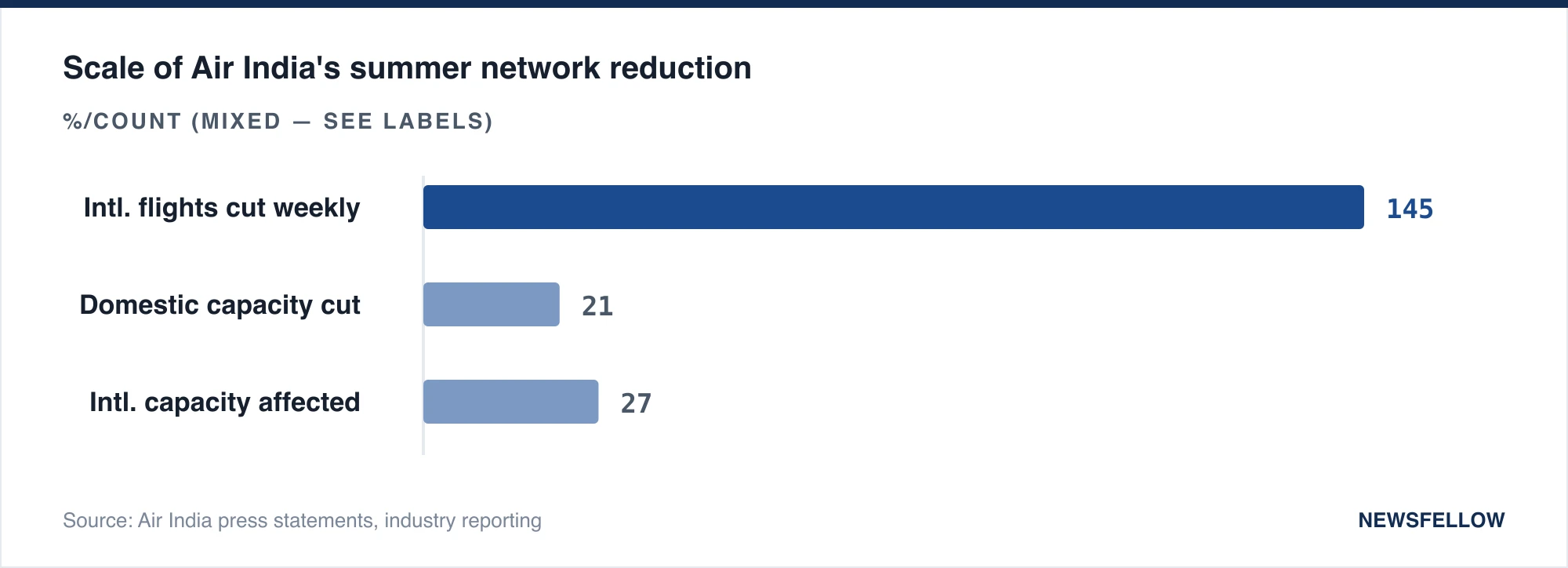
The reductions were not a single dramatic announcement but a series of rolling adjustments through the summer, affecting routes across North America, Europe, Australia, Southeast Asia, East Asia and South Asia. Air India has said the temporary cuts affected around 145 weekly international flights — about 27% of its total overseas capacity — while domestic operations were trimmed by an estimated 20-22% during July and August.
The airline framed the cuts as a stability measure rather than a crisis response, saying in newsroom statements that adjusting the network was intended "to enhance overall network stability and minimise last-minute disruptions and inconvenience for passengers" rather than cancel flights reactively closer to departure. Behind that language sat a harder commercial reality: ATF prices at multiple international price points hit multi-year highs through the summer, squeezing margins on long-haul sectors that were already carrying the cost of continued airspace avoidance around conflict zones in West Asia, which lengthened flight times and burned more fuel on routes to Europe and North America.
Air India is not alone in this. Gulf carriers including Emirates, Etihad and Qatar Airways have also had to manage flight suspensions and route diversions this year tied to the same regional airspace disruptions, and Cathay Pacific and Singapore Airlines have both flagged fuel costs as a pressure point on long-haul economics in 2026. But Air India's cuts were unusually broad, touching both its international and domestic networks at the same time — a sign of how thin the operating margin had become.
The comeback route by route
According to the airline's own schedule filings and reporting cited by aviation trade outlets, the restoration effort is concentrated on exactly the kind of routes an airline protects last and adds back first: premium long-haul.
Additional frequencies are planned for winter on:
- New York (JFK) — added capacity on one of Air India's flagship US routes
- Tokyo (Narita) — increased frequency into one of its newer long-haul additions
- Milan Malpensa — extra services into northern Italy
- Frankfurt — added frequency on a key European connecting hub
- Zurich — increased Swiss capacity
- Vienna — additional Austrian service
- Melbourne — more capacity to Australia
Air India has also said it will launch a new seasonal Mumbai-Toronto service, adding a direct option on the India-Canada corridor at a time when capacity between the two countries has been constrained by broader diplomatic and travel-demand factors over the past two years.
The airline has not yet published the exact number of additional weekly frequencies for each of these routes, and full winter schedule details — covering the period from late October 2026 through into 2027 — are still being finalized. That gap between the announcement and the granular schedule is worth flagging: airlines routinely revise winter capacity plans in the weeks before the season change based on aircraft availability, crew rostering and demand signals, so the final network could differ from what has been previewed.
Why September 1 and not earlier
The timing lines up with two separate calendars. First, Air India's own internal target was to have the reduced international network restored before the airline's Northern Winter 2026-27 schedule filing window, giving it a clean base to build additional capacity onto rather than restoring cuts and adding frequencies in two separate steps. Second, ATF price relief appears to be a factor: outlets covering the restoration have linked the decision explicitly to easing fuel costs compared with the peak levels seen earlier in the summer, though Air India's own public statements have been more measured, framing the move as planned network normalization rather than a direct response to a specific fuel price threshold.
It's also a leadership transition moment. Campbell Wilson, who has led Air India through its post-Tata privatization integration with Vistara and the broader turnaround effort, is set to leave the airline in September 2026, with day-to-day leadership continuing under committee oversight while a successor is selected. A network restoration that lands cleanly — and a winter schedule that shows growth rather than retrenchment — gives whoever takes over a healthier base to inherit than a carrier still working through summer disruption.
What it means for passengers
For travelers who had bookings disrupted, rebooked, or routed through alternative connections over the summer, the practical upshot is more direct capacity returning to routes that had been thinned out — potentially easing fares that firmed up on some international corridors during the reduction period. Passengers on the New York, Tokyo and European routes getting added frequencies should see more schedule flexibility for winter travel once the detailed timetable is published.
The Mumbai-Toronto seasonal service, if it proceeds as described, would be a notable addition for the India-Canada travel market, which has lacked robust direct capacity relative to demand from both leisure travelers and the visiting-friends-and-relatives segment.
Air India has not detailed compensation or rebooking terms tied specifically to the summer reductions beyond its standing flight cancellation and change policies, and the airline's public communications have focused on the forward network rather than remediation for affected summer bookings.
The bigger picture
Route restoration after a cost-driven pullback is a familiar pattern in aviation, but the specifics here — a network cut broadly across geographies and then rebuilt with growth concentrated on premium long-haul — say something about where Air India believes its margin actually sits. Domestic capacity, cut by a fifth during the worst of the summer, has not been reported as returning with the same emphasis as the international network, suggesting the airline is prioritizing the routes most exposed to competition from Gulf and Southeast Asian carriers over the ones where it faces mostly domestic rivals.
Whether the restored and expanded network holds through the winter will depend on factors outside Air India's control — ATF pricing, the state of West Asian airspace restrictions, and how quickly a new CEO settles in. But for now, an airline that spent mid-2026 explaining what it was cutting is spending September explaining what it's adding back, and where.
Sources
- Air India rationalises international route network through August 2026 — Air India Newsroom
- Air India to Restore Flights From September, Expand New York, Tokyo and Europe Services — Aviation A2Z
- Air India to Restore Most International Flights From September 1, Add More Services on Key Routes — Indian Eagle
- Air India plots Sept flight comeback, to add frequencies to New York, Tokyo, Milan — Inkl
- Air India cuts international network through August 2026 — Travel Trends Today