Ahmedabad Just Became India's Third Spoke Airport — Skipping Immigration Twice Is the Whole Point

On September 1, 2026, a traveler flying out of Ahmedabad on an international itinerary did something that, until three months ago, was impossible anywhere outside India's four biggest gateway cities: they cleared immigration and customs at their home airport, boarded a domestic-looking flight to Delhi, and walked straight onto their connecting international service without ever facing an immigration officer again.
That change is the entire premise of India's Hub-and-Spoke International Flight Operations, a framework the Ministry of Civil Aviation has been rolling out city by city since June. Union Minister Ram Mohan Naidu formally launched the service at Ahmedabad's Sardar Vallabhbhai Patel International Airport on September 1, making it the third city brought into the network after Varanasi in June and Amritsar in July.
What Actually Changes for a Passenger
The mechanics are simple but they solve a real problem. Under the old system, a passenger flying from a Tier-2 or Tier-3 city to, say, London, would fly domestically to Delhi, then have to go through security, immigration and customs formalities all over again before boarding the international leg — often with a layover long enough to make the whole trip feel like two separate journeys bolted together.
Under the hub-and-spoke model, all of that front-loads to the spoke airport. A passenger flying out of Ahmedabad now completes check-in, immigration and customs clearance there, and their baggage is checked through to the final international destination. When they land in Delhi to connect onto a long-haul flight, they walk directly to the departure gate — no repeat immigration line, no re-checking bags, no second customs desk.
It is a small operational tweak on paper. In practice it removes one of the most-cited friction points for Indian travelers outside the four traditional international gateways of Delhi, Mumbai, Bengaluru and Chennai.
The Rollout So Far
Ahmedabad is not the pilot — it is the third stop on a sequence the ministry has been building deliberately:
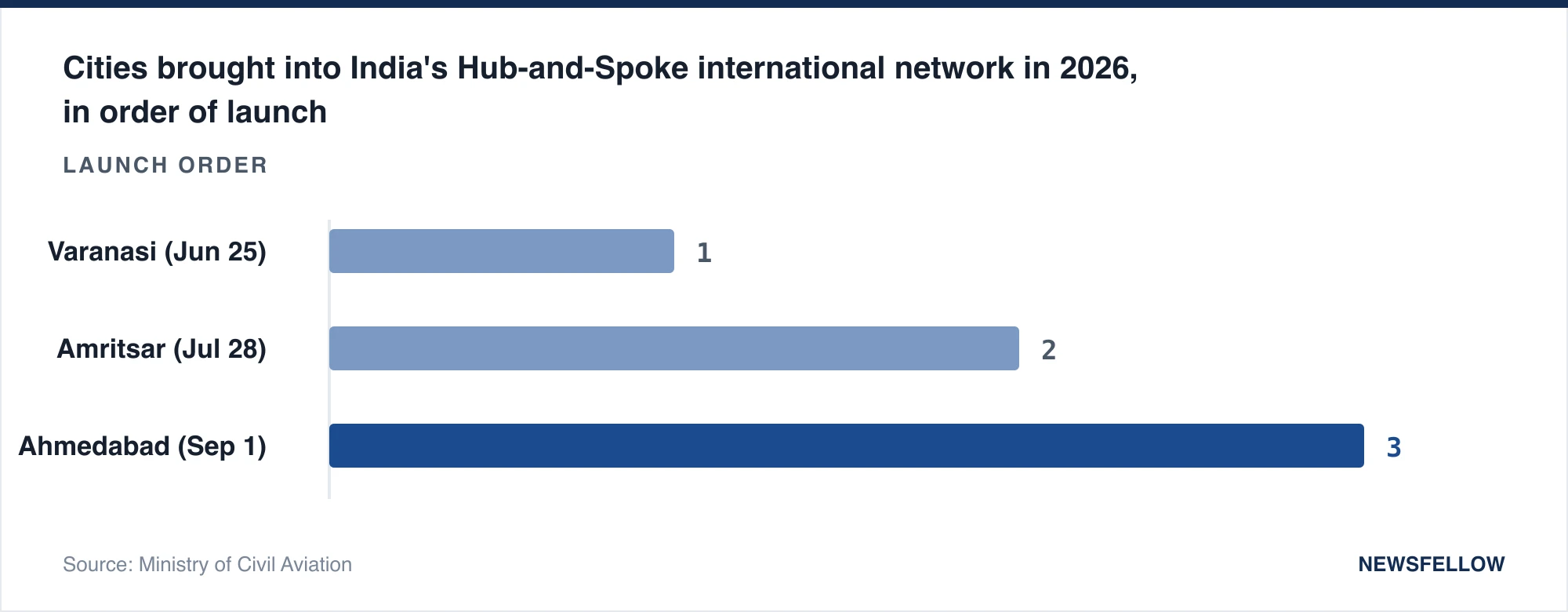
Varanasi went first, launched on June 25 as the flagship proof of concept. Amritsar followed on July 28, connecting the Punjab city to more than 20 international destinations routed through Delhi — airlines at the time estimated roughly 250 passengers a day would use the Amritsar connection. Ahmedabad's addition on September 1 extends the same model to Gujarat's largest city, a market with substantial existing outbound demand from the diaspora corridors to the UK, US and Gulf.
The ministry has said the next phase will extend hub-and-spoke connectivity to 22 additional airports, including Surat, as the network scales toward a stated target of linking roughly 44 airports — four major hub airports and 40 spoke cities — in the coming years.
The Numbers Behind the Push
This is not a symbolic gesture. The Ministry of Civil Aviation has attached serious economic projections to the broader International Aviation Hub Strategy, of which the hub-and-spoke rollout is one piece. Ministry-commissioned studies estimate that developing India's aviation hubs could create around four lakh (400,000) direct and indirect jobs and add close to $30 billion to GDP by 2030. The longer-range projection, running through 2047, puts the cumulative impact at roughly 16 million jobs and nearly $1.4 trillion contributed to the economy — figures the ministry has used to frame hub-and-spoke expansion as core industrial policy rather than a convenience upgrade for flyers.
Those are government projections, not independently audited figures, and should be read as the ministry's own case for the strategy rather than a verified outcome.
Why Tier-2 Cities, and Why Now
The strategic logic is about keeping international connecting traffic inside the Indian aviation system rather than losing it to foreign hubs. A traveler from Amritsar or Ahmedabad heading to Europe or North America has historically had two choices beyond flying via Delhi: book a domestic Indian carrier to a metro and then a separate international ticket, absorbing the friction described above, or route through a foreign hub like Dubai, Doha or Istanbul on a single through-ticket with none of that hassle.
By making the domestic-to-international connection through Delhi as seamless as an itinerary booked entirely on a foreign carrier, India's aviation ministry is trying to close that gap — keeping both the passenger revenue and, crucially, the connecting traffic within Air India's and other Indian carriers' networks rather than ceding it to Gulf or Turkish hub carriers that have spent two decades building exactly this kind of seamless transfer experience.
Air India has been the primary operator threading these routes so far, running the domestic legs that feed into its own long-haul international network out of Delhi. The airline's press materials around each launch — Varanasi, Amritsar, and now Ahmedabad — have framed the initiative as central to its post-privatization strategy of rebuilding hub relevance for Delhi against the pull of Dubai and Doha.
What to Watch Next
The Ahmedabad launch is a data point in a strategy that is explicitly designed to scale. The real test is whether the ministry hits its stated target of 22 additional spoke airports and whether passenger volumes at Varanasi and Amritsar — the two earlier launches — actually materialize at the levels airlines projected. If Amritsar's roughly 250 passengers a day holds up and grows as more spokes come online, the ministry's longer framework of scaling to around 1,200 daily passengers and roughly 4.5 lakh annually across the network becomes plausible. If early adoption lags, the 22-airport expansion plan will be the first place to look for signs of a slowdown.
For now, Ahmedabad joins a short but growing list of Indian cities where an international trip no longer means two immigration lines for one journey.
Sources
- Ahmedabad joins India's international hub-and-spoke aviation network
- Ram Mohan Naidu launches hub-and-spoke international operations from Ahmedabad airport
- International hub-and-spoke flight services launched at Ahmedabad
- Amritsar Becomes India's Second Spoke Airport Under Global Aviation Hub Strategy
- Ministry of Civil Aviation inaugurates Hub & Spoke International Flight Operations from Amritsar
- Flying abroad from Ahmedabad just got easier